Thank you for visiting SNEWPapers!
Sign up free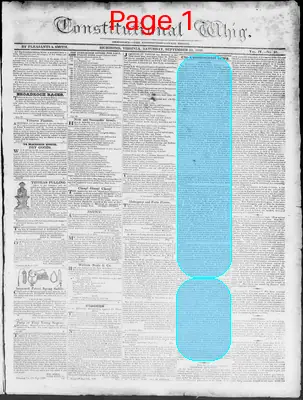
Constitutional Whig
Richmond, Virginia
What is this article about?
Excerpt from Edinburgh Review warns of bloody revolution in Britain if seceding ministers return to power, opposing reforms amid growing democratic sentiments among middle and lower classes. Discusses historical unrest since 1815 and risks of Irish rebellion, wars with France and America.
Merged-components note: Text content is a direct continuation of the article on England from the New York Daily Advertiser, with sequential reading order and spatial adjacency.
Clipping

OCR Quality
Full Text
ENGLAND.
From the New York Daily Advertiser.
The last number of the Edinburgh Review contains an article under the general title of "The Present Administration," in which the writer speaks a bolder language, regarding the political situation and circumstances of Great Britain, than any thing that we have recently met with from that country. He expresses a decided opinion, that if the seceding ministers should return to power, they must come "pledged to oppose every reform, to maintain a constant struggle against the spirit of the age, and defend abuses to which the nation is becoming every day more quicksighted;"— and "that they will not have power, even if they should have the inclination, to act otherwise. And what," says he, "must the end of these things be? We answer, without hesitation, that, if this course be persisted in, if these counsels and these counsellors are maintained, the end must be a revolution. bloody and unsparing revolution—a revolution which will shake the ears of those who hear of it in the remotest countries, and in the remotest times. The middling orders in England are, we all know, attached to the institutions of their country, but not with a blind partial attachment. They see the merits of the system; but they also see its faults; and they have a strong and growing desire that these faults should be removed. If, while their wish for improvement is growing stronger and stronger, the government is to become worse and worse, the consequences are obvious. Even now it is impossible to disguise, that there is arising in the bosom of that class a Republican sect. as audacious, as paradoxical, as little inclined to respect antiquity. as enthusiastically attached to its ends, as un scrupulous in the choice of its means as the French Jacobins themselves;—but far superior to the French Jacobins in acuteness and information—in caution, in patience, and in resolution. They are men who have been put into training for violent exertion. All that is merely ornamental—all that gives the roundness, the smoothness. and the bloom, has been excluded. Nothing is left but nerve. and muscle, and bone."
"A strong democratic party would be formed in the educated class. In the lowest, and the most numerous order of the population, those who have any opinion at all are democrats already. In our manufacturing towns, it is even now formidably strong; and it is not strange that it should be so:
For it is on persons in this situation that the abuses of our system press most heavily. The difference between an arbitrary and a limited monarchy vanishes, when compared with the difference between one meal-a-day and three meals a-day. It is poor consolation to a man who has had no breakfast. and expects no supper, that the King does not possess a dispensing power, and that troops cannot be raised in time of peace, without the consent of Parliament. With this class, our government, free as it is, is even now as unpopular as if it were despotic,—nay much more so."
"The history of our country, since the peace of 1815, is almost entirely made up of the struggles of the lower orders against the government, and of the efforts of the government to keep them down. In 1816, immense assemblies were convened, secret societies were formed, and gross outrages were committed. In 1817. the Habeas Corpus Act was twice suspended. In 1819. the disturbances broke out afresh. Meetings were held, so formidable from their numbers and their spirit, that the Ministry, and the Parliament approved of the conduct of Magistrates who had dispersed one by the sword. Fresh laws were passed against seditious writings and practices. Yet the following year commenced with a desperate and extensive conspiracy for the assassination of the cabinet, and the subversion of the government. A few months after this event. the Queen landed. On that occasion, the majority of the middling order joined with the mob. The effect of the union was irresistible. The Ministry and the Parliament stood aghast: the bill of pains and penalties was dropped, and a convulsion, which seemed inevitable, was averted. But the events of that year ought to impress one lesson on the mind of every public man;—that an alliance between the disaffected multitude and a large portion of the middling orders, is one with which no government can venture to cope, without imminent danger to the constitution.
A government like that with which England would be cursed, if the present Ministry should fall before the present Opposition, would render such an alliance not only inevitable, but permanent. In less than ten years, it would goad every Reformer in the country into a Revolutionist. It would place at the head of the multitude persons possessing all the education, all the judgment, and all the habits of co-operation, in which: the multitude itself is deficient. That great body is physically the most powerful in the state. Like the Hebrew champion, it is set held in captivity by its blindness. But if once the tailless Giant shall find a guide to put his hand on the props of the State—i once he shall learn to lay his finger on the pillars, woe to all who have hitherto made their laughing stock, or chained him to grind at their mill."
We do therefore firmly believe, that even if no external cause were to precipitate a fatal crisis, the country could not be governed for a single generation by such men as Lord Westmorland and Lord Eldon, without extreme risk of revolution. But there are other symptoms in the body politic, not less alarming than those we have described. In Ireland there are several millions of Catholics who do not love our government; and who detest with all their heart with all their soul, with all their mind, and with all their strength. the party now in opposition. The accession of that party to power, would be a death blow to their hopes of obtaining their demands by constitutional means, and we may fairly expect that all those events which followed the recall of Lord Wellesley, will take place again, on a greater and more formidable scale. One thing. indeed. we have no right to expect. that a second Ponsonby will be as unfortunate as the former. A civil war in Ireland will lead almost necessarily to a war with France, and the class of neutral and belligerent pretensions will then produce a war with America. Then come expeditions to Canada and expeditions to Java. The Cape of Good Hope may be garrisoned: Lisbon must be defended. Let us suppose the best; that the contest must be a long conflict, and a hard fought victory. a great addition to a debt already most burdensome. fresh taxes and fresh discontents. "All these are events which may not improbably happen under any government—events which the next month may bring forth— events against which, no minister however able and honest, can with perfect certainty provide—but which ministers, whose policy should exasperate the people of Ireland, would almost unavoidably bring upon us. A cabinet formed by the ex-ministers could scarcely exist for a year, without incensing the lower classes of the English to frenzy, by giving them up to the selfish, tyranny of its aristocratical supporters, without driving Ireland into a rebellion, and without tempting France to war."
What sub-type of article is it?
What keywords are associated?
What entities or persons were involved?
Where did it happen?
Foreign News Details
Primary Location
England
Key Persons
Outcome
potential bloody revolution in britain, irish civil war, wars with france and america, increased debt and taxes
Event Details
Edinburgh Review article warns that return of seceding ministers to power would oppose reforms, leading to revolution due to growing democratic sentiments among middle and lower classes. Reviews unrest since 1815, including assemblies, suspensions of Habeas Corpus, Peterloo-like events, Cato Street conspiracy, and Queen Caroline's arrival. Predicts alliance of disaffected classes, Irish Catholic rebellion, and international conflicts.