Thank you for visiting SNEWPapers!
Sign up free
Story
June 7, 1911
The Laramie Republican
Laramie, Albany County, Wyoming
What is this article about?
Prof. Jules Amar's experiments in Paris show that workers need Sunday rest to maintain efficiency, as the human body recuperates weight daily but loses energy without rest, outperforming machines by 25-35%. Monday labor is weakest due to weekend lassitude.
Clipping
OCR Quality
98%
Excellent
Full Text
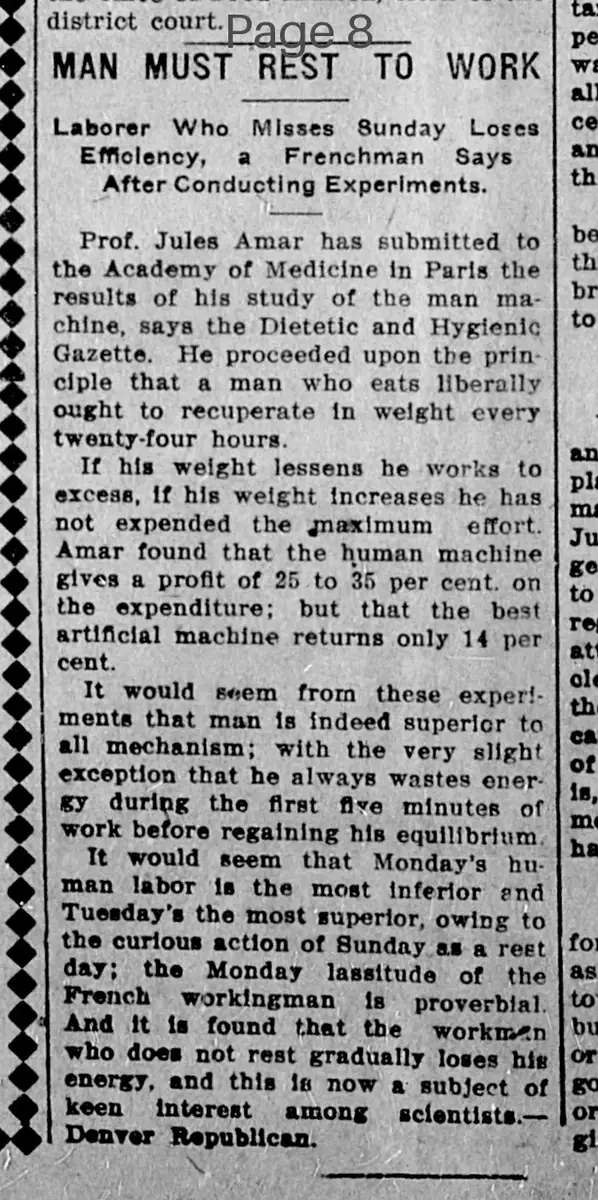
MAN MUST REST TO WORK
Laborer Who Misses Sunday Loses Efficiency, a Frenchman Says After Conducting Experiments.
Prof. Jules Amar has submitted to the Academy of Medicine in Paris the results of his study of the man machine, says the Dietetic and Hygienic Gazette. He proceeded upon the principle that a man who eats liberally ought to recuperate in weight every twenty-four hours.
If his weight lessens he works to excess, if his weight increases he has not expended the maximum effort.
Amar found that the human machine gives a profit of 25 to 35 per cent. on the expenditure; but that the best artificial machine returns only 14 per cent.
It would seem from these experiments that man is indeed superior to all mechanism; with the very slight exception that he always wastes energy during the first five minutes of work before regaining his equilibrium.
It would seem that Monday's human labor is the most inferior and Tuesday's the most superior, owing to the curious action of Sunday as a rest day; the Monday lassitude of the French workingman is proverbial.
And it is found that the workman who does not rest gradually loses his energy, and this is now a subject of keen interest among scientists.—Denver Republican.
Laborer Who Misses Sunday Loses Efficiency, a Frenchman Says After Conducting Experiments.
Prof. Jules Amar has submitted to the Academy of Medicine in Paris the results of his study of the man machine, says the Dietetic and Hygienic Gazette. He proceeded upon the principle that a man who eats liberally ought to recuperate in weight every twenty-four hours.
If his weight lessens he works to excess, if his weight increases he has not expended the maximum effort.
Amar found that the human machine gives a profit of 25 to 35 per cent. on the expenditure; but that the best artificial machine returns only 14 per cent.
It would seem from these experiments that man is indeed superior to all mechanism; with the very slight exception that he always wastes energy during the first five minutes of work before regaining his equilibrium.
It would seem that Monday's human labor is the most inferior and Tuesday's the most superior, owing to the curious action of Sunday as a rest day; the Monday lassitude of the French workingman is proverbial.
And it is found that the workman who does not rest gradually loses his energy, and this is now a subject of keen interest among scientists.—Denver Republican.
What sub-type of article is it?
Curiosity
Medical Curiosity
What themes does it cover?
Moral Virtue
Recovery
What keywords are associated?
Human Efficiency
Sunday Rest
Labor Experiments
Weight Recuperation
Monday Lassitude
What entities or persons were involved?
Prof. Jules Amar
Where did it happen?
Paris
Story Details
Key Persons
Prof. Jules Amar
Location
Paris
Story Details
Prof. Jules Amar studies the human body as a machine, finding that daily weight recuperation indicates optimal work; without Sunday rest, workers lose efficiency, with Monday being the weakest day and human output superior to machines by 25-35%.