Thank you for visiting SNEWPapers!
Sign up free
Story
August 19, 1908
Bisbee Daily Review
Bisbee, Cochise County, Arizona
What is this article about?
James S. Sherman's acceptance speech for Republican vice-presidential nomination in Chicago, endorsing the party's protectionist tariff policies, labor reforms, racial advancement, naval strength, resource conservation, and continuity of Roosevelt's administration, while criticizing Democrats.
Clipping
OCR Quality
98%
Excellent
Full Text
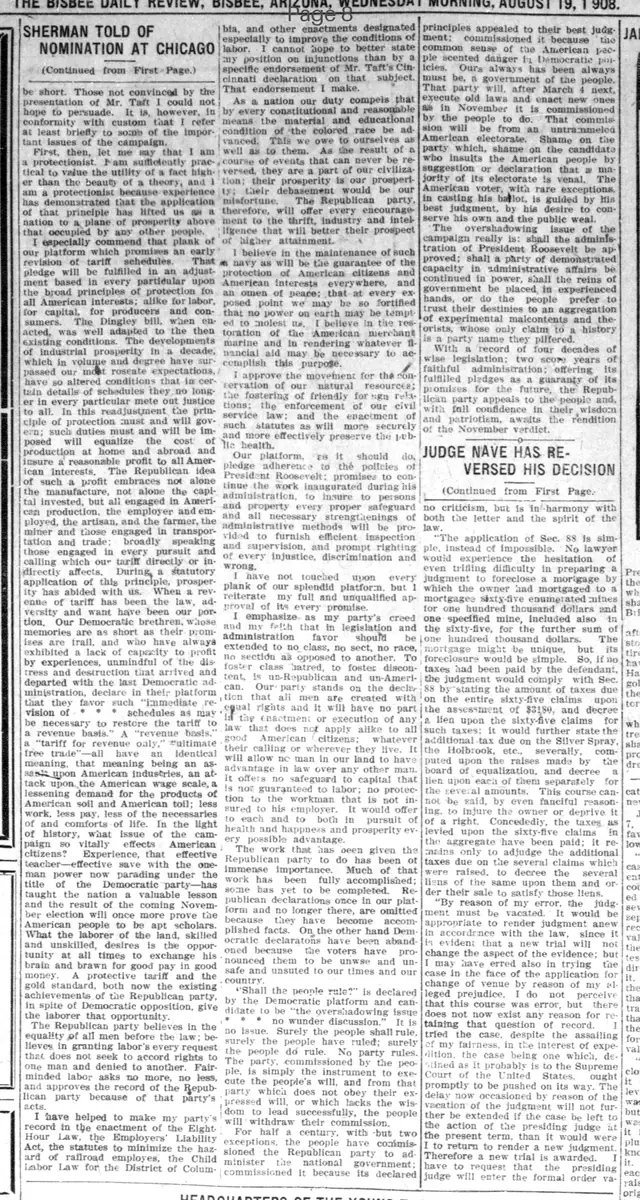
SHERMAN TOLD OF
NOMINATION AT CHICAGO
(Continued from First Page.)
be short. Those not convinced by the presentation of Mr. Taft I could not hope to persuade. It is, however, in conformity with custom that I refer at least briefly to some of the important issues of the campaign.
First, then, let me say that I am a protectionist. I am sufficiently practical to value the utility of a fact higher than the beauty of a theory, and I am a protectionist because experience has demonstrated that the application of that principle has lifted us as a nation to a plane of prosperity above that occupied by any other people.
I especially commend that plank of our platform which promises an early revision of tariff schedules. That pledge will be fulfilled in an adjustment based in every particular upon the broad principles of protection for all American interests; alike for labor, for capital, for producers and consumers. The Dingley bill, when enacted, was well adapted to the then existing conditions. The developments of industrial prosperity in a decade, which in volume and degree have surpassed our most roseate expectations, have so altered conditions that in certain details of schedules they no longer in every particular mete out justice to all. In this readjustment the principle of protection must and will govern; such duties must and will be imposed as will equalize the cost of production at home and abroad and insure a reasonable profit to all American interests. The Republican idea of such a profit embraces not alone the manufacture, not alone the capital invested, but all engaged in American production, the employer and employed, the artisan, and the farmer, the miner and those engaged in transportation and trade: broadly speaking those engaged in every pursuit and calling which our tariff directly or indirectly affects. During a statutory application of this principle, prosperity has abided with us. When a revenue tariff has been the law, adversity and want have been our portion. Our Democratic brethren, whose memories are as short as their promises are frail, and who have always exhibited a lack of capacity to profit by experiences, unmindful of the distress and destruction that arrived and departed with the last Democratic administration, declare in their platform that they favor such "immediate revision of schedules as may be necessary to restore the tariff to a revenue basis." A "revenue basis," a "tariff for revenue only," ultimate free trade"—all have an identical meaning, that meaning being an assault upon American industries, an attack upon the American wage scale, a lessening demand for the products of American soil and American toil: less work, less pay, less of the necessaries and comforts of life. In the light of history, what issue of the campaign so vitally affects American citizens? Experience, that effective teacher—effective save with the one-man power now parading under the title of the Democratic party—has taught the nation a valuable lesson and the result of the coming November election will once more prove the American people to be apt scholars.
What the laborer of the land, skilled and unskilled, desires is the opportunity at all times to exchange his brain and brawn for good pay in good money. A protective tariff and the gold standard, both now the existing achievements of the Republican party, in spite of Democratic opposition, give the laborer that opportunity.
The Republican party believes in the equality of all men before the law; believes in granting labor's every request that does not seek to accord rights to one man and denied to another. Fair-minded labor asks no more, no less, and approves the record of the Republican party because of that party's acts.
I have helped to make my party's record in the enactment of the Eight Hour Law, the Employers' Liability Act, the statutes to minimize the hazard of railroad employees, the Child Labor Law for the District of Columbia, and other enactments designated especially to improve the conditions of labor. I cannot hope to better state my position on injunctions than by a specific endorsement of Mr. Taft's Cincinnati declaration on that subject. That endorsement I make.
As a nation our duty compels that by every constitutional and reasonable means the material and educational condition of the colored race be advanced. This we owe to ourselves as well as to them. As the result of a course of events that can never be reversed, they are a part of our civilization; their prosperity is our prosperity; their debasement would be our misfortune. The Republican party, therefore, will offer every encouragement to the thrift, industry and intelligence that will better their prospect of higher attainment.
I believe in the maintenance of such a navy as will be the guarantee of the protection of American citizens and American interests everywhere, and an omen of peace; that at every exposed point we may be so fortified that no power on earth may be tempted to molest us. I believe in the restoration of the American merchant marine and in rendering whatever financial aid may be necessary to accomplish this purpose.
I approve the movement for the conservation of our natural resources; the fostering of friendly foreign relations; the enforcement of our civil service law; and the enactment of such statutes as will more securely and more effectively preserve the public health.
Our platform, as it should do, pledges adherence to the policies of President Roosevelt; promises to continue the work inaugurated during his administration. To insure to persons and property every proper safeguard and all necessary strengthenings of administrative methods will be provided to furnish efficient inspection and supervision, and prompt righting of every injustice, discrimination and wrong.
I have not touched upon every plank of our splendid platform, but I reiterate my full and unqualified approval of its every promise.
I emphasize as my party's creed and my faith that in legislation and administration favor should be extended to no class, no sect, no race, no section as opposed to another. To foster class hatred, to foster discontent, is un-Republican and un-American. Our party stands on the declaration that all men are created with equal rights and it will have no part in the enactment or execution of any law that does not apply alike to all good American citizens: whatever their calling or wherever they live. It will allow no man in our land to have advantage in law over any other man. It offers no safeguard to capital that is not guaranteed to labor: no protection to the workman that is not insured to his employer. It would offer to each and to both in pursuit of health and happiness and prosperity every possible advantage.
The work that has been given the Republican party to do has been of immense importance. Much of that work has been fully accomplished; some has yet to be completed. Republican declarations once in our platform and no longer there, are omitted because they have become accomplished facts. On the other hand Democratic declarations have been abandoned because the voters have pronounced them to be unwise and unsafe and unsuited to our times and our country.
"Shall the people rule?" is declared by the Democratic platform and candidate to be "the overshadowing issue now under discussion." It is no issue. Surely the people shall rule, surely the people have ruled; surely the people do rule. No party rules. The party, commissioned by the people, is simply the instrument to execute the people's will, and from that party which does not obey their expressed will, or which lacks the wisdom to lead successfully, the people will withdraw their commission.
For half a century, with but two exceptions, the people have commissioned the Republican party to administer the national government; commissioned it because its declared principles appealed to their best judgment; commissioned it because the common sense of the American people scented danger in Democratic policies. Ours always has been, always must be, a government of the people. That party will, after March 4 next, execute old laws and enact new ones as in November it is commissioned by the people to do. That commission will be from an untrammeled American electorate. Shame on the party which, shame on the candidate who insults the American people by suggestion or declaration that a majority of its electorate is venal. The American voter, with rare exceptions, in casting his ballot, is guided by his best judgment, by his desire to conserve his own and the public weal.
The overshadowing issue of the campaign really is: shall the administration of President Roosevelt be approved; shall a party of demonstrated capacity in administrative affairs be continued in power, shall the reins of government be placed in experienced hands, or do the people prefer to trust their destinies to an aggregation of experimental malcontents and theorists, whose only claim to a history is a party name they pilfered.
With a record of four decades of wise legislation; two score years of faithful administration; offering its fulfilled pledges as a guaranty of its promises for the future, the Republican party appeals to the people and, with full confidence in their wisdom and patriotism, awaits the rendition of the November verdict.
NOMINATION AT CHICAGO
(Continued from First Page.)
be short. Those not convinced by the presentation of Mr. Taft I could not hope to persuade. It is, however, in conformity with custom that I refer at least briefly to some of the important issues of the campaign.
First, then, let me say that I am a protectionist. I am sufficiently practical to value the utility of a fact higher than the beauty of a theory, and I am a protectionist because experience has demonstrated that the application of that principle has lifted us as a nation to a plane of prosperity above that occupied by any other people.
I especially commend that plank of our platform which promises an early revision of tariff schedules. That pledge will be fulfilled in an adjustment based in every particular upon the broad principles of protection for all American interests; alike for labor, for capital, for producers and consumers. The Dingley bill, when enacted, was well adapted to the then existing conditions. The developments of industrial prosperity in a decade, which in volume and degree have surpassed our most roseate expectations, have so altered conditions that in certain details of schedules they no longer in every particular mete out justice to all. In this readjustment the principle of protection must and will govern; such duties must and will be imposed as will equalize the cost of production at home and abroad and insure a reasonable profit to all American interests. The Republican idea of such a profit embraces not alone the manufacture, not alone the capital invested, but all engaged in American production, the employer and employed, the artisan, and the farmer, the miner and those engaged in transportation and trade: broadly speaking those engaged in every pursuit and calling which our tariff directly or indirectly affects. During a statutory application of this principle, prosperity has abided with us. When a revenue tariff has been the law, adversity and want have been our portion. Our Democratic brethren, whose memories are as short as their promises are frail, and who have always exhibited a lack of capacity to profit by experiences, unmindful of the distress and destruction that arrived and departed with the last Democratic administration, declare in their platform that they favor such "immediate revision of schedules as may be necessary to restore the tariff to a revenue basis." A "revenue basis," a "tariff for revenue only," ultimate free trade"—all have an identical meaning, that meaning being an assault upon American industries, an attack upon the American wage scale, a lessening demand for the products of American soil and American toil: less work, less pay, less of the necessaries and comforts of life. In the light of history, what issue of the campaign so vitally affects American citizens? Experience, that effective teacher—effective save with the one-man power now parading under the title of the Democratic party—has taught the nation a valuable lesson and the result of the coming November election will once more prove the American people to be apt scholars.
What the laborer of the land, skilled and unskilled, desires is the opportunity at all times to exchange his brain and brawn for good pay in good money. A protective tariff and the gold standard, both now the existing achievements of the Republican party, in spite of Democratic opposition, give the laborer that opportunity.
The Republican party believes in the equality of all men before the law; believes in granting labor's every request that does not seek to accord rights to one man and denied to another. Fair-minded labor asks no more, no less, and approves the record of the Republican party because of that party's acts.
I have helped to make my party's record in the enactment of the Eight Hour Law, the Employers' Liability Act, the statutes to minimize the hazard of railroad employees, the Child Labor Law for the District of Columbia, and other enactments designated especially to improve the conditions of labor. I cannot hope to better state my position on injunctions than by a specific endorsement of Mr. Taft's Cincinnati declaration on that subject. That endorsement I make.
As a nation our duty compels that by every constitutional and reasonable means the material and educational condition of the colored race be advanced. This we owe to ourselves as well as to them. As the result of a course of events that can never be reversed, they are a part of our civilization; their prosperity is our prosperity; their debasement would be our misfortune. The Republican party, therefore, will offer every encouragement to the thrift, industry and intelligence that will better their prospect of higher attainment.
I believe in the maintenance of such a navy as will be the guarantee of the protection of American citizens and American interests everywhere, and an omen of peace; that at every exposed point we may be so fortified that no power on earth may be tempted to molest us. I believe in the restoration of the American merchant marine and in rendering whatever financial aid may be necessary to accomplish this purpose.
I approve the movement for the conservation of our natural resources; the fostering of friendly foreign relations; the enforcement of our civil service law; and the enactment of such statutes as will more securely and more effectively preserve the public health.
Our platform, as it should do, pledges adherence to the policies of President Roosevelt; promises to continue the work inaugurated during his administration. To insure to persons and property every proper safeguard and all necessary strengthenings of administrative methods will be provided to furnish efficient inspection and supervision, and prompt righting of every injustice, discrimination and wrong.
I have not touched upon every plank of our splendid platform, but I reiterate my full and unqualified approval of its every promise.
I emphasize as my party's creed and my faith that in legislation and administration favor should be extended to no class, no sect, no race, no section as opposed to another. To foster class hatred, to foster discontent, is un-Republican and un-American. Our party stands on the declaration that all men are created with equal rights and it will have no part in the enactment or execution of any law that does not apply alike to all good American citizens: whatever their calling or wherever they live. It will allow no man in our land to have advantage in law over any other man. It offers no safeguard to capital that is not guaranteed to labor: no protection to the workman that is not insured to his employer. It would offer to each and to both in pursuit of health and happiness and prosperity every possible advantage.
The work that has been given the Republican party to do has been of immense importance. Much of that work has been fully accomplished; some has yet to be completed. Republican declarations once in our platform and no longer there, are omitted because they have become accomplished facts. On the other hand Democratic declarations have been abandoned because the voters have pronounced them to be unwise and unsafe and unsuited to our times and our country.
"Shall the people rule?" is declared by the Democratic platform and candidate to be "the overshadowing issue now under discussion." It is no issue. Surely the people shall rule, surely the people have ruled; surely the people do rule. No party rules. The party, commissioned by the people, is simply the instrument to execute the people's will, and from that party which does not obey their expressed will, or which lacks the wisdom to lead successfully, the people will withdraw their commission.
For half a century, with but two exceptions, the people have commissioned the Republican party to administer the national government; commissioned it because its declared principles appealed to their best judgment; commissioned it because the common sense of the American people scented danger in Democratic policies. Ours always has been, always must be, a government of the people. That party will, after March 4 next, execute old laws and enact new ones as in November it is commissioned by the people to do. That commission will be from an untrammeled American electorate. Shame on the party which, shame on the candidate who insults the American people by suggestion or declaration that a majority of its electorate is venal. The American voter, with rare exceptions, in casting his ballot, is guided by his best judgment, by his desire to conserve his own and the public weal.
The overshadowing issue of the campaign really is: shall the administration of President Roosevelt be approved; shall a party of demonstrated capacity in administrative affairs be continued in power, shall the reins of government be placed in experienced hands, or do the people prefer to trust their destinies to an aggregation of experimental malcontents and theorists, whose only claim to a history is a party name they pilfered.
With a record of four decades of wise legislation; two score years of faithful administration; offering its fulfilled pledges as a guaranty of its promises for the future, the Republican party appeals to the people and, with full confidence in their wisdom and patriotism, awaits the rendition of the November verdict.
What sub-type of article is it?
Historical Event
What themes does it cover?
Triumph
Justice
Moral Virtue
What keywords are associated?
Republican Platform
Protectionism
Tariff Revision
Labor Rights
Roosevelt Administration
Democratic Criticism
What entities or persons were involved?
Sherman
Mr. Taft
President Roosevelt
Where did it happen?
Chicago
Story Details
Key Persons
Sherman
Mr. Taft
President Roosevelt
Location
Chicago
Event Date
Coming November Election
Story Details
Sherman accepts Republican vice-presidential nomination, endorses protectionist tariff revision, labor protections, advancement of colored race, strong navy, resource conservation, and Roosevelt's policies; criticizes Democratic revenue tariff as harmful to American prosperity and wages.