Thank you for visiting SNEWPapers!
Sign up free
The Sidney Herald
Sidney, Richland County, Montana
What is this article about?
In 1957, Richland County's Agricultural Conservation Program (ACP) achieved significant milestones, spending nearly $100,000 on 531 practices including grass seedings, stubble mulch tillage, contour farming, fencing, livestock watering facilities, water spreading, drainage pooling agreements, and land leveling to enhance soil and water conservation.
Clipping
OCR Quality
Full Text
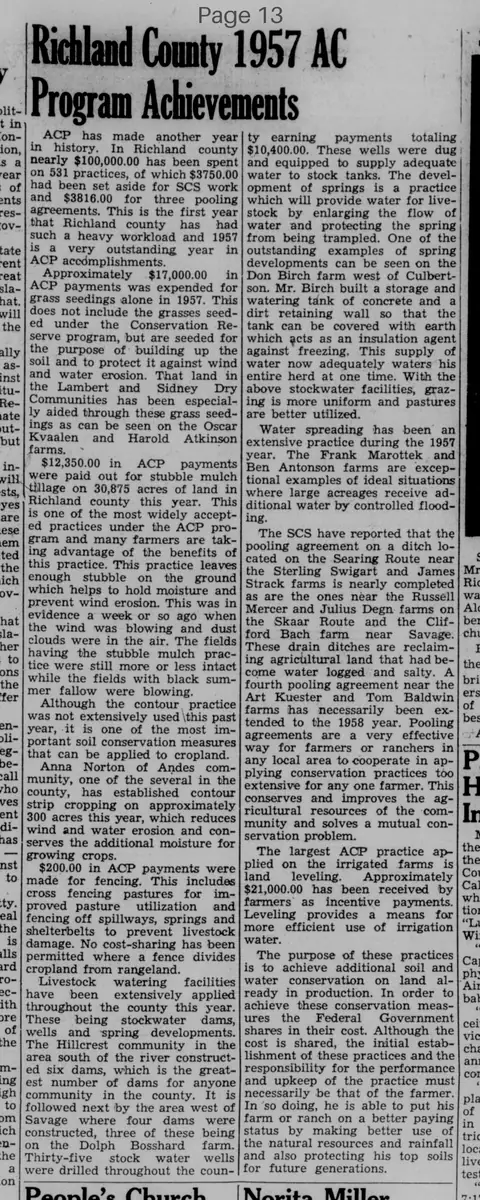
ACP has made another year in history. In Richland county nearly $100,000.00 has been spent on 531 practices, of which $3750.00 had been set aside for SCS work and $3816.00 for three pooling agreements. This is the first year that Richland county has had such a heavy workload and 1957 is a very outstanding year in ACP accomplishments.
Approximately $17,000.00 in ACP payments was expended for grass seedings alone in 1957. This does not include the grasses seeded under the Conservation Reserve program, but are seeded for the purpose of building up the soil and to protect it against wind and water erosion. That land in the Lambert and Sidney Dry Communities has been especially aided through these grass seedings as can be seen on the Oscar Kvaalen and Harold Atkinson farms.
$12,350.00 in ACP payments were paid out for stubble mulch tillage on 30,875 acres of land in Richland county this year. This is one of the most widely accepted practices under the ACP program and many farmers are taking advantage of the benefits of this practice. This practice leaves enough stubble on the ground which helps to hold moisture and prevent wind erosion. This was in evidence a week or so ago when the wind was blowing and dust clouds were in the air. The fields having the stubble mulch practice were still more or less intact while the fields with black summer fallow were blowing.
Although the contour practice was not extensively used this past year, it is one of the most important soil conservation measures that can be applied to cropland. Anna Norton of Andes community, one of the several in the county, has established contour strip cropping on approximately 300 acres this year, which reduces wind and water erosion and conserves the additional moisture for growing crops.
$200.00 in ACP payments were made for fencing. This includes cross fencing pastures for improved pasture utilization and fencing off spillways, springs and shelterbelts to prevent livestock damage. No cost-sharing has been permitted where a fence divides cropland from rangeland.
Livestock watering facilities have been extensively applied throughout the county this year. These being stockwater dams, wells and spring developments. The Hillcrest community in the area south of the river constructed six dams, which is the greatest number of dams for anyone community in the county. It is followed next by the area west of Savage where four dams were constructed, three of these being on the Dolph Bosshard farm.
Thirty-five stock water wells were drilled throughout the county earning payments totaling $10,400.00. These wells were dug and equipped to supply adequate water to stock tanks. The development of springs is a practice which will provide water for livestock by enlarging the flow of water and protecting the spring from being trampled. One of the outstanding examples of spring developments can be seen on the Don Birch farm west of Culbertson. Mr. Birch built a storage and watering tank of concrete and a dirt retaining wall so that the tank can be covered with earth which acts as an insulation agent against freezing. This supply of water now adequately waters his entire herd at one time. With the above stockwater facilities, grazing is more uniform and pastures are better utilized.
Water spreading has been an extensive practice during the 1957 year. The Frank Marottek and Ben Antonson farms are exceptional examples of ideal situations where large acreages receive additional water by controlled flooding.
The SCS have reported that the pooling agreement on a ditch located on the Searing Route near the Sterling Swigart and James Strack farms is nearly completed as are the ones near the Russell Mercer and Julius Degn farms on the Skaar Route and the Clifford Bach farm near Savage. These drain ditches are reclaiming agricultural land that had become water logged and salty. A fourth pooling agreement near the Art Kuester and Tom Baldwin farms has necessarily been extended to the 1958 year. Pooling agreements are a very effective way for farmers or ranchers in any local area to cooperate in applying conservation practices too extensive for any one farmer. This conserves and improves the agricultural resources of the community and solves a mutual conservation problem.
The largest ACP practice applied on the irrigated farms is land leveling. Approximately $21,000.00 has been received by farmers as incentive payments. Leveling provides a means for more efficient use of irrigation water.
The purpose of these practices is to achieve additional soil and water conservation on land already in production. In order to achieve these conservation measures the Federal Government shares in their cost. Although the cost is shared, the initial establishment of these practices and the responsibility for the performance and upkeep of the practice must necessarily be that of the farmer. In so doing, he is able to put his farm or ranch on a better paying status by making better use of the natural resources and rainfall and also protecting his top soils for future generations.
What sub-type of article is it?
What keywords are associated?
What entities or persons were involved?
Where did it happen?
Domestic News Details
Primary Location
Richland County
Event Date
1957
Key Persons
Outcome
nearly $100,000 spent on 531 conservation practices, including $17,000 for grass seedings, $12,350 for stubble mulch on 30,875 acres, $200 for fencing, $10,400 for 35 wells, $21,000 for land leveling, and pooling agreements for drainage; improved soil conservation, erosion control, water management, and agricultural productivity.
Event Details
The 1957 Agricultural Conservation Program in Richland County funded various soil and water conservation practices such as grass seedings to protect against erosion, stubble mulch tillage to retain moisture, contour strip cropping, fencing for pasture management, livestock watering facilities including dams, wells, and spring developments, water spreading for irrigation, cooperative pooling agreements for drainage ditches to reclaim waterlogged land, and land leveling for efficient irrigation on farms.