Thank you for visiting SNEWPapers!
Sign up free
The Gazette
Portland, Cumberland County, Maine
What is this article about?
The 6th Congress convenes in Philadelphia on December 3, 1798. President Adams delivers his annual address on December 8, discussing yellow fever, relations with France, defense preparations, naval expansion, boundary commissions, and financial estimates. Proceedings include committee appointments, resolutions, and Senate's response.
Merged-components note: These components form a continuous report on the proceedings of Congress, including the President's speech and responses from both houses.
Clippings
1 of 2
OCR Quality
Full Text
U. S. A.
Concerns.
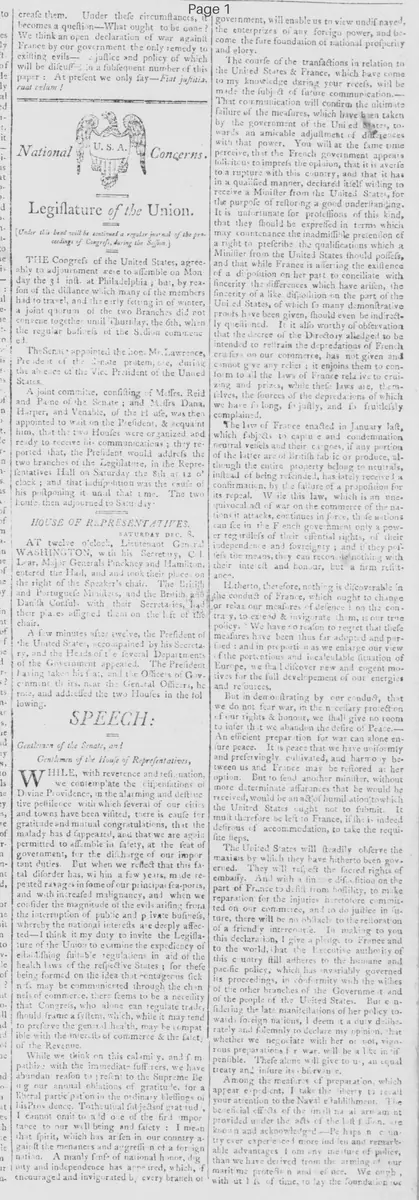
Legislature of the Union.
[Under this head will be continued a regular journal of the proceedings of Congress, during the Session.]
THE Congress of the United States, agreeably to adjournment met to assemble on Monday the 3d inst. at Philadelphia: but, by reason of the distance which many of the members had to travel, and the early setting in of winter, a joint quorum of the two Branches did not convene together until Thursday, the 6th, when the regular business of the Session commenced.
The Senate appointed the hon. Mr. Lawrence, President of the Senate pro tem, during the absence of the Vice-President of the United States.
A joint committee, consisting of Messrs. Reid and Paine of the Senate; and Messrs. Dana, Harper, and Venable, of the House, was then appointed to wait on the President, & acquaint him, that the two Houses were organized and ready to receive his communications; they reported that, the President would address the two branches of the Legislature, in the Representatives Hall on Saturday the 8th at 12 o'clock: and that indisposition was the cause of his postponing it until that time. The two Houses then adjourned to Saturday.
HOUSE OF REPRESENTATIVES.
SATURDAY DEC. 8.
AT twelve o'clock, Lieutenant General WASHINGTON, with his Secretary, Col. Lear, Major Generals Pinckney and Hamilton, entered the Hall, and took their place on the right of the Speaker's chair. The British and Portuguese Ministers, and the British and Danish Consul, with their Secretaries. Had their places assigned them on the left of the chair.
A few minutes after twelve, the President of the United States, accompanied by his Secretary, and the Heads of the several Departments of the Government appeared. The President having taken his seat, and the Officers of Government theirs, near the General Officers, he rose, and addressed the two Houses in the following.
SPEECH:
Gentlemen of the Senate, and Gentlemen of the House of Representatives,
WHILE, with reverence and resignation. W we contemplate the dispensations of Divine Providence, in the alarming and destructive pestilence with which several of our cities and towns have been visited, there is cause for gratitude and mutual congratulations, that the malady has disappeared, and that we are again permitted to assemble in safety, at the seat of government, for the discharge of our important duties. But when we reflect that this fatal disorder has, within a few years, made repeated ravages in some of our principal sea-ports, and with increased malignity, and when we consider the magnitude of the evils arising from the interruption of public and private business, whereby the national interests are deeply affected—I think it my duty to invite the Legislature of the Union to examine the expediency of establishing suitable regulations in aid of the health laws of the respective States; for these being formed on the idea that contagious sickness may be communicated through the channels of commerce, there seems to be a necessity that Congress, who alone can regulate trade, should frame a system, which, while it may tend to preserve the general health, may be compatible with the interest, of commerce & the safety of the Revenue.
While we think on this calamity, and sympathize with the immediate sufferers, we have abundant reason to resign to the Supreme Being our annual oblations of gratitude, for a liberal participation in the ordinary blessings of His Providence. To the usual subjects of gratitude, I cannot omit to add one of the first importance to our well being and safety: I mean that spirit, which has arisen in our country against the menaces and aggression of a foreign nation. A manly sense of national honor, dignity and independence has appeared, which, if encouraged and invigorated by every branch of government, will enable us to view undaunted, the enterprizes of any foreign power, and become the sure foundation of national prosperity and glory.
The course of the transactions in relation to the United States & France, which have come to my knowledge daring your recess, will be made the subject of future communication.— That communication will confirm the ultimate failure of the measures, which have been taken by the government of the United States, towards an amicable adjustment of differences with that power. You will at the same time perceive, that the French government appears solicitous to impress the opinion, that it is averse to a rupture with this country, and that it has in a qualified manner, declared itself willing to receive a Minister from the United States, for the purpose of restoring a good understanding. It is unfortunate for professions of this kind, that they should be expressed in terms which may countenance the inadmissible pretension of a right to prescribe the qualifications which a Minister from the United States should possess, and that while France is alleging the existence of a disposition on her part to conciliate with sincerity the differences which have arisen, the sincerity of a like disposition on the part of the United States, of which so many demonstrative proofs have been given, should even be indirectly questioned. It is also worthy of observation that the decree of the Directory alleged to be intended to restrain the depredations of French cruisers on our commerce, has not given and cannot give any relief; it enjoins them to conform to all the laws of France relative to cruizing and prizes, while these laws are, themselves, the sources of the depredations of which we have so long, so justly, and so fruitlessly complained.
The law of France enacted in January last, which subjects to capture and condemnation neutral vessels and their cargoes, if any portion of the latter are of British fabric or produce, although the entire property belong to neutrals, instead of being rescinded, has lately received a confirmation. by the failure of a proposition for its repeal. While this law, which is an unequivocal act of war on the commerce of the nations it attacks, continues in force, those nations can see in the French government only a power regardless of their essential rights, of their independence and sovereignty; and if they possess the means, they can reconcile nothing with their interest and honor, but a firm resistance.
Hitherto, therefore, nothing is discoverable in the conduct of France, which ought to change or relax our measures of defense! on the contrary, to extend & invigorate them, is our true policy. We have no reason to regret that these measures have been thus far adopted and pursued: and in proportion as we enlarge our view of the portentous and incalculable situation of Europe, we shall discover new and cogent motives for the full development of our energies and resources.
But in demonstrating by our conduct, that we do not fear war, in the necessary protection of our rights & honor, we shall give no room to infer that we abandon the desire of Peace.— An efficient preparation for war can alone ensure peace. It is peace that we have uniformly and perseveringly cultivated, and harmony between us and France may be restored at her option. But to send another minister, without more determinate assurances that he would be received, would be an act of humiliation to which the United States ought not to submit. It must therefore be left to France, if she indeed desirous of accommodation, to take the requisite steps.
The United States will steadily observe the maxims by which they have hitherto been governed. They will respect the sacred rights of embassy. And with a sincere desire on the part of France to desist from hostility, to make reparation for the injuries heretofore committed on our commerce, and to do justice in future, there will be no obstacle to the restoration of a friendly intercourse. In making to you this declaration, I give a pledge to France and to the world, that the Executive authority of this country still adheres to the humane and pacific policy, which has invariably governed its proceedings, in conformity with the wishes of the other branches of the Government and of the people of the United States. But considering the late manifestations of her policy toward foreign nations, I deem it a duty deliberately and solemnly to declare my opinion, that whether we negotiate with her or not, vigorous preparations for war. will be alike indispensable. These alone will give to us dignity, and insure its observance.
Among the measures of preparation which appear expedient, I take the liberty to tell your attention to the Naval establishment. The beneficial effects of the small naval armament provided under the acts of the last session, are known and acknowledged—Perhaps no country ever experienced more judicious and remarkable advantages from any measure of policy, than we have derived from the arming of our maritime protection and defense. We ought, without loss of time, to lay the foundation of to increase our navy to a size sufficient to guard our coasts and protect our trade. Such a naval force, as it is doubtless within the power of the United States to create and maintain, would also afford to them the best means of general defence, by facilitating the safe transportation of troops and stores to every part of our extensive country. To accomplish this important object, a prudent foresight requires that systematic measures be adopted for procuring at all times the requisite timber and other supplies. In what manner this shall be done I leave it to your consideration.
I will now advert, Gentlemen, to some matters of less moment, but proper to be communicated to the National Legislature. After the Spanish garrison had evacuated the posts they occupied at the Natchez and Walnut Hills, the Commissioner of the United States commenced his observations to ascertain the point near the Mississippi, which terminated the northernmost part of the thirty-first degree of north latitude. From thence he proceeded to run the boundary line between the United States and Spain. He was afterwards joined by the Spanish Commissioner, when the work of the former was confirmed; and they proceeded together to the demarcation of the line. Recent information renders it probable that the southern Indians, either instigated to oppose the demarcation, or jealous of the consequences of suffering white people to run a line over lands to which the Indian title had not been extinguished, have ere this time stopped the progress of the Commissioners. And considering the mischiefs which may result from continuing the demarcation, in opposition to the will of the Indian tribes, the great expense attending it, and that the boundaries which the commissioners have actually established probably extend at least as far as the Indian title has been extinguished, it will perhaps become expedient and necessary to suspend further proceedings, by recalling our commissioner.
The commissioners appointed in pursuance of the fifth Article of the Treaty of Amity, Commerce and Navigation, between the United States and his Britannic Majesty, to determine what river was truly intended under the name of the river St. Croix, mentioned in the Treaty of Peace, and forming a part of the boundary therein described, have finally decided that question. On the twenty-fifth of October, they made their declaration that a river called Schoodiac, which falls into Passamaquoddy Bay, as its north-western quarter, was the true St. Croix intended in the treaty of peace, as far as its great fork, where one of its streams comes from the westward and the other from the northward, and that the latter stream is the continuation of the St. Croix to its source. This decision, it is understood, will preclude all contention among individual claimants, as it seems that the Schoodiac and its northern branch, bound the grants of lands which have been made by the respective adjoining governments. A subordinate question however, it has been suggested, still remains to be determined. Between the mouth of the St. Croix, as now settled, and what is usually called the Bay of Fundy, lie a number of valuable islands. The Commissioners have not continued the boundary lines through any channel of these islands, and unless the Bay of Passamaquoddy be a part of the Bay of Fundy, this further adjustment of boundary will be necessary. But it is apprehended that this will not be a matter of any difficulty.
Since progress has been made in the examination and decision of cases of capture and condemnation of American vessels, which were the subject of the seventh Article of the Treaty of Amity, Commerce and Navigation between the United States and Great Britain, that it is supposed the Commissioners will be able to bring their business to a conclusion in August of the ensuing year.
The Commissioners acting under the twenty-fifth Article of the Treaty between the United States and Spain, have adjusted most of the claims of our citizens for losses sustained in consequence of their vessels & cargoes, having been taken by the subjects of his Catholic Majesty, during the late war between France and Spain.
Various circumstances have conspired to delay the execution of the law for augmenting the military establishment. Among these, the desire of obtaining the fullest information to direct the best election of officers. As this object will now be speedily accomplished, it is expected that the raising & organizing of the troops will proceed without obstacle, and with effect.
Gentlemen of the House of Representatives,
I have directed an estimate of the appropriations which will be necessary for the service of the ensuing year to be laid before you, accompanied with a view of the public receipts and expenditures to a recent period. It will afford you satisfaction to infer the great extent and solidity of the public resources, from the prosperous state of the finances, notwithstanding the unexampled embarrassments which have attended commerce. When you reflect on the conspicuous examples of patriotism & liberality which have been exhibited by our mercantile fellow citizens, and how great a proportion of the public resources depends on their enterprise, you will naturally consider, whether their convenience cannot be promoted and reconciled with the security of the revenue, by a revision of the system, by which the collection is at present regulated.
During your recess, measures have been steadily pursued for effecting the valuations and returns directed by the act of the last session, preliminary to the assessment and collection of a direct tax. No other delays or obstacles have been experienced, except such as were expected to arise from the great extent of our country, and the magnitude of the operation.
The President then presented a copy to the President of the Senate, and another to the Speaker of the House of Representatives.
In the Senate. Messrs. Read, Ross and Stockton, were appointed to draft an answer to the address.
In the House of Representatives, the speech was referred to a committee of the whole on Monday.
HOUSE OF REPRESENTATIVES.
MONDAY, DEC. 10.
MR. Sprigg, from North Carolina (in the place of the late Mr. Bryan, who died in this city during the last session) appeared and took his seat in the House.
A message was received from the Senate, informing this House that they had come to the following resolution, to which they request a concurrence:
"Resolved, That two Chaplains be appointed to Congress for the present session, one for each House, who shall interchange weekly."
The resolution was taken up and concurred in; and on motion of Mr. J. Williams, the House proceeded to the election of a Chaplain for this House. On counting the votes it appeared that Dr. Green was chosen.
On motion, the house resolved itself into a committee of the whole on the Speech of the President of the United States, Mr. Dent in the chair; when
Mr. Sprague proposed for adoption the following resolution:
Resolved, That it is the opinion of this committee, that a respectful address ought to be presented by the House of Representatives to the President of the United States, in answer to his speech to both houses of Congress at the commencement of this session—containing assurances that this house will duly attend to the important objects recommended by him to their consideration.
The resolution was agreed to without objection, and the committee rose and reported the resolution. The House took it up, concurred in it, and appointed a committee of five to prepare an answer accordingly.
The committee consisting of Messrs. Dana, Venable, Harper, Hoffman and Baldwin.
Mr. Kittera presented the petition of John Daniels, a soldier in the late war, who prays to be replaced upon the pension list.
Mr. J. Williams moved that a committee of claims be appointed, agreeable to the standing rules and orders of the house. The motion was agreed to.
The committee consists of Messrs. D. Foster, Macon, Hanna, J. Freeman, Israel, Sprigg, and Van Allen.
The above petition was then referred to this committee.
Mr. D. Foster said, that it was desirable that the House should have before it, at an early period, a view of the unfinished business of last session, he would move for the appointment of a committee of revisal and unfinished business.
The motion was agreed to.
The committee consisting of Messrs. Thatcher, Thomas, and Newton.
Mr. J. Williams moved that the speech of the President be referred to a committee of the whole on the state of the Union—which motion being carried,
He also moved the appointment of a committee of Commerce and Manufactures, agreeably to the standing rules and orders of the House. The motion was agreed to, and the committee consists of Messrs. S. Smith, Sewall, Waln, Rutledge, Scureman, Tillinghast, and Blount.
Adjourned.
TUESDAY, DEC. 11.
Mr. Harper moved, that a committee be appointed to prepare and bring in a bill for establishing an uniform system of bankruptcy throughout the United States.
Mr. Harper also laid on the table a resolution, the object of which was to authorize the Secretary of State to cause to be printed copies of the Alien and Sedition laws, to be distributed gratis throughout the United States.
To this he was induced, he said, from observing the unceasing efforts which were made by a certain class of men to bring these acts into odium among the people—Mispresentation had been used, in order to excite an armed opposition to the government.
WEDNESDAY, DEC. 12.
Mr. Harper moved a resolution, that the expenses which the several States might be at in fortifications, should go to their credit towards the balances due to the United States.
Mr. Harper also moved a resolution further to amend the Stamp duty, as respects duplicates of Exchange, and Bills of Lading.
Mr. Dana, from the committee appointed to draft a respectful address, in answer to the President's Speech, made a report, which was committed for to-morrow.
Adjourned.
Senate of the United States.
DEC. 13.
THIS day the Senate of the United States in a body, waited on the President, and presented him the following
ANSWER.
To the PRESIDENT of the United States.
SIR,
THE Senate of the United States join you in thanks to Almighty God for the removal of the late alarming dispensations of his Providence, and for the patriotic spirit, and general prosperity of our country. Sympathy for the sufferings of our fellow citizens, from disease, and the important interests of the Union, demand of the national legislature, a ready co-operation with the State governments, in the use of such means as seem best calculated to prevent the return of this fatal calamity.
Although we have sincerely wished that an adjustment of our differences with the republic of France might be effected on safe and honourable terms, yet the information you have given us of the ultimate failure of the negotiation has not surprised us. In the general conduct of that republic, we have seen a design of universal influence, incompatible with the safe government, and destructive of the independence of other states. In its conduct towards these United States, we have seen a plan of hostility pursued with unremitted constancy, equally by disregarding the obligations of treaties, and the rights of individuals.
We have seen two embassies formed for the purpose of mutual explanation, and clothed with the most extensive and liberal power, dismissed without recognition, and even without a hearing.
The government of France has not only refused to repeal, but has recently enjoined the observance of its former edict, respecting merchandise of British fabric or produce, the property of neutrals, by which, the interruption of our lawful commerce, and the spoliation of the property of our citizens have again received a public sanction—These acts indicate no change of system or disposition—they speak a more intelligible language than professions of solicitude to avoid a rupture however ardently made. But, if after the repeated proofs we have given of a sincere desire for peace, these professions should be accompanied by insinuations, implicating the integrity with which it has been pursued—If neglecting and passing by the constitutional and authorized agents of the government they are made through the medium of individuals without public character or authority—and above all, if they carry with them a claim to prescribe the political qualifications of the minister of the United States, to be employed in the negotiation, they are not entitled to attention or consideration, but ought to be regarded as designed to separate the people from their government, and to bring about by intrigue that which open force could not effect.
We are of opinion with you, Sir, that there has nothing yet been discovered in the conduct of France which can justify a relaxation of the means of defence adopted during the last session of Congress, the happy result of which is so strongly and generally marked. If the force by sea and land which the existing laws authorize should be judged inadequate to the public defence, we will perform the indispensable duty of bringing forward such other acts as will effectually call forth the resources and force of our country.
A steady adherence to this wise and manly policy—a proper direction of the noble spirit of patriotism which has arisen in our country and which ought to be cherished and invigorated by every branch of the government, will secure our liberty and independence against all open and secret attacks.
We enter on the business of the present session with an anxious solicitude for the public good, and shall bestow that consideration on the several objects pointed out in your communication, which they respectively merit.
Your long and important services—your talents and firmness so often displayed in the most trying times and most critical situations, afford a sure pledge of a zealous co-operation in every measure necessary to secure us justice and respect.
To which the President made the following
REPLY:
To the SENATE Of the United States.
GENTLEMEN,
I thank you for this address, so conformable to the spirit of our constitution, and the established character of the senate of the United States, for wisdom, honor and virtue.
I have seen no real evidence of any change of system or disposition in the French republic towards the United States. Although the officious interference of individuals, without public character or authority, is not entitled to any credit, yet it deserves to be considered, whether that temerity and impertinence of individuals, affecting to interfere in public affairs, between France and the United States, whether by their secret correspondence, or otherwise, and intended to impose upon the people, and separate them from their government, ought not to be inquired into and corrected.
I thank you, Gentlemen, for your assurances that you will bestow that consideration on the several objects, pointed out in my communication, which they respectively merit.
If I have participated in that understanding, sincerity and constancy, which have been displayed by my fellow citizens and countrymen, in the most trying times and critical situations, and fulfilled my duties to them, I am happy.
The testimony of the senate of the United States, in my favor, is an high and honourable reward, as it merits, my grateful acknowledgments. My zeal in co-operation, in measures necessary to secure us justice and consideration, may be always depended on.
What sub-type of article is it?
What keywords are associated?
What entities or persons were involved?
Where did it happen?
Domestic News Details
Primary Location
Philadelphia
Event Date
December 3 13, 1798
Key Persons
Outcome
congress organizes; president's speech addresses health regulations, french relations, defense measures, naval expansion, boundary commissions, military augmentation, and financial estimates; committees appointed; resolutions on chaplains, address, claims, unfinished business, commerce; senate presents answer and receives reply.
Event Details
The Congress assembles on December 3 but quorums form on December 6 in Philadelphia. Senate appoints pro tem president. Joint committee notifies President Adams, who speaks on December 8 amid dignitaries including Washington. Speech covers pestilence relief, national spirit against foreign aggression, failed French negotiations, need for defense and naval buildup, boundary progress with Spain and Britain, treaty claims, military delays. House and Senate respond; proceedings include elections, referrals, petitions, and motions through December 13.