Thank you for visiting SNEWPapers!
Sign up free
Springfield Weekly Republican
Springfield, Hampden County, Massachusetts
What is this article about?
The U.S. Senate passed an amended bankruptcy bill this week, designating district courts, territorial courts, and the D.C. Supreme Court as bankruptcy courts with jurisdiction over claims, assets, exemptions, compositions, and discharges. It outlines judicial procedures, appointments of commissioners and supervisors, fees, acts of bankruptcy, and exemptions for bankrupts.
Clipping
OCR Quality
Full Text
As Amended and Passed by the Senate.
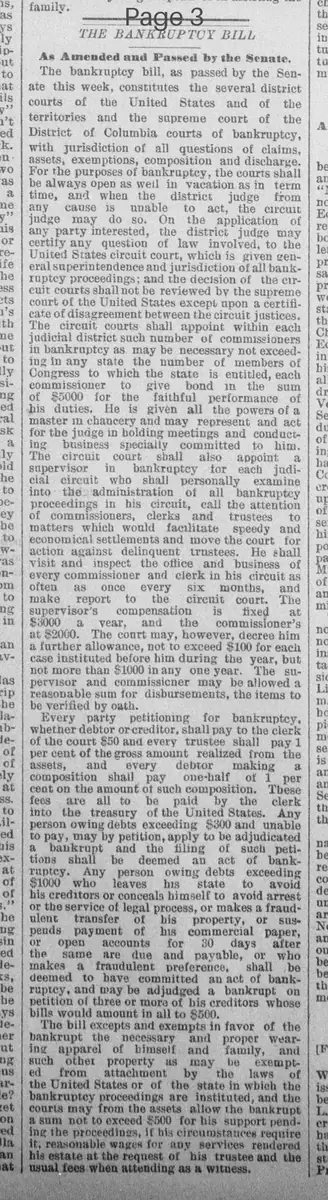
The bankruptcy bill, as passed by the Senate this week, constitutes the several district courts of the United States and of the territories and the supreme court of the District of Columbia courts of bankruptcy, with jurisdiction of all questions of claims, assets, exemptions, composition and discharge. For the purposes of bankruptcy, the courts shall be always open as well in vacation as in term time, and when the district judge from any cause is unable to act, the circuit judge may do so. On the application of any party interested, the district judge may certify any question of law involved, to the United States circuit court, which is given general superintendence and jurisdiction of all bankruptcy proceedings; and the decision of the circuit courts shall not be reviewed by the supreme court of the United States except upon a certificate of disagreement between the circuit justices. The circuit courts shall appoint within each judicial district such number of commissioners in bankruptcy as may be necessary not exceeding in any state the number of members of Congress to which the state is entitled, each commissioner to give bond in the sum of $5000 for the faithful performance of his duties. He is given all the powers of a master in chancery and may represent and act for the judge in holding meetings and conducting business specially committed to him. The circuit court shall also appoint a supervisor in bankruptcy for each judicial circuit who shall personally examine into the administration of all bankruptcy proceedings in his circuit, call the attention of commissioners, clerks and trustees to matters which would facilitate speedy and economical settlements and move the court for action against delinquent trustees. He shall visit and inspect the office and business of every commissioner and clerk in his circuit as often as once every six months, and make report to the circuit court. The supervisor's compensation is fixed at $3000 a year, and the commissioner's at $2000. The court may, however, decree him a further allowance, not to exceed $100 for each case instituted before him during the year, but not more than $1000 in any one year. The supervisor and commissioner may be allowed a reasonable sum for disbursements, the items to be verified by oath. Every party petitioning for bankruptcy, whether debtor or creditor, shall pay to the clerk of the court $50 and every trustee shall pay 1 per cent of the gross amount realized from the assets, and every debtor making a composition shall pay one-half of 1 per cent on the amount of such composition. These fees are all to be paid by the clerk into the treasury of the United States. Any person owing debts exceeding $300 and unable to pay, may by petition, apply to be adjudicated a bankrupt and the filing of such petitions shall be deemed an act of bankruptcy. Any person owing debts exceeding $1000 who leaves his state to avoid his creditors or conceals himself to avoid arrest or the service of legal process, or makes a fraudulent transfer of his property, or suspends payment of his commercial paper, or open accounts for 30 days after the same are due and payable, or who makes a fraudulent preference, shall be deemed to have committed an act of bankruptcy, and may be adjudged a bankrupt on petition of three or more of his creditors whose bills would amount in all to $500. The bill excepts and exempts in favor of the bankrupt the necessary and proper wearing apparel of himself and family, and such other property as may be exempted from attachment by the laws of the United States or of the state in which the bankruptcy proceedings are instituted, and the courts may from the assets allow the bankrupt a sum not to exceed $500 for his support pending the proceedings, if his circumstances require it, reasonable wages for any services rendered his estate at the request of his trustee and the usual fees when attending as a witness.
What sub-type of article is it?
What keywords are associated?
Where did it happen?
Domestic News Details
Primary Location
United States
Event Date
This Week
Outcome
bill passed by the senate, establishing bankruptcy courts and procedures nationwide.
Event Details
The bankruptcy bill constitutes district courts of the United States and territories, and the supreme court of the District of Columbia as courts of bankruptcy with jurisdiction over claims, assets, exemptions, composition, and discharge. Courts are always open; circuit judges may act if district judges cannot. Circuit courts have superintendence; commissioners (up to number of congressional representatives per state) and supervisors appointed with bonds and duties specified. Fees include $50 petition fee, 1% on assets for trustees, 0.5% on compositions. Acts of bankruptcy defined for debts over $300 or $1000 with specific conditions; exemptions for apparel, state-exempt property, and up to $500 support allowance.