Thank you for visiting SNEWPapers!
Sign up free
Gazette Of The United States
New York, New York County, New York
What is this article about?
Reports on the October 1789 Women's March on Versailles due to bread scarcity and court fears, leading to violence, killing of guards, and the Royal Family's relocation to Paris. King signs constitution; National Assembly moves to Paris; financial reforms proposed seizing church goods.
Merged-components note: This is a seamless continuation of the report on commotions and intelligence from France and Paris, split across pages.
Clippings
1 of 2
OCR Quality
Full Text
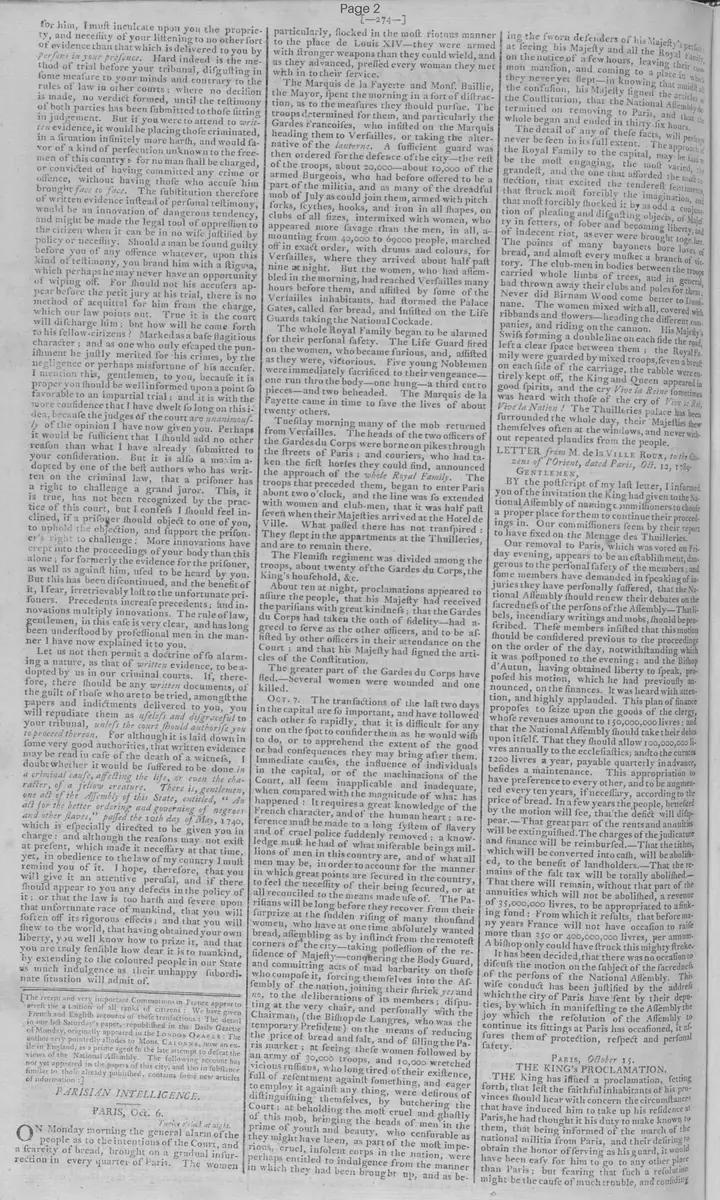
PARISIAN INTELLIGENCE.
PARIS. Oct. 6.
Twelve o'clock at night.
On Monday morning the general alarm of the people as to the intentions of the Court, and a scarcity of bread, brought on a gradual insurrection in every quarter of Paris. The women particularly, flocked in the most riotous manner to the place de Louis XIV—they were armed with stronger weapons than they could wield, and as they advanced, pressed every woman they met with into their service.
The Marquis de la Fayette and Mons. Bailly, the Mayor, spent the morning in a sort of distraction, as to the measures they should pursue. The troops determined for them, and particularly the Gardes Françaises, who insisted on the Marquis heading them to Versailles, or taking the alternative of the lanterne. A sufficient guard was then ordered for the defence of the city—the rest of the troops, about 20,000 about 10,000 of the armed Bourgeois, who had before offered to be a part of the militia, and as many of the dreadful mob of July as could join them, armed with pitch forks, scythes, hooks, and iron in all shapes, on clubs of all sizes, intermixed with women, who appeared more savage than the men, in all, amounting from 40,000 to 50,000 people, marched off in exact order, with drums and colours, for Versailles, where they arrived about half past nine at night. But the women, who had assembled in the morning, had reached Versailles many hours before them, and assisted by some of the Versailles inhabitants, had stormed the Palace Gates, called for bread, and insisted on the Life Guards taking the National Cockade.
The whole Royal Family began to be alarmed for their personal safety. The Life Guard fired on the women, who became furious, and, assisted as they were, victorious. Five young Noblemen were immediately sacrificed to their vengeance— one run thro the body—one hung—a third cut to pieces—and two beheaded. The Marquis de la Fayette came in time to save the lives of about twenty others.
Tuesday morning many of the mob returned from Versailles. The heads of the two officers of the Gardes du Corps were borne on pikes through the streets of Paris; and couriers, who had taken the first horses they could find, announced the approach of the whole Royal Family. The troops that preceded them, began to enter Paris about two o'clock, and the line was so extended with women and club-men, that it was half past seven when their Majesties arrived at the Hotel de Ville. What passed there has not transpired: They slept in the apartments at the Thuilleries, and are to remain there. The Flemish regiment was divided among the troops, about twenty of the Gardes du Corps, the King's household, &c.
About ten at night, proclamations appeared to assure the people, that his Majesty had received the Parisians with great kindness; that the Gardes du Corps had taken the oath of fidelity—had agreed to serve as the other officers, and to be assisted by other officers in their attendance on the Court; and that his Majesty had signed the articles of the Constitution.
The greater part of the Gardes du Corps have fled. Several women were wounded and one killed.
Oct. 7. The transactions of the last two days in the capital are so important, and have followed each other so rapidly, that it is difficult for any one on the spot to consider them as he would wish to do, or to apprehend the extent of the good or bad consequences they may bring after them. Immediate causes, the influence of individuals in the capital, or of the machinations of the Court, all seem inapplicable and inadequate, when compared with the magnitude of what has happened: It requires a great knowledge of the French character, and of the human heart; reference must be made to a long system of slavery and of cruel police suddenly removed; a knowledge must be had of what miserable beings millions of men in this country are, and of what all men may be, in order to account for the manner in which great points are secured in the country, to feel the necessity of their being secured, or at all reconciled to the means made use of. The Parisians will be long before they recover from their surprize at the sudden rising of many thousand women, who have at one time absolutely wanted bread, assembling as by instinct from the remotest corners of the city—taking possession of the residence of Majesty—conquering the Body Guard, and committing acts of mad barbarity on those who compose it, forcing themselves into the Assembly of the nation, joining their shrieks yes and no, to the deliberations of its members; disputing at the very chair, and personally with the Chairman, (the Bishop de Langres, who was the temporary President) on the means of reducing the price of bread and salt, and of filling the Paris market; at seeing these women followed by an army of 30,000 troops, and 10,000 wretched vicious ruffians, who long tired of their existence, full of resentment against something, and eager to employ it against any thing, were desirous of distinguishing themselves, by butchering the Court; at beholding the most cruel and ghastly of this mob, bringing the heads of men in the prime of youth and beauty, who censurable as they might have been, as part of the most imperious, cruel, insolent corps in the nation, were perhaps entitled to indulgence from the manner in which they had been brought up, and as being the sworn defenders of his Majesty's person: at seeing his Majesty and all the Royal Family, on the notice of a few hours, leaving their common mansion, and coming to a place in which they never yet slept—in knowing that amidst all the confusion, his Majesty signed the articles of the Constitution, that the National Assembly determined on removing to Paris, and that the whole began and ended in thirty-six hours.
The detail of any of these facts, will perhaps never be seen in its full extent. The approach of the Royal Family to the capital, may be said to be the most engaging, the most varied, the grandest, and the one that afforded the most reflection, that excited the tenderest sentiments, that struck most forcibly the imagination, and that most forcibly shocked it by as odd a conjunction of pleasing and disgusting objects, of Majesty in fetters, of order and becoming liberty, and of indecent riot, as ever were brought together. The points of many bayonets bore loaves of bread, and almost every musket a branch of victory. The club-men in bodies between the troops carried whole limbs of trees, and in general, had thrown away their clubs and poles for them: Never did Birnam Wood come better to Dunsinane. The women mixed with all, covered with ribbands and flowers—heading the different companies, and riding on the cannon. His Majesty's Swiss forming a double line on each side the road, left a clear space between them; the family were guarded by mixed troops, seven abreast the Royal Family on each side of the carriage, the rabble were entirely kept off, the King and Queen appeared in good spirits, and the cry Vive la Reine sometimes was heard with those of the cry of Vive le Roi, Vive la Nation! The Thuilleries palace has been surrounded the whole day, their Majesties shew themselves often at the windows, and never without repeated plaudits from the people.
LETTER from M. de la VILLE Roux, to the Citizens of l'Orient, dated Paris, Oct. 12, 1789
GENTLEMEN,
BY the postscript of my last letter, I informed you of the invitation the King had given to the National Assembly of naming commissioners to choose a proper place for them to continue their proceedings in. Our commissioners seem by their report to have fixed on the Menage des Thuilleries. Our removal to Paris, which was voted on Friday evening, appears to be an establishment, dangerous to the personal safety of the members; and some members have demanded in speaking of injuries they have personally suffered, that the National Assembly should renew their debates on the sacredness of the persons of the Assembly—That libels, incendiary writings and mobs, should be proscribed. These members insisted that this motion should be considered previous to the proceedings on the order of the day, notwithstanding which it was postponed to the evening; and the Bishop d'Autun, having obtained liberty to speak, proposed his motion, which he had previously announced, on the finances. It was heard with attention, and highly applauded. This plan of finance proposes to seize upon the goods of the clergy, whose revenues amount to 150,000,000 livres; and that the National Assembly should take their debts upon itself. That they should allow 100,000,000 livres annually to the ecclesiastics; and to the curates 1200 livres a year, payable quarterly in advance, besides a maintenance. This appropriation to have preference to every other, and to be augmented every ten years, if necessary, according to the price of bread. In a few years the people, benefited by the motion will see, that the deficit will disappear.—That great part of the rents and annuities will be extinguished. The charges of the judicature and finance will be reimbursed.—That the tithes, which will be converted into cash, will be abolished, to the benefit of landholders.—That the remains of the salt tax will be totally abolished.— That there will remain, without that part of the annuities which will not be abolished, a revenue of 35,000,000 livres, to be appropriated to a sinking fund: From which it results, that before many years France will not have occasion to raise more than 350 or 400,000,000 livres, per annum. A bishop only could have struck this mighty stroke. It has been decided, that there was no occasion to discuss the motion on the subject of the sacredness of the persons of the National Assembly. This wise conduct has been justified by the address which the city of Paris have sent by their deputies, by which in manifesting to the Assembly the joy which the resolution of the Assembly to continue its sittings at Paris has occasioned, it assures them of protection, respect and personal safety.
PARIS, October 15.
THE KING's PROCLAMATION.
THE King has issued a proclamation, setting forth, that let the faithful inhabitants of his provinces should hear with concern the circumstances that have induced him to take up his residence at Paris, he had thought it his duty to make known to them, that being informed of the march of the national militia from Paris, and their desiring to obtain the honor of serving as his guard it would have been easy for him to go to any other place than Paris; but fearing that such a resolution might be the cause of much trouble, and confiding
in the sentiments which he had a right to expect from all his subjects without distinction, he had come to reside in Paris, where he received the most respectful testimonies of love and fidelity from the inhabitants of that good city. That he is certain they will never attempt, in any manner, to influence the free determination of their sovereign; and, from the midst of them, announces to all the inhabitants of his provinces that when the National Assembly shall have terminated the grand work of restoring the public welfare, he will put in execution a plan, which he has long since formed of visiting all his provinces to inquire what good he can do in each, and to prove that they were all equally dear to him. That he flatters himself this declaration, on his part, will engage all the inhabitants of his provinces to second the labors of the National Assembly, in order that France, under the protection of a happy constitution, may enjoy that peace and tranquility, of which an unhappy division has long deprived it.
This proclamation is dated October 9, and under signed
DE SAINT PRIEST.
Paris (Oct. 16th) was again tolerably quiet, and things went on as usual; the mob seemed perfectly contented with the situation of the royal family, whose escape was so much the object of their apprehensions. Their Majesties had another levee of the foreign ministers on Wednesday last, but the King spoke but little, and looked desponding and melancholy. The court was but thinly attended, and had much the appearance of a dumb show.
In the affray at Versailles on the 6th of October, about 50 of the Parisian troops and mob were killed, and 80 of the King's guards cut to pieces. The massacre would have been much more terrible, had it not been for his majesty's orders.
LONDON.
The Queen of France owes the preservation of her life to the gallant Marquis de la Fayette. There is no nation on earth better informed of political events than the French, at the present day. The deputies of all the cities correspond daily with their constituents; and on the arrival of their letters, they are immediately published by the committees of correspondence.
What sub-type of article is it?
What keywords are associated?
What entities or persons were involved?
Where did it happen?
Foreign News Details
Primary Location
Paris
Event Date
Oct. 6, 1789
Key Persons
Outcome
five young noblemen killed (one run through the body, one hung, one cut to pieces, two beheaded); several women wounded, one killed; later reports: about 50 parisian troops and mob killed, 80 king's guards cut to pieces. king signs articles of the constitution; royal family relocates to paris; national assembly decides to move to paris; financial plan proposed to seize clergy goods for revenue.
Event Details
Insurrection in Paris on Oct. 5 due to bread scarcity and court fears; women and mob march to Versailles, storm palace, demand bread and National Cockade; violence against Life Guards; Lafayette intervenes. Royal Family arrives in Paris Oct. 6; king receives Parisians kindly, signs constitution. Follow-up: Assembly debates safety and finances, proposes seizing church revenues; king's proclamation reassures provinces; Paris quiets by Oct. 16.