Thank you for visiting SNEWPapers!
Sign up free
The Virginia Gazette
Richmond, Williamsburg, Richmond County, Virginia
What is this article about?
Detailed report by Blondeau on ancient fresco paintings excavated from Herculaneum, now owned by the King of Naples. Describes four principal pieces featuring Theseus slaying the Minotaur, Rome triumphant, Chiron teaching Achilles, and a Roman family scene possibly of Virginia; plus numerous smaller works with mythological and classical subjects, praising their execution and preservation after 1650 years underground.
Merged-components note: This is a continuation of the literary essay on paintings from Herculaneum across pages 1 and 2, originally labeled as foreign_news on page 2.
Clippings
1 of 2
OCR Quality
Full Text
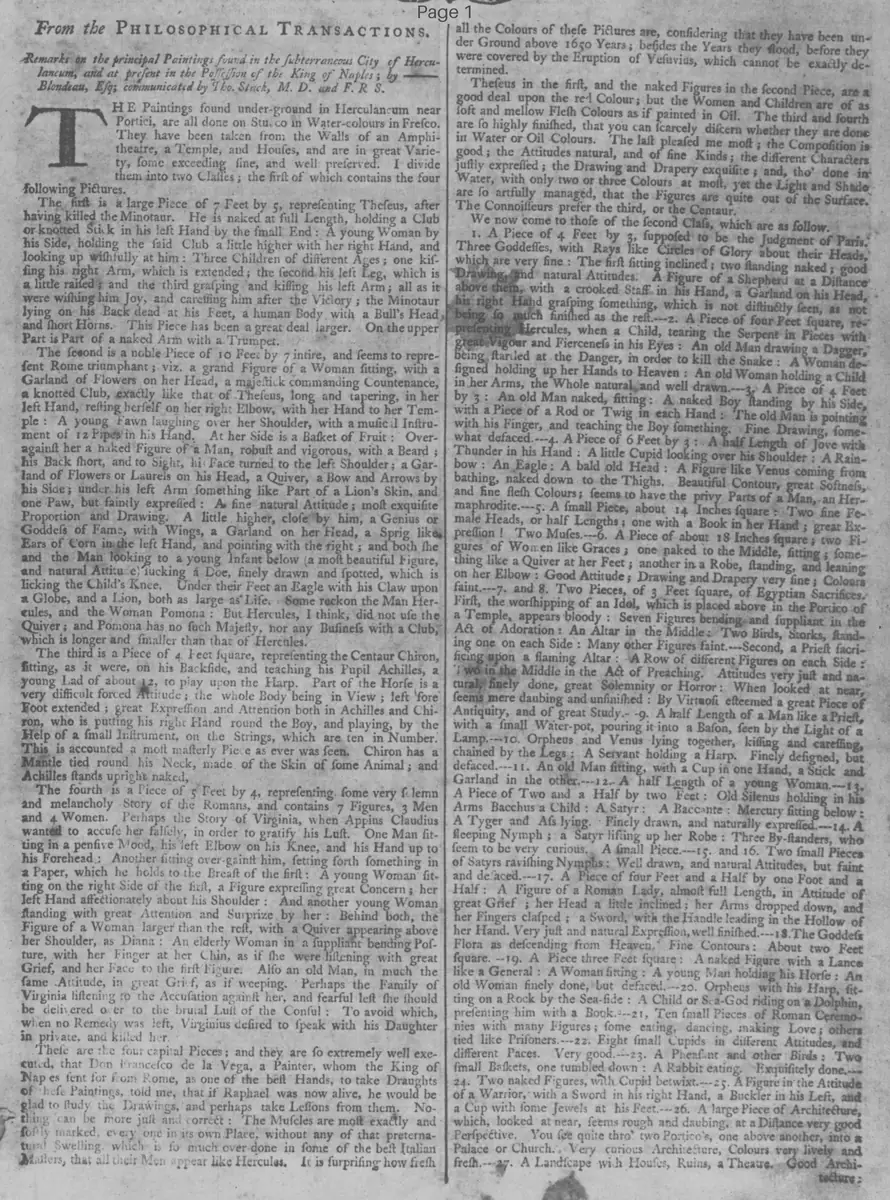
Remarks on the principal Paintings found in the subterraneous City of Herculaneum, and at present in the Possession of the King of Naples; by Blondeau, Esq: communicated by Tho. Stack, M. D. and F. R. S.
The Paintings found under-ground in Herculaneum near Portici, are all done on Stucco in Water-colours in Fresco. They have been taken from the Walls of an Amphitheatre, a Temple, and Houses, and are in great Variety, some exceeding fine, and well preserved. I divide them into two Classes; the first of which contains the four following Pictures.
The first is a large Piece of 7 Feet by 5, representing Theseus, after having killed the Minotaur. He is naked at full Length, holding a Club or knotted Stick in his left Hand by the small End: A young Woman by his Side, holding the said Club a little higher with her right Hand, and looking up wishfully at him: Three Children of different Ages; one kissing his right Arm, which is extended; the second his left Leg, which is a little raised; and the third grasping and kissing his left Arm; all as it were wishing him Joy, and caressing him after the Victory; the Minotaur lying on his Back dead at his Feet, a human Body with a Bull's Head and short Horns. This Piece has been a great deal larger. On the upper Part is Part of a naked Arm with a Trumpet.
The second is a noble Piece of 10 Feet by 7 entire, and seems to represent Rome triumphant; viz. a grand Figure of a Woman sitting, with a Garland of Flowers on her Head, a majestic commanding Countenance, a knotted Club, exactly like that of Theseus, long and tapering, in her left Hand, resting herself on her right Elbow, with her Hand to her Temple: A young Faun laughing over her Shoulder, with a musical Instrument of 12 Pipes in his Hand. At her Side is a Basket of Fruit: Over-against her a naked Figure of a Man, robust and vigorous, with a Beard; his Back short, and to Sight, his Face turned to the left Shoulder; a Garland of Flowers or Laurels on his Head, a Quiver, a Bow and Arrows by his Side; under his left Arm something like Part of a Lion's Skin, and one Paw, but faintly expressed: A fine natural Attitude; most exquisite Proportion and Drawing. A little higher, close by him, a Genius or Goddess of Fame, with Wings, a Garland on her Head, a Sprig like Ears of Corn in the left Hand, and pointing with the right; and both the and the Man looking to a young Infant below (a most beautiful Figure, and natural Attitude) sucking a Doe, finely drawn and spotted, which is licking the Child's Knee. Under their Feet an Eagle with his Claw upon a Globe, and a Lion, both as large as Life. Some reckon the Man Hercules, and the Woman Pomona: But Hercules, I think, did not use the Quiver; and Pomona has no such Majesty, nor any Business with a Club, which is longer and smaller than that of Hercules.
The third is a Piece of 4 Feet square, representing the Centaur Chiron, sitting, as it were, on his Backside, and teaching his Pupil Achilles, a young Lad of about 12, to play upon the Harp. Part of the Horse is a very difficult forced Attitude; the whole Body being in View; left fore Foot extended; great Expression and Attention both in Achilles and Chiron, who is putting his right Hand round the Boy, and playing, by the Help of a small Instrument, on the Strings, which are ten in Number. This is accounted a most masterly Piece as ever was seen. Chiron has a Mantle tied round his Neck, made of the Skin of some Animal; and Achilles stands upright naked.
The fourth is a Piece of 5 Feet by 4, representing some very solemn and melancholy Story of the Romans, and contains 7 Figures, 3 Men and 4 Women. Perhaps the Story of Virginia, when Appius Claudius wanted to accuse her falsely, in order to gratify his Lust. One Man sitting in a pensive Mood, his left Elbow on his Knee, and his Hand up to his Forehead: Another sitting over-against him, setting forth something in Paper, which he holds to the Breast of the first: A young Woman sitting on the right Side of the first, a Figure expressing great Concern; her left Hand affectionately about his Shoulder: And another young Woman standing with great Attention and Surprize by her: Behind both, the Figure of a Woman larger than the rest, with a Quiver appearing above her Shoulder, as Diana: An elderly Woman in a suppliant bending Posture, with her Finger at her Chin, as if she were listening with great Grief, and her Face to the first Figure. Also an old Man, in much the same Attitude, in great Grief, as if weeping. Perhaps the Family of Virginia listening to the Accusation against her, and fearful lest she should be delivered over to the brutal Lust of the Consul: To avoid which, when no Remedy was left, Virginius desired to speak with his Daughter in private, and killed her.
These are the four capital Pieces; and they are so extremely well executed, that Don Francisco de la Vega, a Painter, whom the King of Naples sent for from Rome, as one of the best Hands, to take Draughts of these Paintings, told me, that if Raphael was now alive, he would be glad to study the Drawings, and perhaps take Lessons from them. Nothing can be more just and correct: The Muscles are most exactly and wholly marked, every one in its own Place, without any of that preternatural Swelling, which is so much over done in some of the best Italian Masters, that all their Men appear like Hercules. It is surprising how fresh all the Colours of these Pictures are, considering that they have been under Ground above 1650 Years; besides the Years they stood, before they were covered by the Eruption of Vesuvius, which cannot be exactly determined.
Theseus in the first, and the naked Figures in the second Piece, are a good deal upon the red Colour; but the Women and Children are of as soft and mellow Flesh Colours as if painted in Oil. The third and fourth are so highly finished, that you can scarcely discern whether they are done in Water or Oil Colours. The last pleased me most; the Composition is good; the Attitudes natural, and of fine Kinds; the different Characters justly expressed; the Drawing and Drapery exquisite; and, tho' done in Water, with only two or three Colours at most, yet the Light and Shade are so artfully managed, that the Figures are quite out of the Surface. The Connoisseurs prefer the third, or the Centaur.
We now come to those of the second Class, which are as follow.
I. A Piece of 4 Feet by 3, supposed to be the Judgment of Paris. Three Goddesses, with Rays like Circles of Glory about their Heads, which are very fine: The first sitting inclined; two standing naked; good Drawing, and natural Attitudes. A Figure of a Shepherd at a Distance above them, with a crooked Staff in his Hand, a Garland on his Head, his right Hand grasping something, which is not distinctly seen, as not being so much finished as the rest.
2. A Piece of four Feet square, representing Hercules, when a Child, tearing the Serpent in Pieces with great Vigour and Fierceness in his Eyes: An old Man drawing a Dagger, being startled at the Danger, in order to kill the Snake: A Woman designed holding up her Hands to Heaven: An old Woman holding a Child in her Arms, the Whole natural and well drawn.
3. A Piece of 5 Feet by 3: An old Man naked, sitting: A naked Boy standing by his Side, with a Piece of a Rod or Twig in each Hand: The old Man is pointing with his Finger, and teaching the Boy something. Fine Drawing, somewhat defaced.
4. A Piece of 6 Feet by 3: A half Length of Jove with Thunder in his Hand: A little Cupid looking over his Shoulder: A Rainbow: An Eagle: A bald old Head: A Figure like Venus coming from bathing, naked down to the Thighs. Beautiful Contour, great Softness, and fine flesh Colours; seems to have the privy Parts of a Man,—an Hermaphrodite.
5. A small Piece, about 14 Inches square: Two fine Female Heads, or half Lengths; one with a Book in her Hand; great Expression! Two Muses.
6. A Piece of about 18 Inches square; two Figures of Women like Graces; one naked to the Middle, sitting; something like a Quiver at her Feet; another in a Robe, standing, and leaning on her Elbow: Good Attitude; Drawing and Drapery very fine; Colours faint.
7. and 8. Two Pieces, of 3 Feet square, of Egyptian Sacrifices. First, the worshipping of an Idol, which is placed above in the Portico of a Temple, appears bloody: Seven Figures bending and suppliant in the Act of Adoration: An Altar in the Middle: Two Birds, Storks, standing one on each Side: Many other Figures faint.—Second, a Priest sacrificing upon a flaming Altar: A Row of different Figures on each Side: two in the Middle in the Act of Preaching. Attitudes very just and natural, finely done, great Solemnity or Horror: When looked at near, seems mere daubing and unfinished: By Virtuosi esteemed a great Piece of Antiquity, and of great Study.
9. A half Length of a Man like a Priest, with a small Water-pot, pouring it into a Basin, seen by the Light of a Lamp.
10. Orpheus and Venus lying together, kissing and caressing, chained by the Legs: A Servant holding a Harp. Finely designed, but defaced.
11. An old Man sitting, with a Cup in one Hand, a Stick and Garland in the other.
12. A half Length of a young Woman.
13. A Piece of Two and a Half by two Feet: Old Silenus holding in his Arms Bacchus a Child: A Satyr: A Baccante: Mercury sitting below: A Tiger and Ass lying. Finely drawn, and naturally expressed.
14. A sleeping Nymph; a Satyr lifting up her Robe: Three By-standers, who seem to be very curious. A small Piece.
15. and 16. Two small Pieces of Satyrs ravishing Nymphs: Well drawn, and natural Attitudes, but faint and defaced.
17. A Piece of four Feet and a Half by one Foot and a Half: A Figure of a Roman Lady, almost full Length, in Attitude of great Grief; her Head a little inclined; her Arms dropped down, and her Fingers clasped; a Sword, with the Hilt leaning in the Hollow of her Hand. Very just and natural Expression, well finished.
18. The Goddess Flora as descending from Heaven. Fine Contours: About two Feet square.
19. A Piece three Feet square: A naked Figure with a Lance like a General: A Woman sitting: A young Man holding his Horse: An old Woman finely done, but defaced.
20. Orpheus with his Harp, sitting on a Rock by the Sea-side: A Child or Sea-God riding on a Dolphin, presenting him with a Book.
21. Ten small Pieces of Roman Ceremonies with many Figures; some eating, dancing, making Love; others tied like Prisoners.
22. Eight small Cupids in different Attitudes, and different Faces. Very good.
23. A Pheasant and other Birds: Two small Baskets, one tumbled down: A Rabbit eating. Exquisitely done.
24. Two naked Figures, with Cupid betwixt.
25. A Figure in the Attitude of a Warrior, with a Sword in his right Hand, a Buckler in his Left, and a Cup with some Jewels at his Feet.
26. A large Piece of Architecture, which, looked at near, seems rough and daubing, at a Distance very good Perspective. You see quite thro' two Porticos, one above another, into a Palace or Church. Very curious Architecture, Colours very lively and fresh.
27. A Landscape with Houses, Ruins, a Theatre. Good Architecture:
Encore: Figures of Pheasants, Mules loaded, &c. -- 29. Another Piece of Architecture and Perspective, very good. --- A great many other Figures of Men and Women, not easy to be described, because pretty much defaced: Also many Fancies of Birds, Beasts, Chariots drawn by different Animals, Children driving: All in small. -- Little Pieces of Landscapes, and other Ornaments for the Walls of their Houses, which were painted most of a yellowish Colour: divided into Squares or Panels; with those Pieces of Painting in the Panel, and a Border round it. There is a very good Piece of Ornament or Cornice, that was upon the fixture of Theseus, of very good Taste, and finely finished.
What sub-type of article is it?
What themes does it cover?
What keywords are associated?
What entities or persons were involved?
Literary Details
Title
Remarks On The Principal Paintings Found In The Subterraneous City Of Herculaneum, And At Present In The Possession Of The King Of Naples
Author
By Blondeau, Esq: Communicated By Tho. Stack, M. D. And F. R. S.
Subject
Descriptions Of Ancient Fresco Paintings From Herculaneum
Form / Style
Prose Report On Classical Art And Mythology
Key Lines