Thank you for visiting SNEWPapers!
Sign up free
Editorial
September 11, 1883
Lancaster Daily Intelligencer
Lancaster, Lancaster County, Pennsylvania
What is this article about?
The Lancaster Intelligencer editorial refutes the New York Tribune's misrepresentation of Democratic policy in Pennsylvania, advocating for the abolition of unnecessary federal internal revenue taxes on whisky and tobacco to eliminate surplus revenue, reduce burdens on citizens, and redirect funds locally. It cites President Arthur, Secretary Folger, and the Commissioner of Internal Revenue in support of tax reduction.
Clipping
OCR Quality
98%
Excellent
Full Text
Lancaster Intelligencer.
TUESDAY EVENING, SEPT. 11.
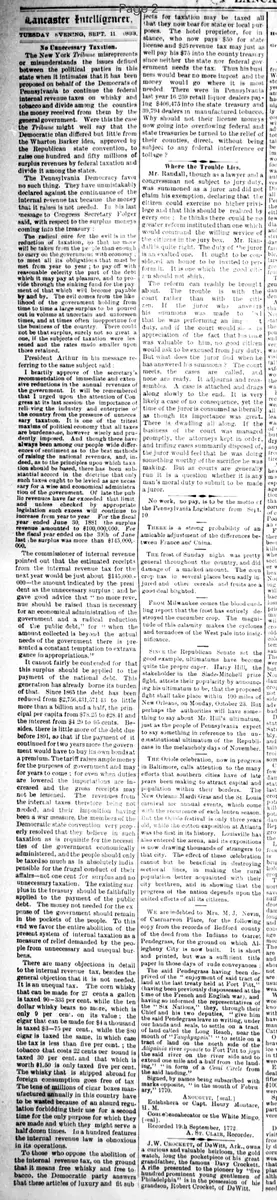
No Unnecessary Taxation.
The New York Tribune misrepresents or misunderstands the issues defined between the political parties in this state when it intimates that it has been proposed on behalf of the Democrats of Pennsylvania to continue the federal internal revenue taxes on whisky and tobacco and divide among the counties the money received from them by the general government. Were this the case the Tribune might well say that the Democratic plan differed but little from the Wharton Barker idea, approved by the Republican state convention, to raise one hundred and fifty millions of surplus revenues by federal taxation and divide it among the states.
The Pennsylvania Democracy favor no such thing. They have unmistakably declared against the continuance of the internal revenue tax because the money that it raises is not needed. In his last message to Congress Secretary Folger said, with respect to the surplus moneys coming into the treasury:
"The radical cure for the evil is in the reduction of taxation, so that no more will be taken from the people than enough to carry on the government with economy; to meet all its obligations that must be met from year to year; to pay off with reasonable celerity the part of the debt which it may pay at pleasure, and to provide through the sinking fund for the payment of that which will become payable by and by. The evil comes from the likelihood of the government holding from time to time a large surplus to be poured out in volume at uncertain and unforeseen times, and at times often inopportune for the business of the country. There could not be that surplus, surely not so great a one, if the subjects of taxation were lessened and the rates made smaller upon those retained."
President Arthur in his message referring to the same subject said:
"I heartily approve of the secretary's recommendation of immediate and extensive reductions in the annual revenues of the government. It will be remembered that I urged upon the attention of Congress at its last session the importance of relieving the industry and enterprise of the country from the pressure of unnecessary taxation. It is one of the tritest maxims of political economy that all taxes are burdensome, however wisely and prudently imposed. And though there have always been among our people wide differences of sentiment as to the best methods of raising the national revenues, and, indeed, as to the principles upon which taxation should be based, there has been substantial accord in the doctrine that only such taxes ought to be levied as are necessary for a wise and economical administration of the government. Of late the public revenues have far exceeded that limit and unless checked by appropriate legislation such excess will continue to increase from year to year. For the fiscal year ended June 30, 1881 the surplus revenue amounted to $100,000,000. For the fiscal year ended on the 30th of June last the surplus was more than $145,000,000."
The commissioner of internal revenue pointed out that the estimated receipts from the internal revenue tax for the next year would be just about $145,000,000--the amount indicated by the president as the unnecessary surplus; and he gave good advice that "no more revenue should be raised than is necessary for an economical administration of the government and a radical reduction of the public debt," for "when the amount collected is beyond the actual needs of the government there is presented a constant temptation to extravagance in appropriations."
It cannot fairly be contended for that this surplus should be applied to the payment of the national debt. This generation has already borne its burden of that. Since 1865 the debt has been reduced from $2,756,431,571.43 to little more than a billion and a half, the principal per capita from $78.25 to $28.41 and the interest from $4.29 to 95 cents. Besides, there is little more of the debt due before 1891, so that if the payment of it continued for two years more the government would have to buy its own bonds at a premium. The tariff raises ample money for the purposes of government and may for years to come; for even when duties are lowered the importations are increased and the gross receipts may not be lessened. The revenues from the internal taxes therefore being not needed, and their imposition having been a war measure, the members of the Democratic state convention very properly resolved that they believe in such taxation as is requisite for the necessities of the government economically administered, and the people should only be taxed so much as is absolutely indispensable for the frugal conduct of their affairs--not one cent for surplus and no unnecessary taxation. The existing surplus in the treasury should be faithfully applied to the payment of the public debt. The money not needed for the expense of the government should remain in the pockets of the people. To this end we favor the entire abolition of the present system of internal taxation as a measure of relief demanded by the people from unnecessary and unequal burdens.
There are many objections in detail to the internal revenue tax, besides the general objection that it is not needed. It is an unequal tax. The corn whisky that can be made for 27 cents a gallon is taxed 90-333 per cent. while the ten dollar whisky bears no more, which is only 9 per cent. on its value; the cigar that can be made for $4 a thousand is taxed $3-75 per cent., while the $80 cigar is taxed the same, in which case the tax is less than five per cent.; the tobacco that costs 22 cents per pound is taxed 30 per cent. and that which is worth $1.50 is only taxed five per cent. The whisky that is shipped abroad for foreign consumption goes free of tax. The tens of millions of cigar boxes manufactured annually in this country have to be wasted because of an absurd regulation forbidding their use for a second time for the only purpose for which they are made and which they might serve a half dozen times. In a hundred features the internal revenue law is obnoxious in its operations.
To those who oppose the abolition of the internal revenue tax, on the ground that it means free whisky and free tobacco, the Democratic party answers that these articles of luxury and fit subjects for taxation may be taxed all that they now bear for state or local purposes. The hotel proprietor, for instance, who now pays $50 for state license and $25 revenue tax may just as well pay his $75 into the county treasury since neither the state nor federal government needs the tax. Thus his business would bear no more impost and the money would go where it is most needed. There were in Pennsylvania last year 16,259 retail liquor dealers paying $1,006,475 into the state treasury and 39,794 dealers in manufactured tobacco. Why should not their license moneys now going into overflowing federal and state treasuries be turned to the relief of their counties direct, without being subject to any federal interference or tollage?
TUESDAY EVENING, SEPT. 11.
No Unnecessary Taxation.
The New York Tribune misrepresents or misunderstands the issues defined between the political parties in this state when it intimates that it has been proposed on behalf of the Democrats of Pennsylvania to continue the federal internal revenue taxes on whisky and tobacco and divide among the counties the money received from them by the general government. Were this the case the Tribune might well say that the Democratic plan differed but little from the Wharton Barker idea, approved by the Republican state convention, to raise one hundred and fifty millions of surplus revenues by federal taxation and divide it among the states.
The Pennsylvania Democracy favor no such thing. They have unmistakably declared against the continuance of the internal revenue tax because the money that it raises is not needed. In his last message to Congress Secretary Folger said, with respect to the surplus moneys coming into the treasury:
"The radical cure for the evil is in the reduction of taxation, so that no more will be taken from the people than enough to carry on the government with economy; to meet all its obligations that must be met from year to year; to pay off with reasonable celerity the part of the debt which it may pay at pleasure, and to provide through the sinking fund for the payment of that which will become payable by and by. The evil comes from the likelihood of the government holding from time to time a large surplus to be poured out in volume at uncertain and unforeseen times, and at times often inopportune for the business of the country. There could not be that surplus, surely not so great a one, if the subjects of taxation were lessened and the rates made smaller upon those retained."
President Arthur in his message referring to the same subject said:
"I heartily approve of the secretary's recommendation of immediate and extensive reductions in the annual revenues of the government. It will be remembered that I urged upon the attention of Congress at its last session the importance of relieving the industry and enterprise of the country from the pressure of unnecessary taxation. It is one of the tritest maxims of political economy that all taxes are burdensome, however wisely and prudently imposed. And though there have always been among our people wide differences of sentiment as to the best methods of raising the national revenues, and, indeed, as to the principles upon which taxation should be based, there has been substantial accord in the doctrine that only such taxes ought to be levied as are necessary for a wise and economical administration of the government. Of late the public revenues have far exceeded that limit and unless checked by appropriate legislation such excess will continue to increase from year to year. For the fiscal year ended June 30, 1881 the surplus revenue amounted to $100,000,000. For the fiscal year ended on the 30th of June last the surplus was more than $145,000,000."
The commissioner of internal revenue pointed out that the estimated receipts from the internal revenue tax for the next year would be just about $145,000,000--the amount indicated by the president as the unnecessary surplus; and he gave good advice that "no more revenue should be raised than is necessary for an economical administration of the government and a radical reduction of the public debt," for "when the amount collected is beyond the actual needs of the government there is presented a constant temptation to extravagance in appropriations."
It cannot fairly be contended for that this surplus should be applied to the payment of the national debt. This generation has already borne its burden of that. Since 1865 the debt has been reduced from $2,756,431,571.43 to little more than a billion and a half, the principal per capita from $78.25 to $28.41 and the interest from $4.29 to 95 cents. Besides, there is little more of the debt due before 1891, so that if the payment of it continued for two years more the government would have to buy its own bonds at a premium. The tariff raises ample money for the purposes of government and may for years to come; for even when duties are lowered the importations are increased and the gross receipts may not be lessened. The revenues from the internal taxes therefore being not needed, and their imposition having been a war measure, the members of the Democratic state convention very properly resolved that they believe in such taxation as is requisite for the necessities of the government economically administered, and the people should only be taxed so much as is absolutely indispensable for the frugal conduct of their affairs--not one cent for surplus and no unnecessary taxation. The existing surplus in the treasury should be faithfully applied to the payment of the public debt. The money not needed for the expense of the government should remain in the pockets of the people. To this end we favor the entire abolition of the present system of internal taxation as a measure of relief demanded by the people from unnecessary and unequal burdens.
There are many objections in detail to the internal revenue tax, besides the general objection that it is not needed. It is an unequal tax. The corn whisky that can be made for 27 cents a gallon is taxed 90-333 per cent. while the ten dollar whisky bears no more, which is only 9 per cent. on its value; the cigar that can be made for $4 a thousand is taxed $3-75 per cent., while the $80 cigar is taxed the same, in which case the tax is less than five per cent.; the tobacco that costs 22 cents per pound is taxed 30 per cent. and that which is worth $1.50 is only taxed five per cent. The whisky that is shipped abroad for foreign consumption goes free of tax. The tens of millions of cigar boxes manufactured annually in this country have to be wasted because of an absurd regulation forbidding their use for a second time for the only purpose for which they are made and which they might serve a half dozen times. In a hundred features the internal revenue law is obnoxious in its operations.
To those who oppose the abolition of the internal revenue tax, on the ground that it means free whisky and free tobacco, the Democratic party answers that these articles of luxury and fit subjects for taxation may be taxed all that they now bear for state or local purposes. The hotel proprietor, for instance, who now pays $50 for state license and $25 revenue tax may just as well pay his $75 into the county treasury since neither the state nor federal government needs the tax. Thus his business would bear no more impost and the money would go where it is most needed. There were in Pennsylvania last year 16,259 retail liquor dealers paying $1,006,475 into the state treasury and 39,794 dealers in manufactured tobacco. Why should not their license moneys now going into overflowing federal and state treasuries be turned to the relief of their counties direct, without being subject to any federal interference or tollage?
What sub-type of article is it?
Taxation
Economic Policy
Partisan Politics
What keywords are associated?
Internal Revenue Tax
Unnecessary Taxation
Surplus Revenue
Democratic Policy
Whisky Tax
Tobacco Tax
Tax Abolition
Pennsylvania Politics
What entities or persons were involved?
New York Tribune
Democrats Of Pennsylvania
Wharton Barker
Republican State Convention
Secretary Folger
President Arthur
Commissioner Of Internal Revenue
Democratic State Convention
Editorial Details
Primary Topic
Abolition Of Unnecessary Internal Revenue Taxes
Stance / Tone
Strongly Opposes Unnecessary Federal Taxation, Supports Democratic Policy For Tax Relief
Key Figures
New York Tribune
Democrats Of Pennsylvania
Wharton Barker
Republican State Convention
Secretary Folger
President Arthur
Commissioner Of Internal Revenue
Democratic State Convention
Key Arguments
Federal Internal Revenue Taxes On Whisky And Tobacco Are Not Needed Due To Surplus Revenues
Reduction Of Taxation Is Essential To Avoid Surplus And Extravagance
Internal Taxes Are Unequal, Burdening Cheaper Goods More Heavily
Tariff Revenues Suffice For Government Needs
Surplus Should Not Accelerate Debt Payment As It Is Already Reduced Sufficiently
Taxes Can Be Redirected To State Or Local Purposes Without Federal Involvement
Abolition Relieves People From Unnecessary Burdens As A War Measure No Longer Required