Thank you for visiting SNEWPapers!
Sign up free
The Kenai Peninsula Cheechako News
Kenai, Soldotna, Alaska
What is this article about?
Historical account of the University of Alaska's development from Delegate James Wickersham's early 1900s idea, opening as Alaska Agricultural College in 1922 amid skepticism, growth to university status by 1935, and a 1958 grant-funded study accepted in 1961, reflecting Alaska's pioneer spirit.
Clipping
OCR Quality
Full Text
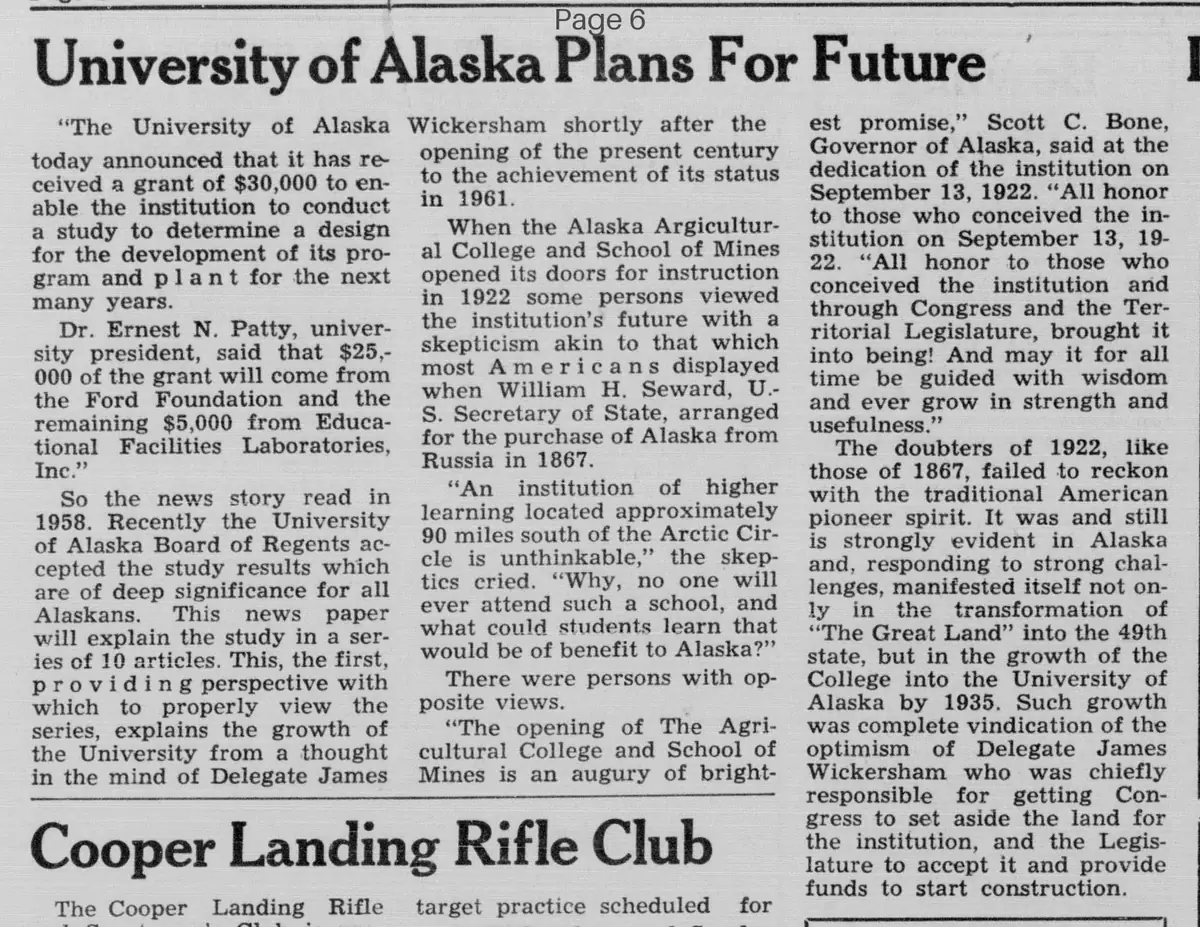
"The University of Alaska today announced that it has received a grant of $30,000 to enable the institution to conduct a study to determine a design for the development of its program and plant for the next many years.
Dr. Ernest N. Patty, university president, said that $25,000 of the grant will come from the Ford Foundation and the remaining $5,000 from Educational Facilities Laboratories, Inc."
So the news story read in 1958. Recently the University of Alaska Board of Regents accepted the study results which are of deep significance for all Alaskans.
This newspaper will explain the study in a series of 10 articles. This, the first, providing perspective with which to properly view the series, explains the growth of the University from a thought in the mind of Delegate James Wickersham shortly after the opening of the present century to the achievement of its status in 1961.
When the Alaska Agricultural College and School of Mines opened its doors for instruction in 1922 some persons viewed the institution's future with a skepticism akin to that which most Americans displayed when William H. Seward, U.S. Secretary of State, arranged for the purchase of Alaska from Russia in 1867.
"An institution of higher learning located approximately 90 miles south of the Arctic Circle is unthinkable," the skeptics cried. "Why, no one will ever attend such a school, and what could students learn that would be of benefit to Alaska?"
There were persons with opposite views.
"The opening of The Agricultural College and School of Mines is an augury of brightest promise," Scott C. Bone, Governor of Alaska, said at the dedication of the institution on September 13, 1922. "All honor to those who conceived the institution and through Congress and the Territorial Legislature, brought it into being! And may it for all time be guided with wisdom and ever grow in strength and usefulness."
The doubters of 1922, like those of 1867, failed to reckon with the traditional American pioneer spirit. It was and still is strongly evident in Alaska and, responding to strong challenges, manifested itself not only in the transformation of "The Great Land" into the 49th state, but in the growth of the College into the University of Alaska by 1935. Such growth was complete vindication of the optimism of Delegate James Wickersham who was chiefly responsible for getting Congress to set aside the land for the institution, and the Legislature to accept it and provide funds to start construction.
What sub-type of article is it?
What themes does it cover?
What keywords are associated?
What entities or persons were involved?
Where did it happen?
Story Details
Key Persons
Location
Alaska, Approximately 90 Miles South Of The Arctic Circle
Event Date
From Early 1900s To 1961
Story Details
The University of Alaska originated from Delegate James Wickersham's idea in the early 1900s, opened as Alaska Agricultural College and School of Mines in 1922 despite skepticism, grew into a university by 1935 due to pioneer spirit, received a 1958 grant for future planning, and had its study accepted by the Board of Regents in 1961.