Thank you for visiting SNEWPapers!
Sign up free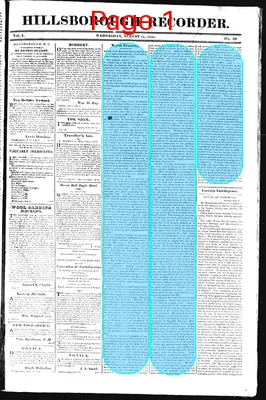
Story
August 16, 1820
The Hillsborough Recorder
Hillsboro, Orange County, North Carolina
What is this article about?
Address by R. Smith to the Maryland Agricultural Society in June 1820, advocating systematic crop rotation alternating grain and green crops to restore soil nutrients, increase livestock and manure production, and enhance farm profitability and sustainability.
Clipping
OCR Quality
95%
Excellent
Full Text
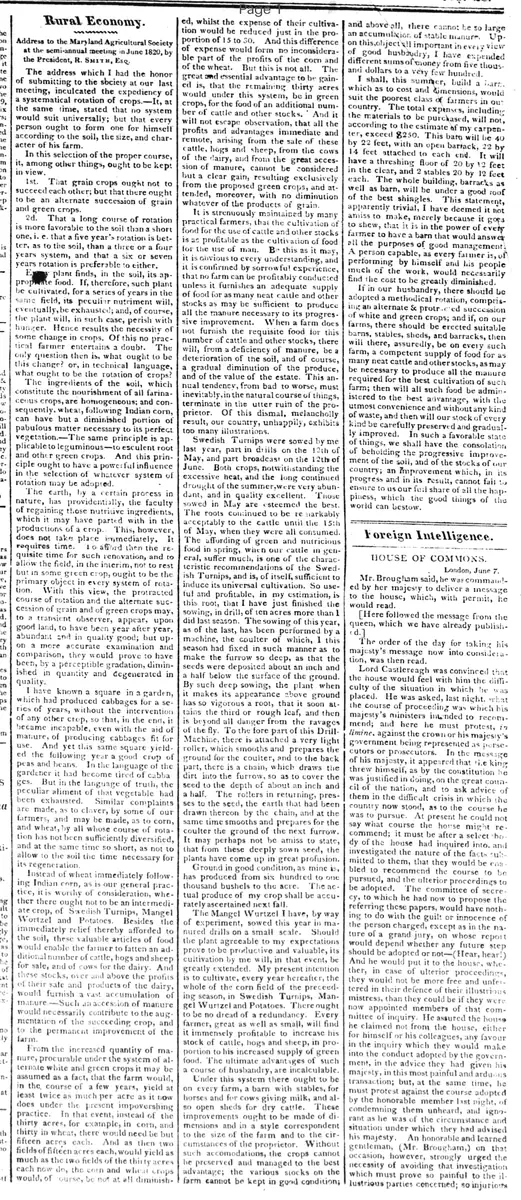
Rural Economy.
Address to the Maryland Agricultural Society at the semi-annual meeting in June 1820, by the President, R. Smith, Esq.
The address which I had the honor of submitting to the society at our last meeting, inculcated the expediency of a systematical rotation of crops. It, at the same time, stated that no system would suit universally; but that every person ought to form one for himself according to the soil, the size, and character of his farm.
In this selection of the proper course, it, among other things, ought to be kept in view.
1st. That grain crops ought not to succeed each other; but that there ought to be an alternate succession of grain and green crops.
2d. That a long course of rotation is more favorable to the soil than a short one, i. e. that a five years rotation is better, as to the soil, than a three or a four years system, and that a six or seven years rotation is preferable to either.
Every plant finds, in the soil, its appropriate food. If, therefore, such plant be cultivated, for a series of years in the same field, its peculiar nutriment will, eventually, be exhausted; and, of course, the plant will, in such case, perish with hunger. Hence results the necessity of some change in crops. Of this no practical farmer entertains a doubt. The only question then is, what ought to be this change? or, in technical language, what ought to be the rotation of crops?
The ingredients of the soil, which constitute the nourishment of all farinaceous crops, are homogeneous; and consequently, wheat, following Indian corn, can have but a diminished portion of pabulous matter necessary to its perfect vegetation. The same principle is applicable to leguminous to esculent root and other green crops. And this principle ought to have a powerful influence in the selection of whatever system of rotation may be adopted.
The earth, by a certain process in nature, has providentially, the faculty of regaining those nutritive ingredients, which it may have parted with in the productions of a crop. This, however, does not take place immediately. It requires time. To afford then the requisite time for such renovation, and to allow the field, in the interim, not to rest but in some green crop, ought to be the primary object in every system of rotation. With this view, the protracted course of rotation and the alternate succession of grain and of green crops may, to a transient observer, appear, upon good land, to have been year after year, abundant and in quality good; but upon a more accurate examination and comparison, they would prove to have been, by a perceptible gradation, diminished in quantity and degenerated in quality.
I have known a square in a garden, which had produced cabbages for a series of years, without the intervention of any other crop, so that, in the end, it became incapable, even with the aid of manure, of producing cabbages fit for use. And yet this same square yielded the following year a good crop of peas and beans. In the language of the gardener it had become tired of cabbages. But in the language of truth, the peculiar aliment of that vegetable had been exhausted. Similar complaints are made, as to clover, by some of our farmers, and may be made, as to corn, and wheat, by all whose course of rotation has not been sufficiently diversified, and at the same time so short, as not to allow to the soil the time necessary for its regeneration.
Instead of wheat immediately following Indian corn, as is our general practice, it is worthy of consideration, whether there ought not to be an intermediate crop, of Swedish Turnips, Mangel Wortzel and Potatoes. Besides the immediate relief thereby afforded to the soil, these valuable articles of food would enable the farmer to fatten an additional number of cattle, hogs and sheep for sale, and of cows for the dairy. And these stocks, over and above the profits of their sale and products of the dairy, would furnish a vast accumulation of manure. Such an accession of manure would necessarily contribute to the augmentation of the succeeding crop, and to the permanent improvement of the farm.
From the increased quantity of manure, procurable under the system of alternate white and green crops it may be assumed as a fact, that the farm would, in the course of a few years, yield at least twice as much per acre as it now does under the present impoverishing practice. In that event, instead of the thirty acres, for example, in corn, and thirty in wheat, there would need be but fifteen acres each. And as then two fields of fifteen acres each, would yield as much as the two fields of the thirty acres each now do, the corn and wheat crops would, of course, be not at all diminished, whilst the expense of their cultivation would be reduced just in the proportion of 15 to 30. And this difference of expense would form no inconsiderable part of the profits of the corn and of the wheat. But this is not all. The great and essential advantage to be gained is, that the remaining thirty acres would under this system, be in green crops, for the food of an additional number of cattle and other stocks. And it will not escape observation, that all the profits and advantages immediate and remote, arising from the sale of these cattle, hogs and sheep, from the cows of the dairy, and from the great accession of manure, cannot be considered but a clear gain, resulting exclusively from the proposed green crops, and attended, moreover, with no diminution whatever of the products of grain.
It is strenuously maintained by many practical farmers, that the cultivation of food for the use of cattle and other stocks is as profitable as the cultivation of food for the use of man. Be this as it may, it is obvious to every understanding, and it is confirmed by sorrowful experience, that no farm can be profitably conducted unless it furnishes an adequate supply of food for as many neat cattle and other stocks as may be sufficient to produce all the manure necessary to its progressive improvement. When a farm does not furnish the requisite food for this number of cattle and other stocks, there will, from a deficiency of manure, be a deterioration of the soil, and of course, a gradual diminution of the produce, and of the value of the estate. This annual tendency, from bad to worse, must inevitably, in the natural course of things, terminate in the utter ruin of the proprietor. Of this dismal, melancholy result, our country, unhappily, exhibits too many illustrations.
Swedish Turnips were sowed by me last year, part in drills on the 12th of May, and part broadcast on the 12th of June. Both crops, notwithstanding the excessive heat, and the long continued drought of the summer, were very abundant, and in quality excellent. Those sowed in May are esteemed the best. The roots continued to be remarkably acceptable to the cattle until the 15th of May, when they were all consumed.
The affording of green and nutritious food in spring, when our cattle in general, suffer much, is one of the characteristic recommendations of the Swedish Turnips, and is, of itself, sufficient to induce its universal cultivation. So useful and profitable, in my estimation, is this root, that I have just finished the sowing, in drill, of ten acres more than I did last season. The sowing of this year, as of the last, has been performed by a machine, the coulter of which, I this season had fixed in such manner as to make the furrow so deep, as that the seeds were deposited about an inch and a half below the surface of the ground. By such deep sowing, the plant when it makes its appearance above ground has so vigorous a root, that it soon attains the third or rough leaf, and then is beyond all danger from the ravages of the fly. To the fore part of this Drill Machine, there is attached a very light roller, which smooths and prepares the ground for the coulter, and to the back part, there is a chain, which draws the dirt into the furrow, so as to cover the seed to the depth of about an inch and a half. The rollers in returning, presses to the seed, the earth that had been drawn thereon by the chain, and at the same time smooths and prepares for the coulter the ground of the next furrow.
It may perhaps not be amiss to state, that from these deeply sown seed, the plants have come up in great profusion. Ground in good condition, as mine is, has produced from six hundred to one thousand bushels to the acre. The actual produce of my crop shall be accurately ascertained next fall.
The Mangel Wurtzel I have, by way of experiment, sowed this year in manured drills on a small scale. Should the plant agreeable to my expectations prove to be productive and valuable, its cultivation by me will, in that event, be greatly extended. My present intention is to cultivate, every year hereafter, the whole of the corn field of the preceding season, in Swedish Turnips, Mangel Wurtzel and Potatoes. There ought to be no dread of a redundancy. Every farmer, great as well as small, will find it immensely profitable to increase his stock of cattle, hogs and sheep, in proportion to his increased supply of green food. The ultimate advantages of such a course of husbandry, are incalculable.
Under this system there ought to be on every farm, a barn with stables, for horses and for cows giving milk, and also open sheds for dry cattle. These improvements ought to be made of dimensions and in a style correspondent to the size of the farm and to the circumstances of the proprietor. Without such accommodations, the crops cannot be preserved and managed to the best advantage; the various stocks on the farm cannot be kept in good condition; and above all, there cannot be so large an accumulation of stable manure. Upon this object so important in every view of good husbandry, I have expended different sums of money from five thousand dollars to a very few hundred.
I shall, this summer, build a barn, which as to cost and dimensions, would suit the poorest class of farmers in our country. The total expenses, including the materials to be purchased, will not, according to the estimate of my carpenter, exceed $250. This barn will be 40 by 22 feet, with an open barntack, 22 by 14 feet attached to each end. It will have a threshing floor of 20 by 12 feet in the clear, and 2 stables 20 by 12 feet each. The whole building, barracks as well as barn, will be under a good roof of the best shingles. This statement, apparently trivial, I have deemed it not amiss to make, merely because it goes to shew, that it is in the power of every farmer to have a barn that would answer all the purposes of good management. A person capable, as every farmer is, of performing by himself and his people much of the work, would necessarily find the cost to be greatly diminished.
If in our husbandry, there should be adopted a methodical rotation, comprising an alternate & protracted succession of white and green crops; and if, on our farms, there should be erected suitable barns, stables, sheds, and barracks, then will there, assuredly, be on every such farm, a competent supply of food for as many neat cattle and other stocks, as may be necessary to produce all the manure required for the best cultivation of such farm; then will all such food be administered to the best advantage, with the utmost convenience and without any kind of waste, and then will our stock of every kind be carefully preserved and gradually improved. In such a favorable state of things, we shall have the consolation of beholding the progressive improvement of the soil, and of the stocks of our country; an Improvement which, in its progress and in its result, cannot fail to ensure to us our full share of all the happiness, which the good things of the world can bestow.
Address to the Maryland Agricultural Society at the semi-annual meeting in June 1820, by the President, R. Smith, Esq.
The address which I had the honor of submitting to the society at our last meeting, inculcated the expediency of a systematical rotation of crops. It, at the same time, stated that no system would suit universally; but that every person ought to form one for himself according to the soil, the size, and character of his farm.
In this selection of the proper course, it, among other things, ought to be kept in view.
1st. That grain crops ought not to succeed each other; but that there ought to be an alternate succession of grain and green crops.
2d. That a long course of rotation is more favorable to the soil than a short one, i. e. that a five years rotation is better, as to the soil, than a three or a four years system, and that a six or seven years rotation is preferable to either.
Every plant finds, in the soil, its appropriate food. If, therefore, such plant be cultivated, for a series of years in the same field, its peculiar nutriment will, eventually, be exhausted; and, of course, the plant will, in such case, perish with hunger. Hence results the necessity of some change in crops. Of this no practical farmer entertains a doubt. The only question then is, what ought to be this change? or, in technical language, what ought to be the rotation of crops?
The ingredients of the soil, which constitute the nourishment of all farinaceous crops, are homogeneous; and consequently, wheat, following Indian corn, can have but a diminished portion of pabulous matter necessary to its perfect vegetation. The same principle is applicable to leguminous to esculent root and other green crops. And this principle ought to have a powerful influence in the selection of whatever system of rotation may be adopted.
The earth, by a certain process in nature, has providentially, the faculty of regaining those nutritive ingredients, which it may have parted with in the productions of a crop. This, however, does not take place immediately. It requires time. To afford then the requisite time for such renovation, and to allow the field, in the interim, not to rest but in some green crop, ought to be the primary object in every system of rotation. With this view, the protracted course of rotation and the alternate succession of grain and of green crops may, to a transient observer, appear, upon good land, to have been year after year, abundant and in quality good; but upon a more accurate examination and comparison, they would prove to have been, by a perceptible gradation, diminished in quantity and degenerated in quality.
I have known a square in a garden, which had produced cabbages for a series of years, without the intervention of any other crop, so that, in the end, it became incapable, even with the aid of manure, of producing cabbages fit for use. And yet this same square yielded the following year a good crop of peas and beans. In the language of the gardener it had become tired of cabbages. But in the language of truth, the peculiar aliment of that vegetable had been exhausted. Similar complaints are made, as to clover, by some of our farmers, and may be made, as to corn, and wheat, by all whose course of rotation has not been sufficiently diversified, and at the same time so short, as not to allow to the soil the time necessary for its regeneration.
Instead of wheat immediately following Indian corn, as is our general practice, it is worthy of consideration, whether there ought not to be an intermediate crop, of Swedish Turnips, Mangel Wortzel and Potatoes. Besides the immediate relief thereby afforded to the soil, these valuable articles of food would enable the farmer to fatten an additional number of cattle, hogs and sheep for sale, and of cows for the dairy. And these stocks, over and above the profits of their sale and products of the dairy, would furnish a vast accumulation of manure. Such an accession of manure would necessarily contribute to the augmentation of the succeeding crop, and to the permanent improvement of the farm.
From the increased quantity of manure, procurable under the system of alternate white and green crops it may be assumed as a fact, that the farm would, in the course of a few years, yield at least twice as much per acre as it now does under the present impoverishing practice. In that event, instead of the thirty acres, for example, in corn, and thirty in wheat, there would need be but fifteen acres each. And as then two fields of fifteen acres each, would yield as much as the two fields of the thirty acres each now do, the corn and wheat crops would, of course, be not at all diminished, whilst the expense of their cultivation would be reduced just in the proportion of 15 to 30. And this difference of expense would form no inconsiderable part of the profits of the corn and of the wheat. But this is not all. The great and essential advantage to be gained is, that the remaining thirty acres would under this system, be in green crops, for the food of an additional number of cattle and other stocks. And it will not escape observation, that all the profits and advantages immediate and remote, arising from the sale of these cattle, hogs and sheep, from the cows of the dairy, and from the great accession of manure, cannot be considered but a clear gain, resulting exclusively from the proposed green crops, and attended, moreover, with no diminution whatever of the products of grain.
It is strenuously maintained by many practical farmers, that the cultivation of food for the use of cattle and other stocks is as profitable as the cultivation of food for the use of man. Be this as it may, it is obvious to every understanding, and it is confirmed by sorrowful experience, that no farm can be profitably conducted unless it furnishes an adequate supply of food for as many neat cattle and other stocks as may be sufficient to produce all the manure necessary to its progressive improvement. When a farm does not furnish the requisite food for this number of cattle and other stocks, there will, from a deficiency of manure, be a deterioration of the soil, and of course, a gradual diminution of the produce, and of the value of the estate. This annual tendency, from bad to worse, must inevitably, in the natural course of things, terminate in the utter ruin of the proprietor. Of this dismal, melancholy result, our country, unhappily, exhibits too many illustrations.
Swedish Turnips were sowed by me last year, part in drills on the 12th of May, and part broadcast on the 12th of June. Both crops, notwithstanding the excessive heat, and the long continued drought of the summer, were very abundant, and in quality excellent. Those sowed in May are esteemed the best. The roots continued to be remarkably acceptable to the cattle until the 15th of May, when they were all consumed.
The affording of green and nutritious food in spring, when our cattle in general, suffer much, is one of the characteristic recommendations of the Swedish Turnips, and is, of itself, sufficient to induce its universal cultivation. So useful and profitable, in my estimation, is this root, that I have just finished the sowing, in drill, of ten acres more than I did last season. The sowing of this year, as of the last, has been performed by a machine, the coulter of which, I this season had fixed in such manner as to make the furrow so deep, as that the seeds were deposited about an inch and a half below the surface of the ground. By such deep sowing, the plant when it makes its appearance above ground has so vigorous a root, that it soon attains the third or rough leaf, and then is beyond all danger from the ravages of the fly. To the fore part of this Drill Machine, there is attached a very light roller, which smooths and prepares the ground for the coulter, and to the back part, there is a chain, which draws the dirt into the furrow, so as to cover the seed to the depth of about an inch and a half. The rollers in returning, presses to the seed, the earth that had been drawn thereon by the chain, and at the same time smooths and prepares for the coulter the ground of the next furrow.
It may perhaps not be amiss to state, that from these deeply sown seed, the plants have come up in great profusion. Ground in good condition, as mine is, has produced from six hundred to one thousand bushels to the acre. The actual produce of my crop shall be accurately ascertained next fall.
The Mangel Wurtzel I have, by way of experiment, sowed this year in manured drills on a small scale. Should the plant agreeable to my expectations prove to be productive and valuable, its cultivation by me will, in that event, be greatly extended. My present intention is to cultivate, every year hereafter, the whole of the corn field of the preceding season, in Swedish Turnips, Mangel Wurtzel and Potatoes. There ought to be no dread of a redundancy. Every farmer, great as well as small, will find it immensely profitable to increase his stock of cattle, hogs and sheep, in proportion to his increased supply of green food. The ultimate advantages of such a course of husbandry, are incalculable.
Under this system there ought to be on every farm, a barn with stables, for horses and for cows giving milk, and also open sheds for dry cattle. These improvements ought to be made of dimensions and in a style correspondent to the size of the farm and to the circumstances of the proprietor. Without such accommodations, the crops cannot be preserved and managed to the best advantage; the various stocks on the farm cannot be kept in good condition; and above all, there cannot be so large an accumulation of stable manure. Upon this object so important in every view of good husbandry, I have expended different sums of money from five thousand dollars to a very few hundred.
I shall, this summer, build a barn, which as to cost and dimensions, would suit the poorest class of farmers in our country. The total expenses, including the materials to be purchased, will not, according to the estimate of my carpenter, exceed $250. This barn will be 40 by 22 feet, with an open barntack, 22 by 14 feet attached to each end. It will have a threshing floor of 20 by 12 feet in the clear, and 2 stables 20 by 12 feet each. The whole building, barracks as well as barn, will be under a good roof of the best shingles. This statement, apparently trivial, I have deemed it not amiss to make, merely because it goes to shew, that it is in the power of every farmer to have a barn that would answer all the purposes of good management. A person capable, as every farmer is, of performing by himself and his people much of the work, would necessarily find the cost to be greatly diminished.
If in our husbandry, there should be adopted a methodical rotation, comprising an alternate & protracted succession of white and green crops; and if, on our farms, there should be erected suitable barns, stables, sheds, and barracks, then will there, assuredly, be on every such farm, a competent supply of food for as many neat cattle and other stocks, as may be necessary to produce all the manure required for the best cultivation of such farm; then will all such food be administered to the best advantage, with the utmost convenience and without any kind of waste, and then will our stock of every kind be carefully preserved and gradually improved. In such a favorable state of things, we shall have the consolation of beholding the progressive improvement of the soil, and of the stocks of our country; an Improvement which, in its progress and in its result, cannot fail to ensure to us our full share of all the happiness, which the good things of the world can bestow.
What sub-type of article is it?
Agricultural Address
Farming Instruction
What themes does it cover?
Moral Virtue
Triumph
What keywords are associated?
Crop Rotation
Green Crops
Swedish Turnips
Mangel Wurtzel
Manure
Livestock
Agriculture
Soil Fertility
What entities or persons were involved?
R. Smith, Esq.
Where did it happen?
Maryland
Story Details
Key Persons
R. Smith, Esq.
Location
Maryland
Event Date
June 1820
Story Details
Presidential address promoting systematic crop rotation with alternating grain and green crops like Swedish Turnips, Mangel Wurtzel, and potatoes to prevent soil exhaustion, increase livestock, manure production, and overall farm productivity and sustainability.