Thank you for visiting SNEWPapers!
Sign up free
The New Hampshire Gazette
Portsmouth, Rockingham County, New Hampshire
What is this article about?
An editorial defending the US government's neutrality during the war with France, responding to Mr. Adet's complaints about violations of the 1778 treaty. It justifies US actions using French laws and history, warns against foreign influence in the presidential election, and urges continued moderation to avoid war.
Merged-components note: These two components form a single continuous opinion piece on US-French relations, signed 'AMERICANUS', better classified as editorial rather than foreign_news.
Clippings
1 of 2
OCR Quality
Full Text
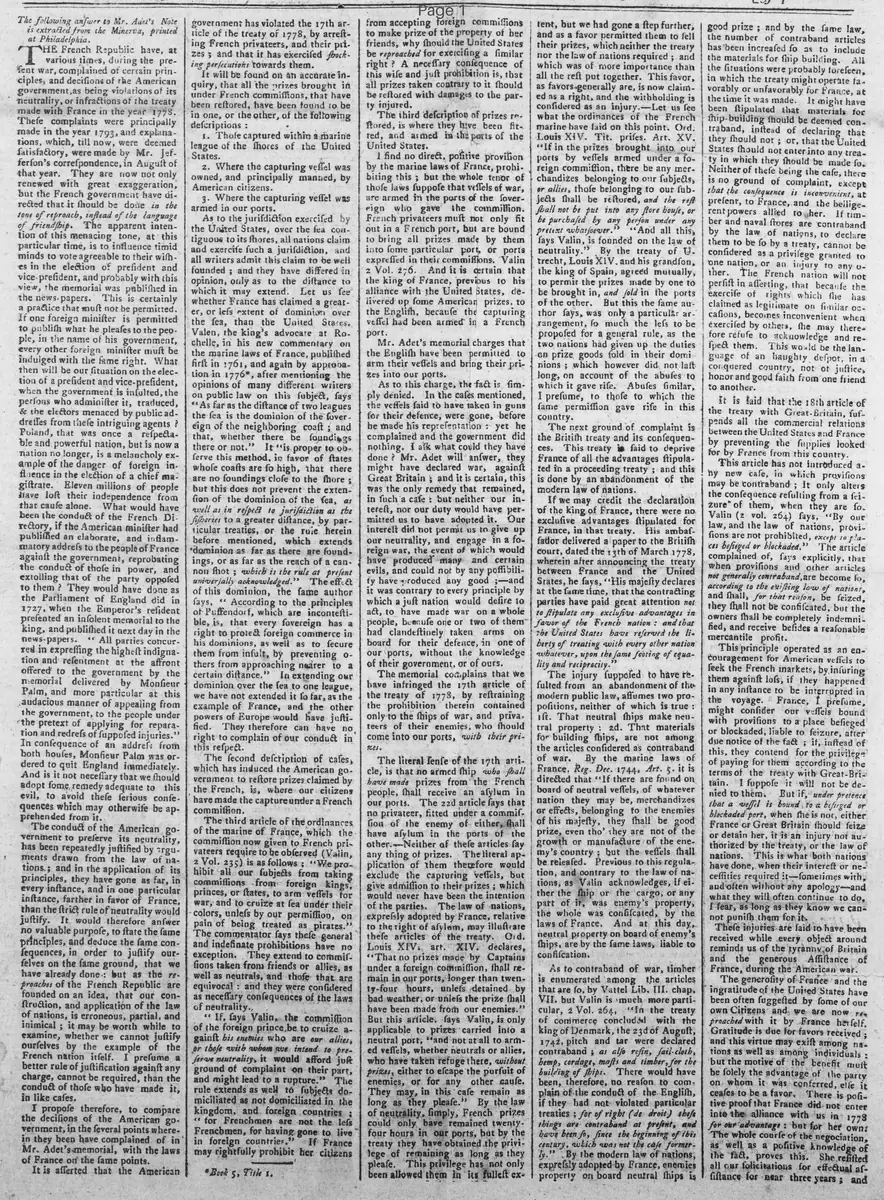
The French Republic have, at various times, during the present war, complained of certain principles, and decisions of the American government, as being violations of its neutrality, or infractions of the treaty made with France in the year 1778.
These complaints were principally made in the year 1793, and explanations, which, till now, were deemed satisfactory, were made by Mr. Jefferson's correspondence, in August of that year. They are now not only renewed with great exaggeration, but the French government have directed that it should be done in the tone of reproach, instead of the language of friendship. The apparent intention of this menacing tone, at this particular time, is to influence timid minds to vote agreeable to their wishes in the election of president and vice-president, and probably with this view, the memorial was published in the newspapers. This is certainly a practice that must not be permitted. If one foreign minister is permitted to publish what he pleases to the people, in the name of his government, every other foreign minister must be indulged with the same right. What then will be our situation on the election of a president and vice-president, when the government is insulted, the persons who administer it, traduced, & the electors menaced by public addresses from these intriguing agents?
Poland, that was once a respectable and powerful nation, but is now a nation no longer, is a melancholy example of the danger of foreign influence in the election of a chief magistrate. Eleven millions of people have lost their independence from that cause alone. What would have been the conduct of the French Directory, if the American minister had published an elaborate, and inflammatory address to the people of France against the government, reprobating the conduct of those in power, and extolling that of the party opposed to them? They would have done as the Parliament of England did in 1727, when the Emperor's resident presented an insolent memorial to the king, and published it next day in the newspapers. "All parties concurred in expressing the highest indignation and resentment at the affront offered to the government by the memorial delivered by Monsieur Palm, and more particularly at this audacious manner of appealing from the government, to the people under the pretext of applying for reparation and redress of supposed injuries."
In consequence of an address from both houses, Monsieur Palm was ordered to quit England immediately. And is it not necessary that we should adopt some remedy adequate to this evil, to avoid these serious consequences which may otherwise be apprehended from it.
The conduct of the American government to preserve its neutrality, has been repeatedly justified by arguments drawn from the law of nations; and in the application of its principles, they have gone as far, in every instance, and in one particular instance, farther in favor of France, than the strict rule of neutrality would justify. It would therefore answer no valuable purpose, to state the same principles, and deduce the same consequences, in order to justify ourselves on the same ground, that we have already done: but as the reproaches of the French Republic are founded on an idea, that our construction, and application of the law of nations, is erroneous, partial, and inimical; it may be worth while to examine, whether we cannot justify ourselves by the example of the French nation itself. I presume a better rule of justification against any charge, cannot be required, than the conduct of those who have made it, in like cases.
I propose therefore, to compare the decisions of the American government, in the several points wherein they have been complained of in Mr. Adet's memorial, with the laws of France on the same points.
It is asserted that the American government has violated the 17th article of the treaty of 1778, by arresting French privateers, and their prizes; and that it has exercised shocking persecutions towards them.
It will be found on an accurate inquiry, that all the prizes brought in under French commissions, that have been restored, have been found to be in one, or the other, of the following descriptions:
1. Those captured within a marine league of the shores of the United States.
2. Where the capturing vessel was owned, and principally manned, by American citizens.
3. Where the capturing vessel was armed in our ports.
As to the jurisdiction exercised by the United States, over the sea contiguous to its shores, all nations claim and exercise such a jurisdiction, and all writers admit this claim to be well founded; and they have differed in opinion, only as to the distance to which it may extend. Let us see whether France has claimed a greater, or less extent of dominion over the sea, than the United States.
Valin, the king's advocate at Rochelle, in his new commentary on the marine laws of France, published first in 1761, and again by approbation in 1776, after mentioning the opinions of many different writers on public law on this subject, says "As far as the distance of two leagues the sea is the dominion of the sovereign of the neighboring coast; and that, whether there be soundings there or not." It "is proper to observe this method, in favor of states whose coasts are so high, that there are no soundings close to the shore; but this does not prevent the extension of the dominion of the sea, as well as in respect to jurisdiction as the fisheries to a greater distance, by particular treaties, or the rule herein before mentioned, which extends dominion as far as there are soundings, or as far as the reach of a cannon shot; which is the rule at present universally acknowledged." The effect of this dominion, the same author says, "According to the principles of Puffendorf, which are incontestable, is, that every sovereign has a right to protect foreign commerce in his dominions, as well as to secure them from insult, by preventing others from approaching nearer in a certain distance." In extending our dominion over the sea to one league, we have not extended it so far, as the example of France, and the other powers of Europe would have justified. They therefore can have no right to complain of our conduct in this respect.
The second description of cases, which has induced the American government to restore prizes claimed by the French, is, where our citizens have made the capture under a French commission.
The third article of the ordinances of the marine of France, which the commission now given to French privateers require to be observed (Valin, 2 Vol. 235) is as follows; "We prohibit all our subjects from taking commissions from foreign kings, princes, or states, to arm vessels for war, and to cruize at sea under their colors, unless by our permission, on pain of being treated as pirates."
The commentator says these general and indefinite prohibitions have no exception. They extend to commissions taken from friends or allies, as well as neutrals, and those that are equivocal: and they were considered as necessary consequences of the laws of neutrality.
"If, says Valin, the commission of the foreign prince be to cruize against his enemies who are our allies; or those with whom we intend to preserve neutrality, it would afford just ground of complaint on their part, and might lead to a rupture." The rule extends as well to subjects domiciliated as not domiciliated in the kingdom, and foreign countries; "for Frenchmen are not the less Frenchmen, for having gone to live in foreign countries." If France may rightfully prohibit her citizens from accepting foreign commissions to make prize of the property of her friends, why should the United States be reproached for exercising a similar right? A necessary consequence of this wise and just prohibition is, that all prizes taken contrary to it should be restored with damages to the party injured.
The third description of prizes restored, is where they have been fitted, and armed in the ports of the United States.
I find no direct, positive provision by the marine laws of France, prohibiting this; but the whole tenor of those laws suppose that vessels of war, are armed in the ports of the sovereign who gave the commission. French privateers must not only fit out in a French port, but are bound to bring all prizes made by them into some particular port, or ports expressed in their commissions. Valin 2 Vol. 276. And it is certain that the king of France, previous to his alliance with the United States, delivered up some American prizes, to the English, because the capturing vessel had been armed in a French port.
Mr. Adet's memorial charges that the English have been permitted to arm their vessels and bring their prizes into our ports.
As to this charge, the fact is implicitly denied. In the cases mentioned, the vessels said to have taken in guns for their defence, were gone, before he made his representation: yet he complained and the government did nothing. I ask what could they have done? Mr. Adet will answer, they might have declared war, against Great Britain: and it is certain, this was the only remedy that remained. in such a case: but neither our interest, nor our duty would have permitted us to have adopted it. Our interest did not permit us to give up our neutrality, and engage in a foreign war, the event of which would have produced many and certain evils, and could not by any possibility have produced any good; and it was contrary to every principle by which a just nation would desire to act, to have made war on a whole people, because one or two of them had clandestinely taken arms on board for their defence, in one of our ports, without the knowledge of their government, or of ours.
The memorial complains that we have infringed the 17th article of the treaty of 1778, by restraining the prohibition therein contained only to the ships of war, and privateers of their enemies, who should come into our ports, with their prizes.
The literal sense of the 17th article. is that no armed ship who shall have made prizes from the French people, shall receive an asylum in our ports. The 22d article says that no privateer, fitted under a commission of the enemy of either, shall have asylum in the ports of the other. Neither of these articles say any thing of prizes. The literal application of them therefore would exclude the capturing vessels, but give admission to their prizes; which would never have been the intention of the parties. The law of nations, expressly adopted by France, relative to the right of asylum, may illustrate these articles of the treaty. Ord. Louis XIV. art. XIV. declares, "That no prizes made by Captains under a foreign commission, shall remain in our ports, longer than twenty-four hours, unless detained by bad weather, or unless the prize shall have been made from our enemies."
But this article, says Valin, is only applicable to prizes carried into a neutral port, "and not at all to armed vessels, whether neutrals or allies, who have taken refuge there, without prizes, either to escape the pursuit of enemies, or for any other cause. They may, in this case remain as long as they please." By the law of neutrality, simply, French prizes could only have remained twenty-four hours in our ports, but by the treaty they have obtained the privilege of remaining as long as they please. This privilege has not only been allowed them in its fullest extent, but we had gone a step further, and as a favor permitted them to sell their prizes, which neither the treaty nor the law of nations required; and which was of more importance than all the rest put together. This favor, as favors generally are, is now claimed as a right, and the withholding is considered as an injury. Let us see what the ordinances of the French marine have said on this point. Ord. Louis XIV. Tit. prizes. Art. XV. "If in the prizes brought into our ports by vessels armed under a foreign commission, there be any merchandizes belonging to our subjects, or allies, those belonging to our subjects shall be restored, and the rest shall not be put into any store house, or be purchased by any person under any pretext whatsoever." "And all this, says Valin, is founded on the law of neutrality." By the treaty of Utrecht, Louis XIV. and his grandson, the king of Spain, agreed mutually, to permit the prizes made by one to be brought in, and sold in the ports of the other. But this the same author says, was only a particular arrangement, so much the less to be proposed for a general rule, as the two nations had given up the duties on prize goods sold in their dominions; which however did not last long, on account of the abuses to which it gave rise. Abuses similar, I presume, to those to which the same permission gave rise in this country.
The next ground of complaint is the British treaty and its consequences. This treaty is said to deprive France of all the advantages stipulated in a preceding treaty; and this is done by an abandonment of the modern law of nations.
If we may credit the declaration of the king of France, there were no exclusive advantages stipulated for France, in that treaty. His ambassador delivered a paper to the British court, dated the 11th of March 1778, wherein after announcing the treaty between France and the United States, he says, "His majesty declares at the same time, that the contracting parties have paid great attention not to stipulate any exclusive advantages in favor of the French nation: and that the United States have reserved the liberty of treating with every other nation whatever, upon the same footing of equality and reciprocity."
The injury supposed to have resulted from an abandonment of the modern public law, assumes two propositions, neither of which is true: 1st. That neutral ships make neutral property: 2d. That materials for building ships, are not among the articles considered as contraband of war.
By the marine laws of France, Reg. Dec. 1744, Art. 5. it is directed that "If there are found on board of neutral vessels, of whatever nation they may be, merchandizes or effects, belonging to the enemies of his majesty, they shall be good prize, even tho' they are not of the growth or manufacture of the enemy's country; but the vessels shall be released." Previous to this regulation, and contrary to the law of nations, as Valin acknowledges, if either the ship or the cargo, or any part of it, was enemy's property, the whole was confiscated, by the laws of France. And at this day, neutral property on board of enemy's ships, are by the same laws, liable to confiscation.
As to contraband of war, timber is enumerated among the articles that are so, by Vattel Lib. III. chap. VII. but Valin is much more particular, 2 Vol. 264, In the treaty of commerce concluded with the king of Denmark, the 23d of August, 1742, pitch and tar were declared contraband; as also resin, sail-cloth hemp, cordage, mats and timber, for the building of ships. There would have been, therefore, no reason to complain of the conduct of the English, if they had not violated particular treaties: for of right (de droit) these things are contraband at present, and have been so, since the beginning of this century, which was not the case formerly." By the modern law of nations, expressly adopted by France, enemies property on board neutral ships is good prize; and by the same law, the number of contraband articles has been increased so as to include the materials for ship building. All the situations were probably foreseen, in which the treaty might operate favorably or unfavorably for France, at the time it was made. It might have been stipulated that materials for ship-building should be deemed contraband, instead of declaring that they should not; or, that the United States should not enter into any treaty in which they should be made so. Neither of these being the case, there is no ground of complaint, except that the consequence is inconvenient, at present, to France, and the belligerent powers allied to her. If timber and naval stores are contraband by the law of nations, to declare them to be so by a treaty, cannot be considered as a privilege granted to one nation, or an injury to any other. The French nation will not persist in asserting, that because the exercise of rights which she has claimed as legitimate on similar occasions, becomes inconvenient when exercised by others, she may therefore refuse to acknowledge and respect them. This would be the language of an haughty despot, in a conquered country, not of justice, honor and good faith from one friend to another.
It is said that the 18th article of the treaty with Great-Britain, suspends all the commercial relations between the United States and France by preventing the supplies looked for by France from this country.
This article has not introduced any new case, in which provisions may be contraband; It only alters the consequence resulting from a seizure of them, when they are so.
Valin (2 vol. 264) says, "By our law, and the law of nations, provisions are not prohibited, except to places besieged or blockaded." The article complained of, says explicitly, that when provisions and other articles not generally contraband, are become so, according to the existing laws of nations, and shall, for that reason, be seized, they shall not be confiscated, but the owners shall be completely indemnified, and receive besides a reasonable mercantile profit.
This principle operated as an encouragement for American vessels to seek the French markets, by insuring them against loss, if they happened in any instance to be interrupted in the voyage. France, I presume, might consider our vessels bound with provisions to a place besieged or blockaded, liable to seizure, after due notice of the fact; if, instead of this, they contend for the privilege of paying for them according to the terms of the treaty with Great-Britain. I suppose it will not be denied to them. But if, under pretence that a vessel is bound to a besieged or blockaded port, when she is not, either France or Great Britain should seize or detain her, it is an injury not authorized by the treaty, or the law of nations. This is what both nations have done, when their interest or necessities required it--sometimes with, and often without any apology--and what they will often continue to do, I fear, as long as they know we cannot punish them for it.
These injuries are said to have been received while every object around reminds us of the tyranny of Britain and the generous Assistance of France, during the American war.
The generosity of France and the ingratitude of the United States have been often suggested by some of our own Citizens and, we are now reproached with it by France herself.
Gratitude is due for favors received; and this virtue may exist among nations as well as among individuals: but the motive of the benefit must be solely the advantage of the party on whom it was conferred, else it ceases to be a favor. There is positive proof that France did not enter into the alliance with us in 1778 for our advantage: but for her own: The whole course of the negociation, as well as a positive knowledge of the fact, proves this. She resisted all our solicitations for effectual assistance- for near three years; and
rose in her demands during the campaign of 1777, when our affairs presented the most threatening aspect. Memorials were presented in August and September of that year, while Gen. Burgoyne was advancing from Canada, in a time of importunity, proportioned to the danger we were in from a junction of the two armies; and they were received with increased coldness from the same cause. But when the knowledge of the capture of Burgoyne's army arrived in December, fearing we might be able to do the business without them, the French Court began to change its tone. In January the British minister gave notice in the House of Commons, that he meant to propose terms of accommodation with America. The French ministry, on the arrival of this intelligence in France, immediately pressed the conclusion of the treaty which they had retarded for three years, and proposed terms much more favorable for us, than those our Commissioners had offered, and they had refused three months before. The treaty was signed on the 6th February. I perceive no generosity in all this. They did then, as we have done now, and as every discerning nation will do, they regarded only their own interest and advantage, and not that of any other nation. In the interval between the declaration of independence and the alliance, with France, that Court sometimes ordered away our privateers, and sometimes restored their prizes: They refused to receive an ambassador, or acknowledge our independence: All of which was for fear of bringing France prematurely into the war. The fact is, that the French spoke of very different terms, as the condition of their assistance, before the Capture of Burgoyne, from those actually agreed on afterwards. There can be no doubt, that our success on that occasion, and the disposition it appeared to have produced in the British ministry, were the immediate causes of that alliance. It was certainly the interest of the French to unite with America in the war against Great Britain. They therefore acted right in doing this at last, tho' with too much refinement in putting it off so long; but it is not the interest of the United States to be engaged in any war whatsoever-- much less do they desire to imbrue their hands in the blood of one nation, to gratify the hatred, or serve the interest of another. We have acted right hitherto, in laying it down as a principle, not to suffer ourselves to be drawn into the wars of Europe, and if we must have a war, I hope it will be for refusing to depart from this principle.
Our government has acted with firmness, consistency and moderation, in repelling the unjust pretensions of the belligerent powers, as far as reason and argument could have weight. If it has not attempted, in every instance, to preserve our rights by force, wherein the remedy would have been worse than the disease, they have not yielded them by concession, in any instance. Into whatsoever hands the administration of the government may now come, they are called on by the suggestions of a wise policy, and the voice of their country to pursue the same general line of conduct, that has been hitherto pursued, without yielding to the violence of party on either side. They then will be sure of the approbation and support of the most virtuous, which it is hoped are the most numerous part, of all parties. On the contrary, if, departing from these principles, they unnecessarily involve their country in the horrors of war, they will meet the merited execration of good men, and in the end, the punishment justly due to such conduct, from an injured people.
AMERICANUS.
What sub-type of article is it?
What keywords are associated?
What entities or persons were involved?
Editorial Details
Primary Topic
Defense Of Us Neutrality Against French Complaints In Adet's Memorial
Stance / Tone
Strongly Supportive Of Us Neutrality And Against Foreign Election Interference
Key Figures
Key Arguments