Thank you for visiting SNEWPapers!
Sign up free
Virginia Argus
Richmond, Virginia
What is this article about?
In a letter from Prince Edward dated November 27, 1811, 'Melville' reflects on the American Revolution's hard-won independence from British oppression, praises the resulting freedoms, and laments rumors of renewed war due to British violations like impressment, piracy, and infringement on neutral rights, distinguishing between British rulers and common people.
Clipping
OCR Quality
Full Text
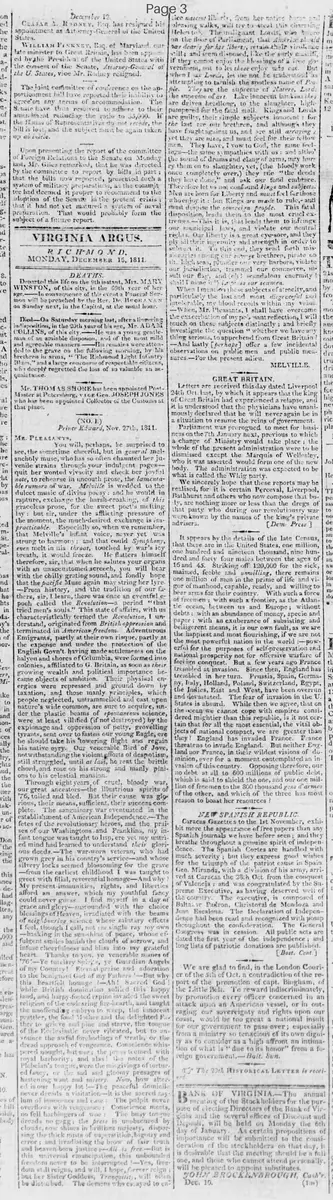
Prince Edward, Nov. 27th, 1811.
MR. PLEASANTS,
You will, perhaps, be surprised to see, the sometime cheerful, but in general melancholy muse, who has so often chaunted her juvenile strains through your indulgent pages—quit her wonted vivacity and check her joyful note, to rehearse in uncouth prose, the lamentable rumors of war. Melville is wedded to the dulcet music of divine poesy: and he would in rapture, exchange the harsh-croaking, of this graceless prose, for the sweet poet's melting lay: but sir, under the afflicting pressure of the moment, the much-desired exchange is impracticable. Especially so, when we remember that Melville's infant voice never yet was strung to harmony; and that could Symphony, even melt in his throat, touched by war's icy breath, it would freeze. He flatters himself therefore, sir, that when he salutes your organs with an unaccustomed screech, you will bear with the chilly grating sound, and fondly hope that the pacific Muse again may string her lyre.
—From history, and the tradition of our fathers, sir, I learn, there was once an eventful epoch called the Revolution—a period "that tried men's souls." This state of affairs, with us characteristically termed the Revolution, I understand, originated from British oppression and terminated in American freedom. Adventurous Emigrants, partly at their own risque, partly at the expense and under the protection of the English Gov't. having made settlements on the halcyon vales and shores of Columbia, were formed into colonies, affiliated to G. Britain, as soon as their growing wealth and political importance became objects of ambition. Their physical energies were repressed and ground down by taxation, and those manly principles, which people neglected, untrammelled and cast upon nature's wide common, are sure to acquire, under the plastic beams of spontaneous science, were at least villified (if not destroyed) by the espionage and oppression of petty, grovelling tyrants, sent over to fasten our young Eagle, ere he should take his towering flight and regain his native eyry. Our venerable Bird of Jove, notwithstanding the violent efforts of despotism, still struggled, until at last, he rent the brittle chord, and rose on his strong and manly pinions to his celestial mansion.
Through eight years of cruel, bloody war, our great ancestors—the illustrious spirits of '76, toiled and bled. But their cause was glorious, their means, sufficient, their success complete. The sanguinary war eventuated in the establishment of American Independence.—The feats of the revolutionary heroes, and the praises of our Washingtons and Franklins, my infant tongue was taught to lisp, ere yet my untried mind had learned to understand their glorious deeds.—The war-worn veteran, who had grown grey in his country's service—and whose silvery locks seemed blossoming for the grave—from the earliest childhood I was taught to greet with filial, reverential homage—And why? My present immunities, rights, and liberties afford an answer, which my youthful fancy could never guess. I find myself in a day of grace and glory—surrounded with the choice blessings of Heaven, irradiated with the beams of neighbouring science whose salutary effects I feel, though I call not one single ray my own—basking in the sun-shine of peace, whose effulgent smiles banish the clouds of sorrow, and infuse cheerfulness and bliss into my grateful heart. Thanks to you, ye venerable manes of '76:—Ye tutelary Spirits! ye Guardian Angels of my Country! Eternal praise and adoration to the benignant God of my Fathers'—But why this heartfelt homage!—Ah! Sacred God! while British domination sullied this happy land, and harpy-footed repine invaded the sweet religion of the endearing fire-hearth, and taught the unoffending embryo to weep, the innocent prattler, the fond Mother and the delighted Father to grieve and pine and starve, the tongue of the Ecclesiastic never vibrated, but to announce the awful forebodings of wrath, or the dread approach of vengeance. Conscience whispered nought but woe; the press teemed with royal barbarity, and alas! the notes of the Plebeian's tongue, were the misgivings of tortured fancy, or its sad and gloomy presages of hastening want and misery. Now, how altered is our happy lot!—The peaceful domicile never dreads a visitation—it is the sacred retreat of innocence and ease: The pulpit never overflows with vengeance: Conscience meets, no fell harbingers of woe: The busy tongue dreads no gag, the press is unobscured by clouds, now shines in brilliant majesty, dispersing the thick mists of superstition, bigotry and error; and irradiating the brow of fair truth and heaven-born justice—All these free-fruits this universal emancipation, this unbounded freedom never to be interrupted'—Yes, freedom still reigns, and will, I hope, forever reign; but her Sister Goddess, Tranquillity, will often be disturbed. The demons who essayed to entice nascent liberty, from her native hamlet and pleasing walks, will try to steal this charming Helen too. The malignant Lords, who swore on the floor of Parliament, that America should pay dear for her liberty, retain their virulence still: and seem disposed, like the surviving assassin, if they cannot enjoy the blessing's of a free government, not to let these enjoy it. But when I say Lords, let me not be understood as attempting to tarnish the spotless name of People. They are the supreme of Nature. Lord. the supreme of art. Like innocent lambs they are driven headlong, to the slaughter, high-pampered for the fatal stall. Kings and Lords are guilty, their simple subjects innocent: for the last are our brethren, and although they have fought against us, and are still arraying: yet they are near, and must feel for their fellow men. They have, I vow to God, the same feelings—the same sympathies with us: and altho' the sound of drums and clang of arms, may hurry them on to slaughter, yet, (the bloody work once completely over.) they rue "the deeds they have done." and ask our fond embrace.
Therefore let us not confound kings and subjects. Men are born for Liberty and must feel for those who enjoy it: but Kings are made to rule,—and must despise the sovereign people. This fatal disposition, leads them to the most cruel extremes,—This it is, that leads them to infringe our municipal laws, and violate our neutral rights. Our liberty is a great eye-sore, and they ply all their ingenuity and strength in order to subvert it. To this end, they send forth missionaries among our savage brethren, pirate on the high seas, plunder our very harbors, violate our jurisdiction, trammel our commerce, insult our flag, and (oh! scandalous enormity! shall I name it) impress our seamen.
When I mention these subjects of atrocity, and particularly the last and most disgraceful and intolerable, my blood recoils within my veins…When, Mr. Pleasants, I shall have overcome the exacerbation of my indignant reflection, I will touch on these subjects distinctly: and briefly investigate the question "whether we have any thing serious, to apprehend from Great Britain?"—And lastly [perhaps] offer a few incidental observations on public men and public measures.—For the present adieu.
MELVILLE.
What sub-type of article is it?
What themes does it cover?
What keywords are associated?
What entities or persons were involved?
Letter to Editor Details
Author
Melville
Recipient
Mr. Pleasants
Main Argument
the writer reflects on the american revolution's achievement of liberty from british oppression and warns of ongoing threats to peace and neutral rights through british actions like impressment and piracy, urging distinction between british rulers and common people.
Notable Details