Thank you for visiting SNEWPapers!
Sign up free
Story
April 25, 1825
New Hampshire Statesman
Concord, Merrimack County, New Hampshire
What is this article about?
A dramatic portrait of Aaron Burr as a rebellious, Caesar-like figure who plotted treason but evaded punishment, now living in obscurity in New York. Speculates on his grander plans involving Mexico and potential conquest of the U.S.
Clipping
OCR Quality
95%
Excellent
Full Text
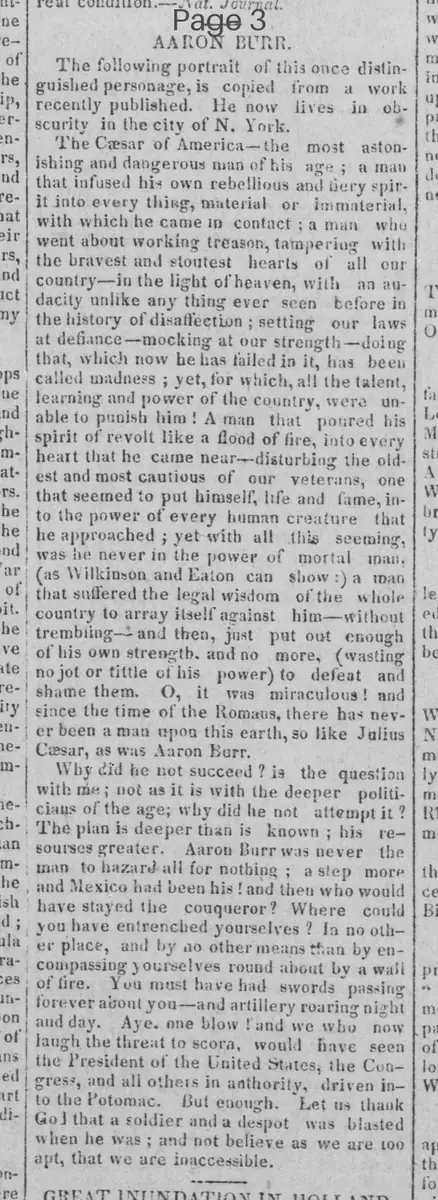
AARON BURR.
The following portrait of this once distinguished personage, is copied from a work recently published. He now lives in obscurity in the city of N. York.
The Caesar of America—the most astonishing and dangerous man of his age; a man that infused his own rebellious and fiery spirit into every thing, material or immaterial, with which he came in contact; a man who went about working treason, tampering with the bravest and stoutest hearts of all our country—in the light of heaven, with an audacity unlike any thing ever seen before in the history of disaffection; setting our laws at defiance—mocking at our strength—doing that, which now he has failed in it, has been called madness; yet, for which, all the talent, learning and power of the country, were unable to punish him! A man that poured his spirit of revolt like a flood of fire, into every heart that he came near—disturbing the oldest and most cautious of our veterans, one that seemed to put himself, life and fame, into the power of every human creature that he approached; yet with all this seeming, was he never in the power of mortal man, (as Wilkinson and Eaton can show:) a man that suffered the legal wisdom of the whole country to array itself against him—without trembling—and then, just put out enough of his own strength, and no more, (wasting no jot or tittle of his power) to defeat and shame them. O, it was miraculous! and since the time of the Romans, there has never been a man upon this earth, so like Julius Caesar, as was Aaron Burr.
Why did he not succeed? is the question with me; not as it is with the deeper politicians of the age; why did he not attempt it? The plan is deeper than is known; his resources greater. Aaron Burr was never the man to hazard all for nothing; a step more and Mexico had been his! and then who would have stayed the conqueror? Where could you have entrenched yourselves? In no other place, and by no other means than by encompassing yourselves round about by a wall of fire. You must have had swords passing forever about you—and artillery roaring night and day. Aye, one blow! and we who now laugh the threat to scorn, would have seen the President of the United States, the Congress, and all others in authority, driven into the Potomac. But enough. Let us thank God that a soldier and a despot was blasted when he was; and not believe as we are too apt, that we are inaccessible.
The following portrait of this once distinguished personage, is copied from a work recently published. He now lives in obscurity in the city of N. York.
The Caesar of America—the most astonishing and dangerous man of his age; a man that infused his own rebellious and fiery spirit into every thing, material or immaterial, with which he came in contact; a man who went about working treason, tampering with the bravest and stoutest hearts of all our country—in the light of heaven, with an audacity unlike any thing ever seen before in the history of disaffection; setting our laws at defiance—mocking at our strength—doing that, which now he has failed in it, has been called madness; yet, for which, all the talent, learning and power of the country, were unable to punish him! A man that poured his spirit of revolt like a flood of fire, into every heart that he came near—disturbing the oldest and most cautious of our veterans, one that seemed to put himself, life and fame, into the power of every human creature that he approached; yet with all this seeming, was he never in the power of mortal man, (as Wilkinson and Eaton can show:) a man that suffered the legal wisdom of the whole country to array itself against him—without trembling—and then, just put out enough of his own strength, and no more, (wasting no jot or tittle of his power) to defeat and shame them. O, it was miraculous! and since the time of the Romans, there has never been a man upon this earth, so like Julius Caesar, as was Aaron Burr.
Why did he not succeed? is the question with me; not as it is with the deeper politicians of the age; why did he not attempt it? The plan is deeper than is known; his resources greater. Aaron Burr was never the man to hazard all for nothing; a step more and Mexico had been his! and then who would have stayed the conqueror? Where could you have entrenched yourselves? In no other place, and by no other means than by encompassing yourselves round about by a wall of fire. You must have had swords passing forever about you—and artillery roaring night and day. Aye, one blow! and we who now laugh the threat to scorn, would have seen the President of the United States, the Congress, and all others in authority, driven into the Potomac. But enough. Let us thank God that a soldier and a despot was blasted when he was; and not believe as we are too apt, that we are inaccessible.
What sub-type of article is it?
Biography
Historical Event
Crime Story
What themes does it cover?
Betrayal
Crime Punishment
Fortune Reversal
What keywords are associated?
Aaron Burr
Treason
Rebellion
Caesar Comparison
Political Conspiracy
What entities or persons were involved?
Aaron Burr
Wilkinson
Eaton
Julius Caesar
Where did it happen?
City Of N. York
Story Details
Key Persons
Aaron Burr
Wilkinson
Eaton
Julius Caesar
Location
City Of N. York
Story Details
Portrait of Aaron Burr as a treasonous, Caesar-like figure who evaded punishment despite plotting rebellion; speculates on his deeper plans for Mexico and U.S. conquest, now in obscurity.