Thank you for visiting SNEWPapers!
Sign up free
The Alexandria Herald
Alexandria, Virginia
What is this article about?
Thomas T. Barr announces his 1816 candidacy against Henry Clay in Kentucky's Fayette-Jessamine-Woodford district, opposing Clay's support for the Bank and Compensation bills as unconstitutional, expedient doctrines threatening liberties, and dangerous precedents.
Clipping
OCR Quality
Full Text
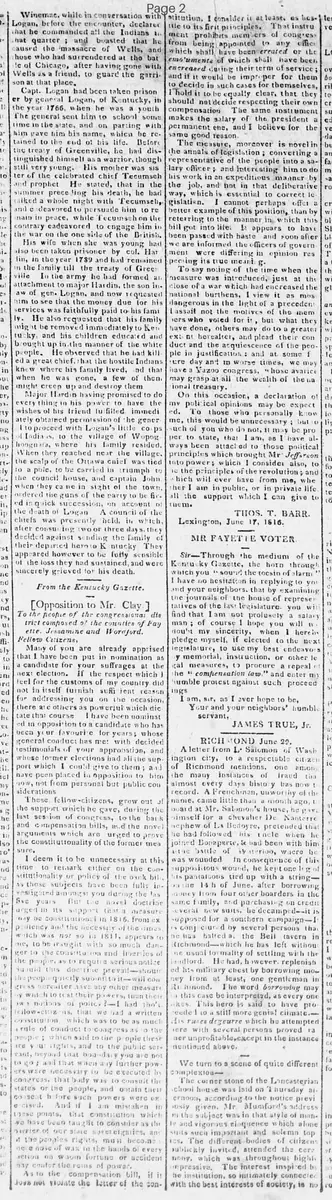
[Opposition to Mr. Clay.]
To the people of the congressional district composed of the counties of Fayette, Jessamine and Woodford.
Fellow Citizens,
Many of you are already apprised that I have been put in nomination as a candidate for your suffrages at the next election. If the respect which I feel for the customs of my country did not in itself furnish sufficient reason for addressing you on the occasion, there are others as powerful which dictate that course. I have been nominated in opposition to a candidate who has been your favorite for years; whose general conduct has met with decided testimonials of your approbation, and whose former elections had all the support which I could give to them; and have been placed in opposition to him now, not from personal but public considerations.
These, fellow-citizens, grow out of the support which he gave, during the last session of congress, to the bank and compensation bills, and the novel arguments which are urged to prove the constitutionality of the former measure.
I deem it to be unnecessary at this time to remark either on the constitutionality or policy of the Bank bill, as those subjects have been fully investigated amongst you during the last five years. But the novel doctrine urged in its support that a measure may be Constitutional in 1816, from expediency and the necessity of the times which was not so in 1811, appears to me, to be fraught with so much danger to the constitution and liberties of the people, as to require serious notice. Should this doctrine prevail—should the people quietly submit to it—will congress hereafter adopt any other measure whereby to test their powers, than their own notions of policy?—I had thought fellow-citizens, that we had a written constitution which was to be as much the rule of conduct to congress as to the people; which said to the people these are your undoubted rights, and to the public servants, beyond that boundary you are not to go; and that when any further powers were necessary to be exercised by congress, that body was to consult the states or the people, and obtain their consent before such powers were to be exercised. And if I am mistaken in these points, that constitution which we have been taught to consider as the barrier of our state sovereignties, and the peoples rights, must become a nose of wax in the hands of every person on whom fortune or accident may confer the reins of power.
As to the compensation bill, if it does not violate the letter of the constitution, I consider it at least, as hostile to its first principles. That instrument prohibits members of congress from being appointed to any office which shall have been created or the emoluments of which shall have been increased during their term of service; and if it would be improper for them to decide in such cases for themselves, I hold it to be equally clear, that they should not decide respecting their own compensation. The same instrument makes the salary of the president a permanent one, and I believe for the same good reason.
The measure, moreover is novel in the annals of legislation; converting a representative of the people into a salary officer; and interesting him to do his work in an expeditious manner by the job, and not in that deliberative way, which is essential to correct legislation. I cannot perhaps offer a better example of this position, than by referring to the manner in which this bill got into life: It appears to have been passed with haste and soon after we are informed the officers of government were differing in opinion respecting its true meaning.
To say nothing of the time when the measure was introduced, just at the close of a war which had increased the national burdens, I view it as most dangerous in the light of a precedent. I assail not the motives of the members who voted for it, but what they have done, others may do to a greater extent hereafter, and plead their conduct and the acquiescence of the people in justification: and at some day and in worse times, we may have a Yazoo congress, whose avarice may grasp at all the wealth of the national treasury.
On this occasion, a declaration of my political opinions may be expected. To those who personally know me, this would be unnecessary; but to such of you who do not, it may be proper to state, that I am, as I have always been attached to those political principles which brought Mr. Jefferson into power; which I consider also, to be the principles of the revolution; and which will ever have from me, whether I am in public, or in private life, all the support which I can give to them.
THOS. T. BARR.
Lexington, June 17, 1816.
What sub-type of article is it?
What themes does it cover?
What keywords are associated?
What entities or persons were involved?
Letter to Editor Details
Author
Thos. T. Barr.
Recipient
To The People Of The Congressional District Composed Of The Counties Of Fayette, Jessamine And Woodford.
Main Argument
thomas t. barr opposes henry clay's reelection due to clay's support for the unconstitutional bank bill based on expedient doctrines and the self-interested compensation bill, which sets dangerous precedents threatening constitutional liberties and promoting hasty, corrupt legislation.
Notable Details