Thank you for visiting SNEWPapers!
Sign up free
Gazette Of The United States
New York, New York County, New York
What is this article about?
In the U.S. House of Representatives on January 10, members debated resolutions to loan balances due from the United States to states, focusing on debtor/creditor status, commissioners' authority, and amendments to protect debtor states. Debate adjourned to the next day.
Clipping
OCR Quality
Full Text
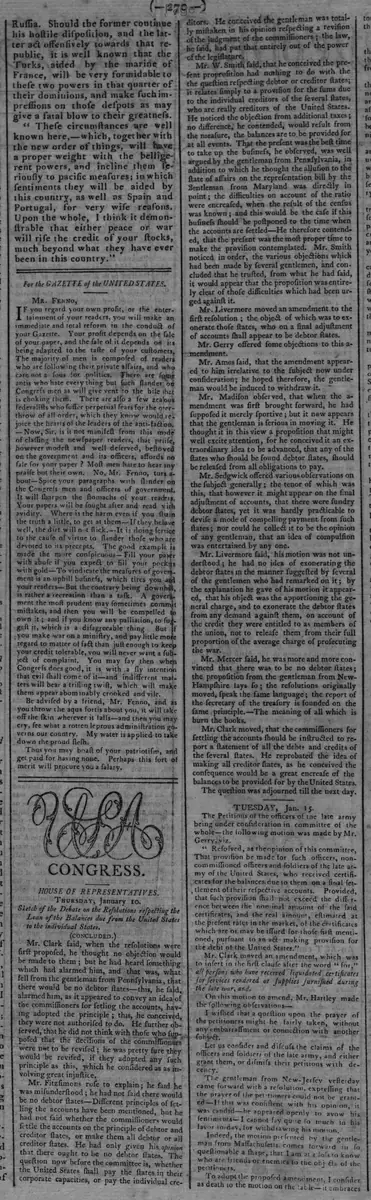
THURSDAY, January 10.
Sketch of the Debate on the Resolutions respecting the Loan of the Balances due from the United States to the individual States.
(CONCLUDED.)
Mr. Clark said, when the resolutions were first proposed, he thought no objection would be made to them; but he had heard something which had alarmed him, and that was, what fell from the gentleman from Pennsylvania, that there would be no debtor states—this, he said, alarmed him, as it appeared to convey an idea of the commissioners for settling the accounts, having adopted the principle; this, he conceived, they were not authorized to do. He further observed, that he did not think with those who supposed that the decisions of the commissioners were not to be revised; he was pretty sure they would be revised, if they adopted any such principle as this, which he considered as one involving great injustice.
Mr. Fitzsimons rose to explain; he said he was misunderstood; he had not said there would be no debtor states—Different principles of settling the accounts have been mentioned, but he had not said whether the commissioners would settle the accounts on the principle of debtor and creditor states, or make them all debtor or all creditor states. He had only given his opinion that there ought to be no debtor states. The question now before the committee is, whether the United States shall pay the states in their corporate capacities, or pay the individual creditors. He conceived the gentleman was totally mistaken in his opinion respecting a revision of the judgment of the commissioners; the law, he said, had put that entirely out of the power of the legislature.
Mr. W. Smith said, that he conceived the present proposition had nothing to do with the question respecting debtor or creditor states; it relates simply to a provision for the sums due to the individual creditors of the several states, who are really creditors of the United States. He noticed the objection from additional taxes; no difference, he contended, would result from the measure, the balances are to be provided for at all events. That the present was the best time to take up the business, he observed, was well argued by the gentleman from Pennsylvania, in addition to which he thought the allusion to the state of affairs on the representation bill by the gentleman from Maryland was directly in point; the difficulties on account of the ratio were increased, when the result of the census was known; and this would be the case if this business should be postponed to the time when the accounts are settled—He therefore contended, that the present was the most proper time to make the provision contemplated. Mr. Smith noticed in order, the various objections which had been made by several gentlemen, and concluded that he trusted, from what he had said, it would appear that the proposition was entirely clear of those difficulties which had been urged against it.
Mr. Livermore moved an amendment to the first resolution; the object of which was to exonerate those states, who on a final adjustment of accounts shall appear to be debtor states.
Mr. Gerry offered some objections to this amendment.
Mr. Ames said, that the amendment appeared to him irrelevant to the subject now under consideration; he hoped therefore, the gentleman would be induced to withdraw it.
Mr. Madison observed, that when the amendment was first brought forward, he had supposed it merely sportive; but it now appears that the gentleman is serious in moving it. He thought it in this view a proposition that might well excite attention, for he conceived it an extraordinary idea to be advanced, that any of the states who should be found debtor states, should be released from all obligations to pay.
Mr. Sedgwick offered various observations on the subject generally; the tenor of which was this, that however it might appear on the final adjustment of accounts, that there were sundry debtor states, yet it was hardly practicable to devise a mode of compelling payment from such states; nor could he collect it to be the opinion of any gentleman, that an idea of compulsion was entertained by any one.
Mr. Livermore said, his motion was not understood; he had no idea of exonerating the debtor states in the manner suggested by several of the gentlemen who had remarked on it; by the explanation he gave of his motion it appeared, that his object was the apportioning the general charge, and to exonerate the debtor states from any demand against them, on account of the credit they were entitled to as members of the union, not to release them from their full proportion of the average charge of prosecuting the war.
Mr. Mercer said, he was more and more convinced that there was to be no debtor states; the proposition from the gentleman from New-Hampshire lays open; the resolutions originally moved, speak the same language; the report of the secretary of the treasury is founded on the same principle.—The meaning of all which is burn the books.
Mr. Clark moved, that the commissioners for settling the accounts should be instructed to report a statement of all the debts and credits of the several states. He reprobated the idea of making all creditor states, as he conceived the consequence would be a great increase of the balances to be provided for by the United States.
The question was adjourned till the next day.
What sub-type of article is it?
What keywords are associated?
What entities or persons were involved?
Where did it happen?
Domestic News Details
Primary Location
House Of Representatives
Event Date
Thursday, January 10.
Key Persons
Outcome
the question was adjourned till the next day.
Event Details
Debate on resolutions respecting the loan of balances due from the United States to individual states, including discussions on debtor and creditor states, revisions of commissioners' decisions, amendments to exonerate debtor states, and instructions for reporting debts and credits.