Thank you for visiting SNEWPapers!
Sign up free
The Daily Telegram
Clarksburg, Harrison County, West Virginia
What is this article about?
On December 10, 1913, a 'Committee of One Thousand' from the Anti-Saloon League marched to the U.S. Capitol in Washington, D.C., presenting a constitutional amendment bill to prohibit intoxicating liquors. Temperance leaders addressed the crowd and Congress, pledging support amid enthusiastic gatherings.
Clipping
OCR Quality
Full Text
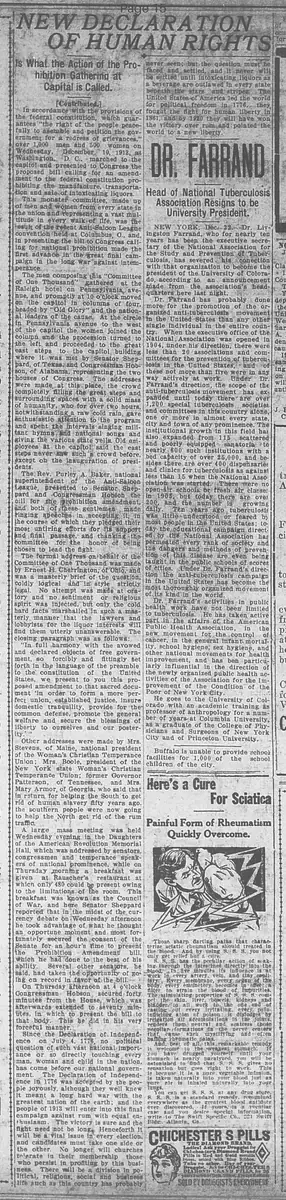
What the Action of the Prohibition Gathering at Capital is Called.
In accordance with the provisions of the federal constitution, which guarantees "the right of the people peaceably to assemble and petition the government for a redress of grievances," over 1,000 men and 500 women on Wednesday, December 10, 1913, at Washington, D. C., marched to the capitol and presented to Congress the proposed bill calling for an amendment to the federal constitution prohibiting the manufacture, transportation and sale of intoxicating liquors.
This monster committee, made up of men and women from every state in the union and representing a vast multitude in every walk of life, was the result of the recent Anti-Saloon League convention held at Columbus, O., and, in presenting the bill to Congress calling for national prohibition made the first advance in the great final campaign in the long war against intemperance.
The men composing this "Committee of One Thousand" gathered at the Raleigh hotel on Pennsylvania avenue, and promptly at 10 o'clock moved on the capitol in columns of four, headed by "Old Glory" and the national leaders of the cause. At the circle in Pennsylvania avenue to the west of the capitol the women joined the column and the procession turned to the left, and proceeded to the great east steps to the capitol building where it was met by Senator Sheppard, of Texas, and Congressman Hobson, of Alabama, representing the two houses of Congress. The addresses were made at this place the crowd completely filling the great steps and surrounding spaces with a solid mass of humanity, who for over two hours, notwithstanding a raw cold rain, gave enthusiastic attention to the program and spent the intervals singing militant hymns and national songs and giving the various state yells. Old employees at the capitol said the east steps never saw such a crowd before, except on the inauguration of presidents.
The Rev. Purley A. Baker, national superintendent of the Anti-Saloon League, presented to Senator Sheppard and Congressman Hobson the bill for the prohibition amendment, and both of these gentlemen made ringing speeches in accepting it, in the course of which they pledged their most untiring efforts for its support and final passage, and thanking the committee for the honor of being chosen to lead the fight.
The formal address on behalf of the Committee of One Thousand was made by Ernest H. Cherrington, of Ohio, and was a masterly brief of the question, coldly logical and in style strictly legal. No attempt was made at oratory and no sentiment or religious spirit was injected, but only the cold hard facts marshalled in such a masterly manner that the lawyers and lobbyists for the liquor interests will find them utterly unanswerable. The closing paragraph was as follows:
"In full harmony with the avowed and declared objects of free government, so forcibly and fittingly set forth in the language of the preamble to the constitution of the United States, we present to you this proposed amendment to that sacred document 'in order to form a more perfect union, establish justice, insure domestic tranquility, provide for the common defense, promote the general welfare and secure the blessings of liberty to ourselves and our posterity.'"
Other addresses were made by Mrs. Stevens, of Maine, national president of the Woman's Christian Temperance Union; Mrs. Boole, president of the New York state Woman's Christian Temperance Union; former Governor Patterson, of Tennessee, and Mrs. Mary Armor, of Georgia, who said that in return for helping the South to get rid of human slavery fifty years ago, the southern people were now going to help the North get rid of the rum traffic.
A large mass meeting was held Wednesday evening in the Daughters of the American Revolution Memorial Hall, which was addressed by senators, congressmen and temperance speakers of national prominence, while on Thursday morning a breakfast was given at Rauscher's restaurant at which only 480 could be present owing to the limitations of the room. This breakfast was known as the Council of War, and here Senator Sheppard reported that in the midst of the currency debate on Wednesday afternoon he took advantage of what he thought an opportune moment and most fortunately secured the consent of the Senate for an hour's time to present the Prohibition Amendment bill, which he had done to the best of his ability. Several other senators, he said, had taken the opportunity of going on record in favor of the bill.
On Thursday afternoon at 4 o'clock Congressman Hobson secured forty minutes from the House, which was afterwards extended to seventy minutes, in which to present the bill to that body. This he did in his very forcible manner.
Since the Declaration of Independence on July 4, 1776, no political question of such vast national importance or so directly touching every man, woman and child in the nation, has come before our national government. The Declaration of Independence in 1776 was accepted by the people joyously, although they well knew it meant a long hard war with the greatest nation of the earth; and the people of 1913 will enter into this final campaign against rum with equal enthusiasm. The victory is sure and the fight need not be long. Henceforth it will be a vital issue in every election, and candidates must take one side or the other. No longer will churches tolerate in their membership those who persist in profiting by this business. There will be a division in political, religious, social and business life such as this country has probably never seen; but the question must be faced and settled, and it never will be settled until intoxicating liquors as a beverage are outlawed in every state beneath the stars and stripes. The United States of America led the world for political freedom in 1776,—they fought the fight for human liberty in 1861, and by 1920 they will have won the victory over rum and pointed the world to a new liberty.
What sub-type of article is it?
What themes does it cover?
What keywords are associated?
What entities or persons were involved?
Where did it happen?
Story Details
Key Persons
Location
Washington, D. C.
Event Date
Wednesday, December 10, 1913
Story Details
Over 1,000 men and 500 women from the Anti-Saloon League marched to the U.S. Capitol to present a bill for a constitutional amendment prohibiting the manufacture, transportation, and sale of intoxicating liquors. Leaders including Rev. Purley A. Baker and Ernest H. Cherrington delivered addresses, with Senator Sheppard and Congressman Hobson accepting the bill and pledging support. Additional meetings and presentations followed, marking a key advance in the national prohibition campaign.