Thank you for visiting SNEWPapers!
Sign up free
Editorial
December 30, 1829
Phenix Gazette
Alexandria, Virginia
What is this article about?
Satirical editorial from Boston Courier mocks Dr. Johnson's dictionary definition of Congress as a meeting to settle affairs, instead portraying it as a heterogeneous group of idle members focused on personal routines rather than business, explaining congressional inefficiency through humor.
Clipping
OCR Quality
98%
Excellent
Full Text
Washington, Dec. 14.
UNWRITTEN POLITICS.
Congress—A meeting for the settlement of affairs, &c.
Johnson.
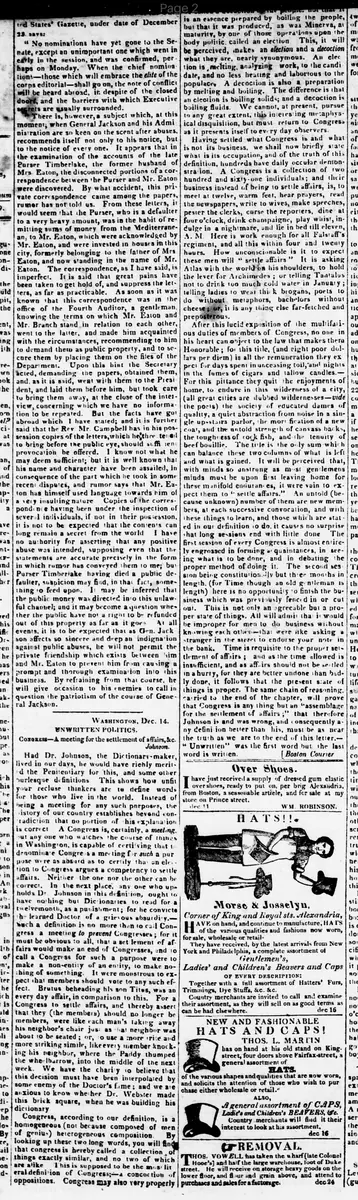
Had Dr. Johnson, the Dictionary-maker, lived in our days, he would have richly merited the Penitentiary for this, and some other burlesque definitions. This shows how unfit your recluse thinkers are to define words for those who live in the world. Instead of being a meeting for any such purposes, the history of our country establishes beyond contradiction that no portion of his explanation is correct. A Congress is, certainly, a meeting, but any one who watches the course of things in Washington, is capable of certifying that to denominate Congress a meeting for such a purpose were as absurd as to certify that an election to Congress argues a competency to settle affairs. Neither the one nor the other can be correct. In the next place, any one who upholds Dr. Johnson in this definition, ought to have nothing but Dictionaries to read for a twelvemonth, as a punishment; for he convicts the learned Doctor of a grievous absurdity.—Such a definition is no more than to call Congress a meeting to prevent Congresses; for it must be obvious to all, that a settlement of affairs would make an end of Congresses, and to call a Congress for such a purpose were to make a non-entity of an entity, to make nothing of something. It were monstrous to expect that members should vote to any such effect. Brutus beheading his son Titus, was an every day affair, in comparison to this. For a Congress to settle affairs, and thereby assert that they (the members) should no longer be members, were like each man's taking away his neighbor's chair just as that neighbor was about to be seated; or, to use a more sprightly and more striking simile, like every member knocking his neighbor, where the Paddy thumped the wheelbarrow, into the middle of the next week. We have the charity to believe that this decision must have been interpolated by some enemy of the Doctor's fame: and we are anxious to know whether Dr. Webster made this brick square, when he was building his dictionary.
Congress, according to our definition, is a homogeneous (not because composed of men of genius) heterogeneous composition. By looking up these two long words, you will find that congress is hereby called a collection of things exactly similar, and no two of which are alike. This is supposed to be the most literal definition of Congress; a concoction of oppositions. Congress may also very properly
is an essence prepared by boiling the people, but that it was produced, as was Minerva, at maturity, by one of those operations upon the body politic, called an election. This, it will be perceived, makes an election and a decoction what they are, nearly synonymous. An election is melting, analyzing work, to the candidate, and no less beating and laborious to the populace. A decoction is also a preparation by melting and boiling. The difference is that an election is boiling solids; and a decoction is boiling fluids. We cannot, at present, pursue to any great extent, this interesting metaphorical disquisition, but must return to Congress as it presents itself to every day observers.
Having settled what Congress is and what is not its business, we shall now briefly state what is its occupation, and of the truth of this definition, hundreds have daily ocular demonstration. A Congress is a collection of two hundred and sixty-one individuals; and their business instead of being to settle affairs, is, to meet at twelve, warm feet, hear prayers, read the newspapers, write to wives, make speeches, pester the clerks, curse the reporters, dine at four o'clock, drink champagne, play whist, indulge in a nightmare, and lie in bed till eleven, A. M. Here is work enough for all Falstaff's regiment, and all this within four and twenty hours. How unconscionable is it to expect these men will settle affairs? It is asking Atlas with the world on his shoulders, to hold the lever for Archimedes; or telling Tantalus not to drink too much cold water in January; telling ladies to wear thick brogans, poets to do without metaphors, bachelors without cheese; or, it is any thing else far-fetched and preposterous.
After this lucid exposition of the multifarious duties of members of Congress, no one in his heart can object to the law that makes them Honorable: for this title, (and eight poor dollars per diem) is all the remuneration they expect for days spent in unceasing toil, and nights in the fumes of cigars and tallow candles.—For this pittance they quit the enjoyments of home, to endure in this wilderness of a city, (all great cities are dubbed wildernesses—vide the poets) the society of educated dames of quality, a quiet abstraction from noise in a single up-stairs parlor, the mortification of a new coat, and the untold strength of canvass backs, the toughness of rock fish, and the tenuity of beef bouilli. The title is the only sum which can balance these two columns of what is left and what is gained. It will be perceived that, with minds so unstrung as gentlemen's minds must be upon first leaving home for these manifold endurances, it were vain to expect them to 'settle affairs.'
An untold (the cause unknown) number of them are new members, at each successive convocation, and with these things to learn, and those which are stated in our definition to do, it causes no surprise that long sessions end with little done. The first session of every Congress is almost entirely engrossed in forming acquaintances, in seeing what is to be done, and in debating the proper method of doing it. The second session being constitutionally but three months in length, (for Time though an old gentleman is brief) here is no opportunity to finish the business which was previously fenced in or cut out. This is not only an agreeable but a proper state of things. All will admit that it would be improper for men to do business without knowing each other—that were like asking a stranger in the street to endorse your note in the bank. Time is requisite to the proper settlement of affairs: and as the time allowed is insufficient, and as affairs should not be settled in a hurry, for they are better undone than badly done, it follows that the present state of things is proper. The same chain of reasoning, carried to the end of the chapter, will prove that Congress is any thing but an 'assemblage for the settlement of affairs:' that therefore Johnson is and was wrong, and consequently any definition better than his, must be as near the truth as we are to the end of this letter.—
'Unwritten' was the first word but the last word is written.
Boston Courier.
UNWRITTEN POLITICS.
Congress—A meeting for the settlement of affairs, &c.
Johnson.
Had Dr. Johnson, the Dictionary-maker, lived in our days, he would have richly merited the Penitentiary for this, and some other burlesque definitions. This shows how unfit your recluse thinkers are to define words for those who live in the world. Instead of being a meeting for any such purposes, the history of our country establishes beyond contradiction that no portion of his explanation is correct. A Congress is, certainly, a meeting, but any one who watches the course of things in Washington, is capable of certifying that to denominate Congress a meeting for such a purpose were as absurd as to certify that an election to Congress argues a competency to settle affairs. Neither the one nor the other can be correct. In the next place, any one who upholds Dr. Johnson in this definition, ought to have nothing but Dictionaries to read for a twelvemonth, as a punishment; for he convicts the learned Doctor of a grievous absurdity.—Such a definition is no more than to call Congress a meeting to prevent Congresses; for it must be obvious to all, that a settlement of affairs would make an end of Congresses, and to call a Congress for such a purpose were to make a non-entity of an entity, to make nothing of something. It were monstrous to expect that members should vote to any such effect. Brutus beheading his son Titus, was an every day affair, in comparison to this. For a Congress to settle affairs, and thereby assert that they (the members) should no longer be members, were like each man's taking away his neighbor's chair just as that neighbor was about to be seated; or, to use a more sprightly and more striking simile, like every member knocking his neighbor, where the Paddy thumped the wheelbarrow, into the middle of the next week. We have the charity to believe that this decision must have been interpolated by some enemy of the Doctor's fame: and we are anxious to know whether Dr. Webster made this brick square, when he was building his dictionary.
Congress, according to our definition, is a homogeneous (not because composed of men of genius) heterogeneous composition. By looking up these two long words, you will find that congress is hereby called a collection of things exactly similar, and no two of which are alike. This is supposed to be the most literal definition of Congress; a concoction of oppositions. Congress may also very properly
is an essence prepared by boiling the people, but that it was produced, as was Minerva, at maturity, by one of those operations upon the body politic, called an election. This, it will be perceived, makes an election and a decoction what they are, nearly synonymous. An election is melting, analyzing work, to the candidate, and no less beating and laborious to the populace. A decoction is also a preparation by melting and boiling. The difference is that an election is boiling solids; and a decoction is boiling fluids. We cannot, at present, pursue to any great extent, this interesting metaphorical disquisition, but must return to Congress as it presents itself to every day observers.
Having settled what Congress is and what is not its business, we shall now briefly state what is its occupation, and of the truth of this definition, hundreds have daily ocular demonstration. A Congress is a collection of two hundred and sixty-one individuals; and their business instead of being to settle affairs, is, to meet at twelve, warm feet, hear prayers, read the newspapers, write to wives, make speeches, pester the clerks, curse the reporters, dine at four o'clock, drink champagne, play whist, indulge in a nightmare, and lie in bed till eleven, A. M. Here is work enough for all Falstaff's regiment, and all this within four and twenty hours. How unconscionable is it to expect these men will settle affairs? It is asking Atlas with the world on his shoulders, to hold the lever for Archimedes; or telling Tantalus not to drink too much cold water in January; telling ladies to wear thick brogans, poets to do without metaphors, bachelors without cheese; or, it is any thing else far-fetched and preposterous.
After this lucid exposition of the multifarious duties of members of Congress, no one in his heart can object to the law that makes them Honorable: for this title, (and eight poor dollars per diem) is all the remuneration they expect for days spent in unceasing toil, and nights in the fumes of cigars and tallow candles.—For this pittance they quit the enjoyments of home, to endure in this wilderness of a city, (all great cities are dubbed wildernesses—vide the poets) the society of educated dames of quality, a quiet abstraction from noise in a single up-stairs parlor, the mortification of a new coat, and the untold strength of canvass backs, the toughness of rock fish, and the tenuity of beef bouilli. The title is the only sum which can balance these two columns of what is left and what is gained. It will be perceived that, with minds so unstrung as gentlemen's minds must be upon first leaving home for these manifold endurances, it were vain to expect them to 'settle affairs.'
An untold (the cause unknown) number of them are new members, at each successive convocation, and with these things to learn, and those which are stated in our definition to do, it causes no surprise that long sessions end with little done. The first session of every Congress is almost entirely engrossed in forming acquaintances, in seeing what is to be done, and in debating the proper method of doing it. The second session being constitutionally but three months in length, (for Time though an old gentleman is brief) here is no opportunity to finish the business which was previously fenced in or cut out. This is not only an agreeable but a proper state of things. All will admit that it would be improper for men to do business without knowing each other—that were like asking a stranger in the street to endorse your note in the bank. Time is requisite to the proper settlement of affairs: and as the time allowed is insufficient, and as affairs should not be settled in a hurry, for they are better undone than badly done, it follows that the present state of things is proper. The same chain of reasoning, carried to the end of the chapter, will prove that Congress is any thing but an 'assemblage for the settlement of affairs:' that therefore Johnson is and was wrong, and consequently any definition better than his, must be as near the truth as we are to the end of this letter.—
'Unwritten' was the first word but the last word is written.
Boston Courier.
What sub-type of article is it?
Satire
Partisan Politics
What keywords are associated?
Congress Definition
Satire
Dr Johnson
Political Inefficiency
Washington Congress
Honorable Members
Elections Decoction
What entities or persons were involved?
Dr. Johnson
Dr. Webster
Congress
Members Of Congress
Editorial Details
Primary Topic
Satirical Redefinition Of Congress
Stance / Tone
Satirical Mockery Of Congressional Inefficiency
Key Figures
Dr. Johnson
Dr. Webster
Congress
Members Of Congress
Key Arguments
Dr. Johnson's Definition Of Congress As A Meeting To Settle Affairs Is Absurd And Incorrect
Congress Is A Heterogeneous Collection Of Dissimilar Individuals
True Business Of Congress Members Is Daily Routines Like Reading Newspapers, Dining, And Socializing, Not Settling Affairs
Members Endure Hardships Away From Home For Little Pay And The Title 'Honorable'
New Members And Short Sessions Prevent Efficient Work, Which Is Proper To Avoid Hasty Decisions