Thank you for visiting SNEWPapers!
Sign up free
Windham County Observer
Putnam, Windham County, Connecticut
What is this article about?
Historical account of Pomfret, CT's militia response to the 1775 Revolution alarm, Captain Ingalls' company marching to Boston, local preparations like powder house and saltpeter, and overall contributions to the war effort.
Clipping
OCR Quality
Full Text
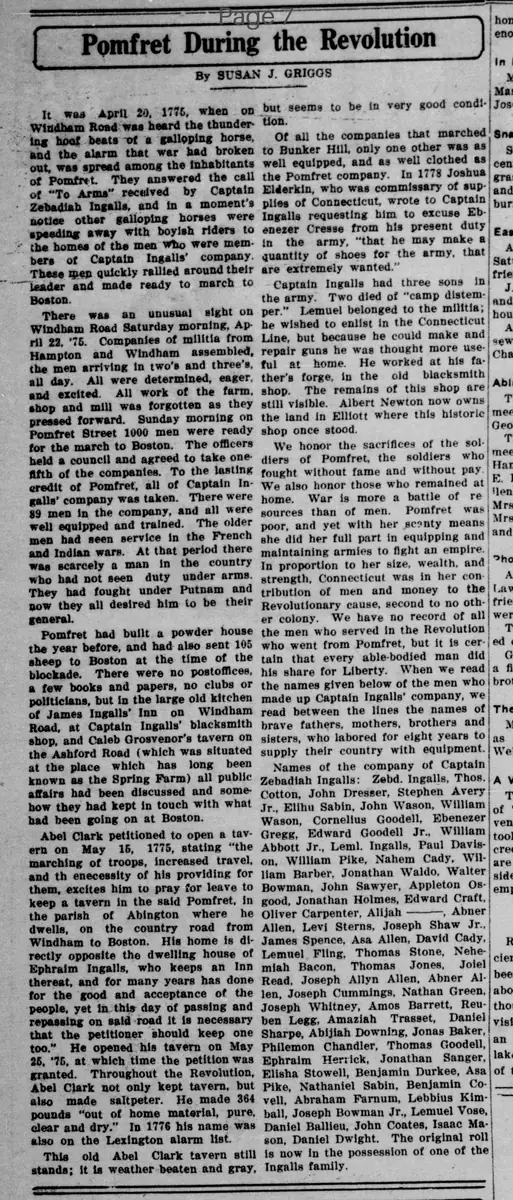
By SUSAN J. GRIGGS
It was April 20, 1776, when on Windham Road was heard the thundering hoof beats of a galloping horse, and the alarm that war had broken out, was spread among the inhabitants of Pomfret. They answered the call of "To Arms" received by Captain Zebadiah Ingalls, and in a moment's notice other galloping horses were speeding away with boyish riders to the homes of the men who were members of Captain Ingalls' company. These men quickly rallied around their leader and made ready to march to Boston.
There was an unusual sight on Windham Road Saturday morning, April 22, '75. Companies of militia from Hampton and Windham assembled, the men arriving in two's and three's, all day. All were determined, eager, and excited. All work of the farm, shop and mill was forgotten as they pressed forward. Sunday morning on Pomfret Street 1000 men were ready for the march to Boston. The officers held a council and agreed to take one-fifth of the companies. To the lasting credit of Pomfret, all of Captain Ingalls' company was taken. There were 89 men in the company, and all were well equipped and trained. The older men had seen service in the French and Indian wars. At that period there was scarcely a man in the country who had not seen duty under arms. They had fought under Putnam and now they all desired him to be their general.
Pomfret had built a powder house the year before, and had also sent 105 sheep to Boston at the time of the blockade. There were no postoffices, a few books and papers, no clubs or politicians, but in the large old kitchen of James Ingalls' Inn on Windham Road, at Captain Ingalls' blacksmith shop, and Caleb Grosvenor's tavern on the Ashford Road (which was situated at the place which has long been known as the Spring Farm) all public affairs had been discussed and somehow they had kept in touch with what had been going on at Boston.
Abel Clark petitioned to open a tavern on May 16, 1775, stating "the marching of troops, increased travel, and the necessity of his providing for them, excites him to pray for leave to keep a tavern in the said Pomfret, in the parish of Abington where he dwells, on the country road from Windham to Boston. His home is directly opposite the dwelling house of Ephraim Ingalls, who keeps an Inn thereat, and for many years has done for the good and acceptance of the people, yet in this day of passing and repassing on said road it is necessary that the petitioner should keep one too." He opened his tavern on May 26, '75, at which time the petition was granted. Throughout the Revolution, Abel Clark not only kept tavern, but also made saltpeter. He made 364 pounds "out of home material, pure, clear and dry." In 1776 his name was also on the Lexington alarm list.
This old Abel Clark tavern still stands; it is weather beaten and gray, but seems to be in very good condition.
Of all the companies that marched to Bunker Hill, only one other was as well equipped, and as well clothed as the Pomfret company. In 1778 Joshua Elderkin, who was commissary of supplies of Connecticut, wrote to Captain Ingalls requesting him to excuse Ebenezer Cresse from his present duty in the army, "that he may make a quantity of shoes for the army, that are extremely wanted."
Captain Ingalls had three sons in the army. Two died of "camp distemper." Lemuel belonged to the militia; he wished to enlist in the Connecticut Line, but because he could make and repair guns he was thought more useful at home. He worked at his father's forge, in the old blacksmith shop. The remains of this shop are still visible. Albert Newton now owns the land in Elliott where this historic shop once stood.
We honor the sacrifices of the soldiers of Pomfret, the soldiers who fought without fame and without pay. We also honor those who remained at home. War is more a battle of resources than of men. Pomfret was poor, and yet with her scanty means she did her full part in equipping and maintaining armies to fight an empire. In proportion to her size, wealth, and strength, Connecticut was in her contribution of men and money to the Revolutionary cause, second to no other colony. We have no record of all the men who served in the Revolution who went from Pomfret, but it is certain that every able-bodied man did his share for Liberty. When we read the names given below of the men who made up Captain Ingalls' company, we read between the lines the names of brave fathers, mothers, brothers and sisters, who labored for eight years to supply their country with equipment.
Names of the company of Captain Zebadiah Ingalls: Zebd. Ingalls, Thos. Cotton, John Dresser, Stephen Avery Jr., Elihu Sabin, John Wason, William Wason, Cornelius Goodell, Ebenezer Gregg, Edward Goodell Jr., William Abbott Jr., Leml. Ingalls, Paul Davison, William Pike, Nahem Cady, William Barber, Jonathan Waldo, Walter Bowman, John Sawyer, Appleton Osgood, Jonathan Holmes, Edward Craft, Oliver Carpenter, Alijah Abner Allen, Levi Sterns, Joseph Shaw Jr., James Spence, Asa Allen, David Cady, Lemuel Fling, Thomas Stone, Nehemiah Bacon, Thomas Jones, Joel Read, Joseph Allyn Allen, Abner Allen, Joseph Cummings, Nathan Green, Joseph Whitney, Amos Barrett, Reuben Legg, Amaziah Trasset, Daniel Sharpe, Abijiah Downing, Jonas Baker, Philemon Chandler, Thomas Goodell, Ephraim Herrick, Jonathan Sanger, Elisha Stowell, Benjamin Durkee, Asa Pike, Nathaniel Sabin, Benjamin Covell, Abraham Farnum, Lebbius Kimball, Joseph Bowman Jr., Lemuel Vose, Daniel Ballieu, John Coates, Isaac Mason, Daniel Dwight. The original roll is now in the possession of one of the Ingalls family.
What sub-type of article is it?
What themes does it cover?
What keywords are associated?
What entities or persons were involved?
Where did it happen?
Story Details
Key Persons
Location
Pomfret, Connecticut
Event Date
April 1775 1776
Story Details
In April 1775, Pomfret militia under Captain Zebadiah Ingalls responded to the alarm and marched to Boston, fully equipped. Local contributions included a powder house, sheep to Boston, and saltpeter production by Abel Clark, who also ran a tavern. The company fought at Bunker Hill; Ingalls' sons served, two dying of disease. Pomfret supported the Revolution proportionally to its size.