Thank you for visiting SNEWPapers!
Sign up free
Editorial
May 8, 1784
The New Hampshire Gazette And General Advertiser
Portsmouth, Exeter, Rockingham County, New Hampshire
What is this article about?
An unsigned essay by PHILOPAIDEIAS emphasizes the critical role of moral and religious education in youth development, stressing the need for virtuous instructors, daily prayer and Bible reading in schools, and progressive methods for teaching pronunciation, spelling, and motivation through competition and rewards.
Clipping
OCR Quality
98%
Excellent
Full Text
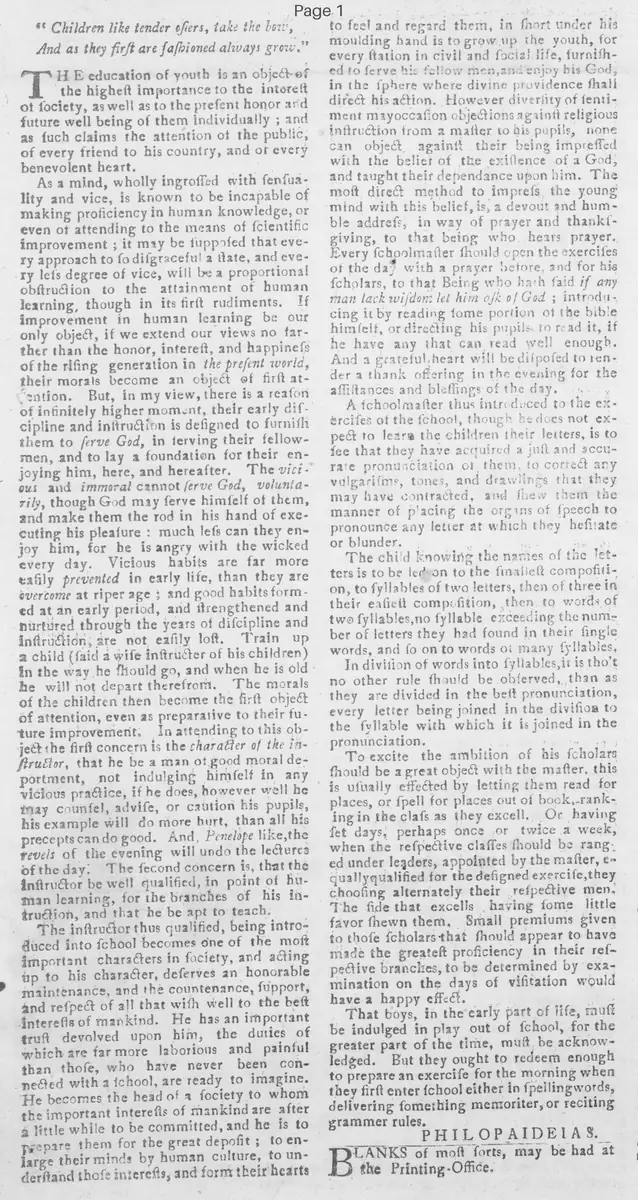
As children like tender osiers, take the form,
And as they first are fashioned always grow.
THE education of youth is an object of the highest importance to the interest of society, as well as to the present honor and future well being of them individually; and as such claims the attention of the public, of every friend to his country, and of every benevolent heart.
As a mind, wholly engrossed with sensuality and vice, is known to be incapable of making proficiency in human knowledge, or even of attending to the means of scientific improvement; it may be supposed that every approach to so disgraceful a state, and every less degree of vice, will be a proportional obstruction to the attainment of human learning, though in its first rudiments. If improvement in human learning be our only object, if we extend our views no farther than the honor, interest, and happiness of the rising generation in the present world, their morals become an object of first attention. But, in my view, there is a reason of infinitely higher moment, their early discipline and instruction is designed to furnish them to serve God, in serving their fellow-men, and to lay a foundation for their enjoying him, here, and hereafter. The vicious and immoral cannot serve God, voluntarily, though God may serve himself of them, and make them the rod in his hand of executing his pleasure: much less can they enjoy him, for he is angry with the wicked every day. Vicious habits are far more easily prevented in early life, than they are overcome at riper age; and good habits formed at an early period, and strengthened and nurtured through the years of discipline and instruction, are not easily lost. Train up a child (said a wise instructor of his children) in the way he should go, and when he is old he will not depart therefrom. The morals of the children then become the first object of attention, even as preparative to their future improvement. In attending to this object, the first concern is the character of the instructor, that he be a man of good moral deportment, not indulging himself in any vicious practice. If he does, however well he may counsel, advise, or caution his pupils, his example will do more hurt, than all his precepts can do good. And, Penelope like, the revels of the evening will undo the lectures of the day. The second concern is, that the Instructor be well qualified, in point of human learning, for the branches of his instruction, and that he be apt to teach.
The instructor thus qualified, being introduced into school becomes one of the most important characters in society, and acting up to his character, deserves an honorable maintenance, and the countenance, support, and respect of all that wish well to the best interests of mankind. He has an important trust devolved upon him, the duties of which are far more laborious and painful than those, who have never been connected with a school, are ready to imagine. He becomes the head of a society to whom a little while to be committed, and he is to enlarge their minds by human culture, to unfold them for the great deposit; to understand those interests, and form their hearts to feel and regard them. In short under his moulding hand is to grow up the youth, for every station in civil and social life, furnished to serve his fellow men, and enjoy his God, in the sphere where divine providence shall direct his action. However diversity of sentiment may occasion objections against religious instruction from a master to his pupils, none can object against their being impressed with the belief of the existence of a God, and taught their dependence upon him. The most direct method to impress the young mind with this belief, is, a devout and humble address, in way of prayer and thanksgiving, to that being who hears prayer. Every schoolmaster should open the exercises of the day with a prayer before, and for his scholars, to that Being who hath said if any man lack wisdom let him ask of God: introducing it by reading some portion of the bible himself, or directing his pupils to read it, if he have any that can read well enough. And a grateful heart will be disposed to render a thank offering in the evening for the assistances and blessings of the day.
A schoolmaster thus introduced to the exercises of the school, though he does not expect to learn the children their letters, is to see that they have acquired a just and accurate pronunciation of them, to correct any vulgarisms, tones, and drawlings that they may have contracted, and shew them the manner of placing the organs of speech to pronounce any letter at which they hesitate or blunder.
The child knowing the names of the letters is to be led on to the simplest composition, to syllables of two letters, then of three in their easiest composition, then to words of two syllables, no syllable exceeding the number of letters they had found in their single words, and so on to words of many syllables.
In division of words into syllables, it is thought no other rule should be observed, than as they are divided in the best pronunciation, every letter being joined in the division to the syllable with which it is joined in the pronunciation.
To excite the ambition of his scholars should be a great object with the master, this is usually effected by letting them read for places, or spell for places out of book--ranking in the class as they excel. Or having set days, perhaps once or twice a week, when the respective classes should be ranged under leaders, appointed by the master, equally qualified for the designed exercise, they choosing alternately their respective men. The side that excels having some little favor shewn them. Small premiums given to those scholars that should appear to have made the greatest proficiency in their respective branches, to be determined by examination on the days of visitation would have a happy effect.
That boys, in the early part of life, must be indulged in play out of school, for the greater part of the time, must be acknowledged. But they ought to redeem enough to prepare an exercise for the morning when they first enter school either in spelling words, delivering something memoriter, or reciting grammar rules.
By PHILOPAIDEIAS.
And as they first are fashioned always grow.
THE education of youth is an object of the highest importance to the interest of society, as well as to the present honor and future well being of them individually; and as such claims the attention of the public, of every friend to his country, and of every benevolent heart.
As a mind, wholly engrossed with sensuality and vice, is known to be incapable of making proficiency in human knowledge, or even of attending to the means of scientific improvement; it may be supposed that every approach to so disgraceful a state, and every less degree of vice, will be a proportional obstruction to the attainment of human learning, though in its first rudiments. If improvement in human learning be our only object, if we extend our views no farther than the honor, interest, and happiness of the rising generation in the present world, their morals become an object of first attention. But, in my view, there is a reason of infinitely higher moment, their early discipline and instruction is designed to furnish them to serve God, in serving their fellow-men, and to lay a foundation for their enjoying him, here, and hereafter. The vicious and immoral cannot serve God, voluntarily, though God may serve himself of them, and make them the rod in his hand of executing his pleasure: much less can they enjoy him, for he is angry with the wicked every day. Vicious habits are far more easily prevented in early life, than they are overcome at riper age; and good habits formed at an early period, and strengthened and nurtured through the years of discipline and instruction, are not easily lost. Train up a child (said a wise instructor of his children) in the way he should go, and when he is old he will not depart therefrom. The morals of the children then become the first object of attention, even as preparative to their future improvement. In attending to this object, the first concern is the character of the instructor, that he be a man of good moral deportment, not indulging himself in any vicious practice. If he does, however well he may counsel, advise, or caution his pupils, his example will do more hurt, than all his precepts can do good. And, Penelope like, the revels of the evening will undo the lectures of the day. The second concern is, that the Instructor be well qualified, in point of human learning, for the branches of his instruction, and that he be apt to teach.
The instructor thus qualified, being introduced into school becomes one of the most important characters in society, and acting up to his character, deserves an honorable maintenance, and the countenance, support, and respect of all that wish well to the best interests of mankind. He has an important trust devolved upon him, the duties of which are far more laborious and painful than those, who have never been connected with a school, are ready to imagine. He becomes the head of a society to whom a little while to be committed, and he is to enlarge their minds by human culture, to unfold them for the great deposit; to understand those interests, and form their hearts to feel and regard them. In short under his moulding hand is to grow up the youth, for every station in civil and social life, furnished to serve his fellow men, and enjoy his God, in the sphere where divine providence shall direct his action. However diversity of sentiment may occasion objections against religious instruction from a master to his pupils, none can object against their being impressed with the belief of the existence of a God, and taught their dependence upon him. The most direct method to impress the young mind with this belief, is, a devout and humble address, in way of prayer and thanksgiving, to that being who hears prayer. Every schoolmaster should open the exercises of the day with a prayer before, and for his scholars, to that Being who hath said if any man lack wisdom let him ask of God: introducing it by reading some portion of the bible himself, or directing his pupils to read it, if he have any that can read well enough. And a grateful heart will be disposed to render a thank offering in the evening for the assistances and blessings of the day.
A schoolmaster thus introduced to the exercises of the school, though he does not expect to learn the children their letters, is to see that they have acquired a just and accurate pronunciation of them, to correct any vulgarisms, tones, and drawlings that they may have contracted, and shew them the manner of placing the organs of speech to pronounce any letter at which they hesitate or blunder.
The child knowing the names of the letters is to be led on to the simplest composition, to syllables of two letters, then of three in their easiest composition, then to words of two syllables, no syllable exceeding the number of letters they had found in their single words, and so on to words of many syllables.
In division of words into syllables, it is thought no other rule should be observed, than as they are divided in the best pronunciation, every letter being joined in the division to the syllable with which it is joined in the pronunciation.
To excite the ambition of his scholars should be a great object with the master, this is usually effected by letting them read for places, or spell for places out of book--ranking in the class as they excel. Or having set days, perhaps once or twice a week, when the respective classes should be ranged under leaders, appointed by the master, equally qualified for the designed exercise, they choosing alternately their respective men. The side that excels having some little favor shewn them. Small premiums given to those scholars that should appear to have made the greatest proficiency in their respective branches, to be determined by examination on the days of visitation would have a happy effect.
That boys, in the early part of life, must be indulged in play out of school, for the greater part of the time, must be acknowledged. But they ought to redeem enough to prepare an exercise for the morning when they first enter school either in spelling words, delivering something memoriter, or reciting grammar rules.
By PHILOPAIDEIAS.
What sub-type of article is it?
Education
Moral Or Religious
What keywords are associated?
Youth Education
Moral Instruction
Religious Schooling
Schoolmaster Duties
Teaching Methods
Prayer In Schools
What entities or persons were involved?
Schoolmasters
Youth
God
Editorial Details
Primary Topic
Moral And Religious Education Of Youth
Stance / Tone
Advocacy For Virtuous Instructors And Religious Practices In Schools
Key Figures
Schoolmasters
Youth
God
Key Arguments
Morals Are Essential For Learning And Serving God
Instructors Must Exemplify Good Morals To Effectively Teach
Daily Prayer And Bible Reading Should Open School Exercises
Progressive Teaching From Letters To Syllables And Words
Motivate Students Through Competition, Rankings, And Rewards
Balance Play With Preparation For School Exercises