Thank you for visiting SNEWPapers!
Sign up free
Daily National Intelligencer
Washington, District Of Columbia
What is this article about?
Marshal Ney publishes a detailed justification defending his actions during Napoleon's 1815 return, denying conspiracy, explaining his brief allegiance to prevent civil war, and affirming loyalty to the King, culminating in his call for submission after Waterloo.
Merged-components note: These two components continue the same article on Marshal Ney's justification of his conduct, with sequential reading order and direct text continuation.
Clippings
1 of 2
OCR Quality
Full Text
FROM A LONDON PAPER.
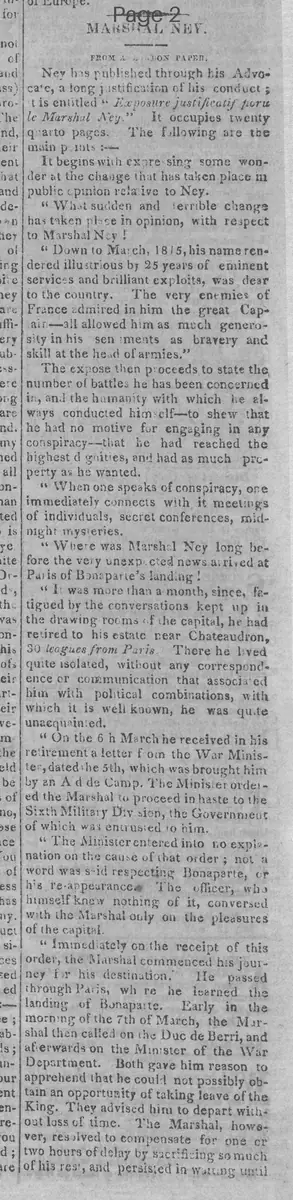
Ney has published through his Advocate, a long justification of his conduct; it is entitled "Exposé justificatif pour le Maréchal Ney." It occupies twenty quarto pages. The following are the main points:—
It begins with expressing some wonder at the change that has taken place in public opinion relative to Ney.
"What sudden and terrible change has taken place in opinion, with respect to Marshal Ney!
"Down to March, 1815, his name rendered illustrious by 25 years of eminent services and brilliant exploits, was dear to the country. The very enemies of France admired in him the great Captain—all allowed him as much generosity in his sentiments as bravery and skill at the head of armies."
The exposé then proceeds to state the number of battles he has been concerned in, and the humanity with which he always conducted himself—to shew that he had no motive for engaging in any conspiracy—that he had reached the highest dignities, and had as much property as he wanted.
"When one speaks of conspiracy, one immediately connects with it meetings of individuals, secret conferences, midnight mysteries.
"Where was Marshal Ney long before the very unexpected news arrived at Paris of Bonaparte's landing!
"I was more than a month, since, fatigued by the conversations kept up in the drawing rooms of the capital, he had retired to his estate near Chateaudun, 50 leagues from Paris. There he lived quite isolated, without any correspondence or communication that associated him with political combinations, with which it is well known, he was quite unacquainted.
"On the 6th March he received in his retirement a letter from the War Minister, dated the 5th, which was brought him by an Aide de Camp. The Minister ordered the Marshal to proceed in haste to the Sixth Military Division, the Government of which was entrusted to him.
"The Minister entered into no explanation on the cause of that order; not a word was said respecting Bonaparte, or his re-appearance. The officer, who himself knew nothing of it, conversed with the Marshal only on the pleasures of the capital.
"Immediately on the receipt of this order, the Marshal commenced his journey for his destination. He passed through Paris, where he learned the landing of Bonaparte. Early in the morning of the 7th of March, the Marshal then called on the Duc de Berri, and afterwards on the Minister of the War Department. Both gave him reason to apprehend that he could not possibly obtain an opportunity of taking leave of the King. They advised him to depart without loss of time. The Marshal, however, resolved to compensate for one or two hours of delay by sacrificing so much of his rest, and persisted in waiting until
he could have the honor of being admitted to his Majesty.
"Why this earnestness? It certainly was not, as has been reported, for the purpose of asking from his Majesty employment in the expedition against Bonaparte, or to solicit a command. The Marshal was in active service, and urged even by the letter of the Minister to proceed to his post. The Marshal did not come to offer himself; he obeyed the orders which called him.
"At the august aspect of the Monarch, all of whose traits breathe bounty, the Marshal, electrified by the flattering words in which his Majesty was pleased to address him, warmly participated in the solicitude with which all minds seemed to be occupied. Those who know the ardour of his liberal soul, and the promptitude of his language in seconding it, never would mistake for falsehood or stratagem any thing which the Marshal may have said to the King even in language boldly figurative. Could duplicity have induced him to utter such accents, it would have led to no advantage.
"This is a place for decidedly contradicting a calumny directed against Marshal Ney, with the view of forever discrediting him.
"It has been invented and circulated with affectation in public, that on his departure the King ordered him a sum, according to some, of 500,000, and according to others, from 6 to 7, and even 800,000 francs, to secure as far as possible his fidelity.
"This is a falsehood. It is not true that either the King or any of his Ministers ordered Marshal Ney either 500,000 or any sum whatever. On this point he invokes with the most respectful confidence the testimony of his Majesty.
"Nevertheless this false and injurious insinuation has hitherto been generally credited!
"On leaving the King, the Marshal repeated to his family and his friends the same language he had held at the Thuilleries. He mounted his carriage, and set out for Besancon. All the Marshals, all the General Officers were already at their posts. He had no idea, and no opportunity of forming a concert with any one."
The Exposé proceeds to state, that Ney found Besancon quite bare of troops; that the Duke de Maillé on the 11th March informed him of the troops at Grenoble having gone over to Bonaparte, and that the latter might be able to enter Lyons on the 11th. He (Ney) resolves to repair to Lons-le-Saulnier. He writes to Suchet that it was unfortunate Bonaparte had not been attacked. Ney's force consisted only of four regiments, without a single piece of artillery. The Exposé then states the disposition he made, and he let it be known he wrote to Oudinot not to hasten the arrival of troops.
"We are on the eve of a great revolution, it is only cutting the evil by the roots that we shall avoid it." His advanced guard passed over to Bonaparte. Among the troops remained inactive. He found himself in the centre of insurrection. His army was annihilated from him, and threatened him if he prevented their going over to Bonaparte.
"On the night of the 13th of March, the emissaries of Bonaparte came to the Marshal, whom they found in great agitation, accessible to all impressions, and trembling for the fate of France. They brought a letter from Bertrand, who told him,
"That Bonaparte had concerted his enterprise with Austria, through the Austrian General Kohler.
"England had favored his escape.
"Murat advanced rapidly to the north of Italy, to assist his brother-in-law.
"The troops of Russia had returned to their distant quarters.
"Prussia could not contend alone against France.
"That if Ney continued to resist, he would give up France to all the horrors of civil war."
"These last words completed the triumph over the Marshal's best resolutions.
After some attempts to excuse this step, the Exposé proceeds:-
"Before repairing to Auxerre, the Marshal drew up hastily a long series of grievances, which was to be read to Bonaparte. It began with the severest qualifications, and the bitterest reproaches.
"I am not come to join you, (said he in substance) either from respect or attachment to your person. You have been the tyrant of my country; you have brought sorrow into all families, and despair into several; you have disturbed the peace of the whole world, &c. Swear, then, since fate has recalled you, that your sole future study will be to repair the evils you have inflicted on France—that you will render the people happy. I call upon you to take up arms only for the maintenance of our limits, and never more to pass them for the purpose of attempting useless conquests, &c. On these conditions, I renounce opposing your projects. I yield, in order to preserve my country from the distractions with which it is menaced, &c. &c.
"Bonaparte submitted to every thing demanded by the Marshal, and even promised much more for the prosperity of France.
"Soon after Bonaparte's return to Paris, the Marshal retired to his estate, not disgraced, as was said, but because he was soon undeceived respecting the false assertions given by Bonaparte of a speedy composition with the powers.
"For one moment Marshal Ney conceived the hope of snatching his country from the calamities of foreign war—his expectations were disappointed on the 18th June. He immediately returned to Paris. And in what disposition? We may judge by the frank and vigorous declaration he made in the Chamber of Peers on the 22d June.
"Bonaparte sent by one of his Ministers an audaciously lying message to the Chamber. But Marshal Ney was there with his inflexibility of character—too honest a man to compound with his conscience—too much the friend of his country to suffer it to be abused by the fresh lie. He declares openly that the 18th of June has left no other alternative but that of speedy submission.
"That if his open proposal had been followed, if on the 22d June it had been decreed to negotiate, he negotiation conformably to the treaty signed at Vienna on the 25th March by all the powers, would have restored the King sooner to his people.
"And who knows if in that case, the French territory would have been occupied by so many foreigners, and such great evils thus turned aside?"
After saying that the public good was always his guide, the Exposé concludes as follows:-
"Such, without any disguise, is the conduct of Marshal Ney since the month of March, 1815—Does there result from it, we do not say the prejudice, that he has committed the odious crime of treason, but even a real moral degradation? All crime, in the legal acceptation of the word, supposes premeditation or interest more or less prevailing. The crime of treason consists of long successive efforts, or cowardly and perfidious combinations.
"An error of the moment, the effect of an unheard of concurrence of the most strange incidents—an error of which one sees in the principle a sentiment praiseworthy in itself, but ill directed—in short an error which served the Usurper in nothing, which profited nothing to the person committing it—is such an error any other than a fatal mistake?
"Is it not then allowable for Marshal Ney to call to his support that judgment pronounced by the Monarch on such of his subjects as were misled?—Are not the instigators of the disorder, the authors of this blot, formed in favour of Bonaparte, those whom his Majesty first consigned to the vengeance of the laws?
"It is proved that, far from having formed any conspiracy, Marshal Ney, notwithstanding his fault, had entered into none; that he was sincere in his promises to the King; that he only yielded to the irresistible influence of the safety of the State, which was in his opinion compromised by an impending civil war; that his hands remained pure, his character independent and inaccessible to all the seductions of personal interest; that the first moment it was possible to repair his error, while there still was danger in pronouncing against the Usurper, and in favor of the legitimate Sovereign, the Marshal did not hesitate to lay open his whole soul, and to vote that France should adopt the course of submission.
"By what fatal exception then is Marshal Ney treated as a criminal? He was certainly far from expecting such an occurrence when in the last instance the place to which he had retired was surrounded. To have concealed himself, or to have fled, would have been easy; but both these courses were repugnant to his heart. With the calmness of a conscience, from which honor never was banished, the Marshal offered himself to those charged to secure his person—a last act which completes the appreciation of his character, and which attests his confidence in the institutions by which he is to be judged."
What sub-type of article is it?
What keywords are associated?
What entities or persons were involved?
Where did it happen?
Foreign News Details
Primary Location
France
Event Date
March 1815 To June 1815
Key Persons
Outcome
ney briefly joined bonaparte to avert civil war but later advocated submission to the king after waterloo; denies treason, faces trial.
Event Details
Marshal Ney's published justification details his isolation before Napoleon's landing, orders to his post, audience with the King, troop defections leading to his switch to Bonaparte under false assurances of peace, subsequent disillusionment, and public call for negotiation and submission in the Chamber of Peers.