Thank you for visiting SNEWPapers!
Sign up free
Daily Richmond Whig
Richmond, Virginia
What is this article about?
In his fourth letter dated March 19, 1830, John R. Cooke meticulously refutes Philip Doddridge's circular's distortions of December 18-19, 1829, events in the Virginia Constitutional Convention on representation plans, detailing votes, speeches, and honorable communications to support Gen. Gordon's compromise over the defeated western plan.
Clipping
OCR Quality
Full Text
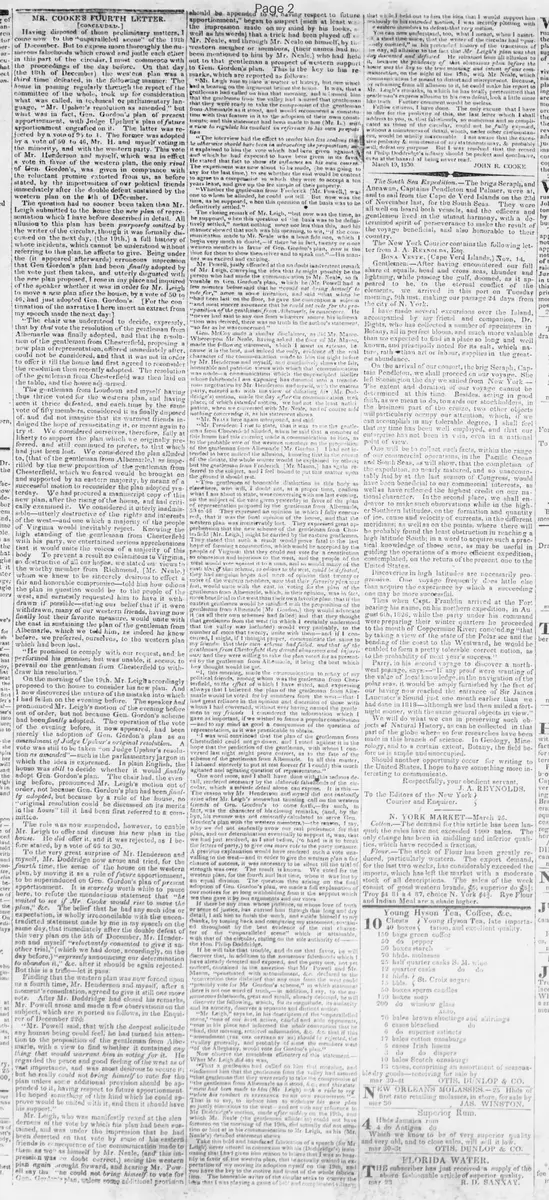
[concluded,]
Having disposed of these preliminary matters, I come now to the "unparalleled scene" of the 19th of December. But to expose more thoroughly the numerous falsehoods which crowd and jostle each other in this part of the circular, I must commence with the proceedings of the day before. On that day (the 18th of December) the western plan was a third time defeated, in the following manner: The house in passing regularly through the report of the committee of the whole, took up for consideration what was called, in technical or parliamentary language, "Mr. Upshur's resolution as amended" but what was in fact, Gen. Gordon's plan of present apportionment, with Judge Upshur's plan of future apportionment engrafted on it. The latter was rejected by a vote of 95 to 1. The former was adopted by a vote of 50 to 46, Mr. H. and myself voting in the minority, and with the western party. This vote of Mr. Henderson and myself, which was in effect a vote in favor of the western plan, the only rival of Gen. Gordon's, was given in compliance with the reluctant promise extorted from us, as before stated, by the importunities of our political friends immediately after the double defeat sustained by the western plan on the 8th of December.
The question had no sooner been taken than Mr. Leigh submitted to the house the new plan of representation which I have before described in detail. All allusion to this plan has been purposely omitted by the writer of the circular, though it was formally discussed on the next day, (the 19th,) a full history of whose incidents, which cannot be understood without referring to this plan, he affects to give. Being under the (it appeared afterwards) erroneous impression that Gen. Gordon's plan had been finally adopted by the vote just then taken, and utterly disgusted with the new plan proposed, I rose in my place and inquired of the speaker whether it was in order for Mr. Leigh to move a new plan after the house, by a vote of 50 to 46, had just adopted Gen. Gordon's. [For the continuation of the narrative I here insert an extract from my speech made the next day:]
"The chair was understood to decide, expressly, that by that vote the resolution of the gentleman from Albemarle was finally adopted, and that the resolution of the gentleman from Chesterfield, proposing a new plan of representation, offered immediately after, could not be considered, and that it was not in order to offer it till the house had first agreed to reconsider the resolution then recently adopted. The resolution of the gentleman from Chesterfield was then laid on the table, and the house adjourned.
The gentleman from Loudoun and myself having thus thrice voted for the western plan, and having seen it thrice defeated, and each time by the same vote of fifty members, considered it as finally disposed of, and did not imagine that its warmest friends indulged the hope of resuscitating it, or meant again to try it. We considered ourselves, therefore, fully at liberty to support the plan which we originally preferred, and still continued to prefer, to that which had just been lost. We considered the plan alluded to, (that of the gentleman from Albemarle,) as imperilled by the new proposition of the gentleman from Chesterfield, which we feared would be brought on and supported by an eastern majority, by means of a successful motion to reconsider the plan adopted yesterday. We had procured a manuscript copy of this new plan, after the rising of the house, and had critically examined it. We considered it utterly inadmissible—utterly destructive of the rights and interests of the west—and one which a majority of the people of Virginia would inevitably reject. Knowing the high standing of the gentleman from Chesterfield with his party, we entertained serious apprehensions that it would unite the voices of a majority of this body.
To prevent a result so calamitous to Virginia, so destructive of all our hopes, we stated our views to the worthy member from Richmond, [Mr. Neale,] whom we knew to be sincerely desirous to effect a fair and honorable compromise—told him how odious the plan in question would be to the people of the west, and earnestly requested him to have it withdrawn if possible—stating our belief that if it were withdrawn, many of our western friends, having now finally lost their favorite measure, would unite with the east in sustaining the plan of the gentleman from Albemarle, which we told him, as indeed he knew before, we preferred, ourselves, to the western plan which had been lost.
He promised to comply with our request, and he performed his promise; but was unable, it seems, to prevail on the gentleman from Chesterfield to withdraw his resolution."
On the morning of the 19th, Mr. Leigh accordingly proposed to the house to consider his new plan. And I now discovered the nature of the mistake into which I had fallen on the evening before. The speaker had pronounced Mr. Leigh's motion of the evening before out of order, but not because Gen. Gordon's scheme had been finally adopted. The operation of the vote of the evening before, it now appeared, had been merely the adoption of Gen. Gordon's plan as an amendment of Judge Upshur's original resolution. A vote was still to be taken "on Judge Upshur's resolution as amended"—such is the parliamentary jargon in which the idea is expressed. In plain English, the house was still to decide whether it would finally adopt Gen. Gordon's plan. The chair had, the evening before, pronounced Mr. Leigh's motion out of order, not because Gen. Gordon's plan had been finally adopted, but because by a rule of the house, no "original resolution could be discussed on its merits in the house" till it had been first referred to a committee.
The rule was now suspended, however, to enable Mr. Leigh to offer and discuss his new plan in the house. He did offer it, and it was rejected, as I before stated, by a vote of 66 to 30.
To the very great surprise of Mr. Henderson and myself, Mr. Doddridge now arose and tried, for the fourth time, the sense of the house on the western plan, by moving it as a rule of future apportionment, to be superinduced on Gen. Gordon's plan of present apportionment. It is scarcely worth while to pause here, to refute the mendacious statement that "he waited to see if Mr. Cooke would rise to move the plan," &c. The belief that he had any such idea or expectation, is wholly irreconcilable with the uncontradicted statement made by me in my speech on the same day, that immediately after the double defeat of this very plan on the 5th of December, Mr. Henderson and myself "reluctantly consented to give it another trial," (which we had done, accordingly, on the day before,) "expressly announcing our determination to abandon it," &c. after it should be again rejected.
But this is a trifle—let it pass.
Finding that the western plan was now forced upon us a fourth time, Mr. Henderson and myself, after a moment's consultation, agreed to give it still one more vote. After Mr. Doddridge had closed his remarks, Mr. Powell arose and made a few observations on the subject, which are reported as follows, in the Enquirer of December 22d:
"Mr. Powell said, that with the deepest solicitude any human being could feel, he had turned his attention to the proposition of the gentleman from Albemarle, with a view to find whether it contained any thing that would warrant him in voting for it. He regarded the peace and good feeling of the west as of vast importance, and was most desirous to secure it; but he really could not bring himself to vote for the plan unless some additional provision should be appended to it, having respect to future apportionment. He hoped something of this kind which he could approve would be united with it, and then it should have his support."
Mr. Leigh, who was manifestly vexed at the slenderness of the vote by which his plan had been sustained, and was under the impression that he had been deserted on that vote by some of his eastern friends in consequence of the communication made to them as well as himself by Mr. Neale, (and this impression was no doubt correct,) seeing the western plan again brought forward, and hearing Mr. Powell say that "he could not bring himself to vote for Gen. Gordon's plan, unless some additional provision appeared to it, having respect to future apportionment," began to suspect (such at least was the impression made on my mind by his looks, as well as his words) that a trick had been played off on Mr. Neale, and through Mr. Neale on himself, by the western member or members, (their names had not been mentioned to him by Mr. Neale) who had held out to that gentleman a prospect of western support to Gen. Gordon's plan. This is the key to his remarks, which are reported as follows:
"Mr. Leigh rose to state a matter of history, but one which had a bearing on the argument before the house. It was, that a gentleman had called on him that morning, and informed him that the gentlemen from the valley had assured that gentleman that they were ready to take the compromise of the gentleman from Albemarle as it stood, and would recommend a constitution with that feature in it to the adoption of their own constituents; and this statement had been made to him (Mr. L.) with a view to regulate his conduct in reference to his own proposition.
The interview had the effect to render him less zealous than he otherwise should have been in advocating the proposition; and it explained to him the vote which had been given against and which he had expected to have been given in its favor. He stated that fact to show its influence on his own course. The experiment was now about to be made, (he was going to say for the last time,) to see whether the east would be content to agree to a compromise in which they were to accept a ten years lease, and give up the fee simple of their property.
Whether the gentleman from Frederick [Mr. Powell,] was one to whom he alluded, he could not tell. But now was the time, as he supposed, when this question of the basis was to be definitively settled."
The closing remark of Mr. Leigh, "but now was the time, as he supposed, when this question of the basis was to be definitively settled," meant nothing more nor less than this, and his manner showed that such was his meaning, to wit, "if the communication made to Mr. Neale was a bona fide one, which I begin very much to doubt,—if there be in fact, twenty or more western members in favor of Gen. Gordon's plan, now is the time for them to show themselves and to speak out."—His manner was excited and exciting.
Mr. Powell, justly offended at the no doubt inadvertent remark of Mr. Leigh, conveying the idea that he might possibly be the person who had made the communication to Mr. Neale, so favorable to Gen. Gordon's plan, which he Mr. Powell had a few minutes before said that he "could not bring himself to vote for," arose in some irritation, and said that when he "had been last on the floor, he gave the convention a solemn and most sincere assurance that he could not vote for the proposition of the gentleman from Albemarle, in consequence "He never had said to any one from whatever source his information was derived, there was no truth in the author's statement, so far as he was concerned "
Gen. McCoy made a similar disclaimer, as did Mr. Mason.
Whereupon Mr. Neale, having asked the floor of Mr. Mason, made the following statement, which I insert in extenso, because it is the best, and indeed the only, evidence of the real character of the communication made to him the night before by Mr. Henderson and myself, and conclusively shows the fair, honorable and patriotic views with which that communication was made—a communication which the unprincipled libeller whose falsehoods I am exposing has distorted into a treacherous negotiation by Mr. Henderson and myself, with the eastern party, entered into with the view of defeating his (Mr. Doddridge's) motion, made the day after the communication took place, of which intended motion, we had not the least anticipation, when we conversed with Mr. Neale, and of course said nothing concerning it, as his statement shows.
"Mr. Neale here again interposed, and said:
Mr. President: I rise to state, that it was to me this gentleman from Chesterfield alluded, when he said that a member of this house had this morning made a communication to him, as to the probable vote of the western members on the proposition of the gentleman from Albemarle [Mr. Gordon.] I had not intended to have noticed the allusion, knowing that in the course of the debate, the whole matter would be explained by others; but the gentleman from Frederick (Mr. Mason.) has again referred to the subject, and I feel bound to put this matter upon the ground it should rest.
Two gentlemen of honorable distinction in this body as elsewhere, who will, I doubt not, at a proper time, confirm what I am about to state, were conversing with me last evening, on the subject of the vote given yesterday in favor of the plan of representation proposed by the gentleman from Albemarle, 50 to 46. They expressed an opinion in which I fully concurred, that it was the final opinion of the house, and that the western plan was irretrievably lost. They expressed great apprehension that the new scheme of the gentleman from Chesterfield [Mr. Leigh,] might be carried by the eastern gentlemen. They stated that such a result would prove fatal to the last hope of forming a constitution, which would be accepted by the people of Virginia: that they could not vote for a constitution so obnoxious and injurious to the west, and the people of the west would vote against it to a man, and so would many of the east: that if that scheme, so odious to the west, could be defeated, they had sanguine hopes and were of opinion that twenty or more of the western members, now that their favorite plan was lost, would unite with the east, in voting for the plan of the gentleman from Albemarle, which, in their opinion, was in fact, more beneficial to the west than their own favorite plan. that if the eastern gentlemen would be satisfied with the proposition of the gentleman from Albemarle [Mr. Gordon,] they would advocate it (as all their own schemes had failed) and that they thought that gentlemen from the west (in which I certainly understood that the valley was included) would very probably, to the number of more than twenty, unite with them—and if I concurred, I might, if I thought proper, communicate the same to my friends: that their own scheme had failed, and that of the gentleman from Chesterfield they deemed obnoxious and injurious; and they were willing to take the plan voted for as presented by the gentleman from Albemarle, it being the best which they thought would be got.
I, this morning, made the communication to many of my political friends, among whom was the gentleman from Chesterfield, to the effect of which I have stated, and expressing always that I believed the plan of the gentleman from Albemarle would be voted for by members from the west—that I had great reliance in the opinion and discretion of those with whom I had conversed, without ever having named the gentlemen to my friends. I considered the information which I gave as important, if we wished to frame a popular constitution—and to my mind as good a compromise of the question of representation, as it was practicable to obtain.
I was well convinced that the plan of the gentleman from Chesterfield could not go down, and I voted against it in the hope that the prediction of the gentleman, with whom I conversed last night might prove correct, as to the fate of the scheme of the gentleman from Albemarle. In all this matter, I labored sincerely to put at rest forever (if I could) this much agitated and agitating question of representation."
One word more, and I shall have done with this tedious detail, rendered necessary by the elaborate falsehoods of the circular, which a minute detail alone can expose. It is this—
The reason why Mr. Henderson and myself did not instantly arise after Mr. Leigh's somewhat taunting call on the western friends of Gen. Gordon's to come forth,—for such, in fact, was the character of his closing remarks, (and, by the bye, his manner was not eminently calculated to serve Gen. Gordon's plan with the western members.)—the reason, I say, why we did not instantly avow our real preference for that plan, and our determination eventually to support it, was, that we had just resolved, as I said before, (so hard is it to break the fetters of party,) to give one more vote to the party measure. A previous explanation would have rendered such a vote unavailing to the west—and in order to give the western plan a fair chance of success, it was necessary to be silent till the trial of strength was over. The result is known. We voted for the western plan, for the fourth and last time, when it was lost by an equal division. The question then arising on the final adoption of Gen. Gordon's plan, we made a full explanation of our motives for so long withholding from it the support which we then gave it by our arguments and our votes.
If there be any man whose patience, or whose love of truth or sense of justice, has carried him through this long and dry detail, I ask him to finish the work, and entitle himself to my thanks, by turning back and comparing my statement, sustained throughout by the best evidence of the real character of the "unparalleled scene" which is attainable, with that of the circular, resting on the sole authority of the Hon. Philip Doddridge.
If he will take that trouble, and do me that favor, he will discover that, in addition to the numerous falsehoods which have already detected and exposed, and the petty one, not yet noticed, contained in the assertion that Mr. Powell and Mr. Mason, "penetrated with astonishment, &c. declared to the convention their disbelief that any man from the west could possibly vote for Mr. Gordon's scheme," in which statement there is not one word of truth, in addition, I say, to the numerous falsehoods, great and small, already detected, he will discover the following, which, for its magnitude, its audacity and its atrocity, deserves a separate and distinct notice.
"Mr. Leigh," says he, in his description of the 'unparalleled scene,' "one of our most active, candid and able opponents, rose in his place and informed the whole convention that he had, that morning, received information, &c. &c. that if this amendment (THE ONE OFFERED BY US) should be rejected, the valley generally, and probably some of the members west of the Alleghany, would vote for Gordon's plan."
Now observe the matchless effrontery of this statement—
What Mr. Leigh did say was,
"That a gentleman had called on him that morning, and informed him that the gentlemen from the valley had assured that gentleman that they were ready to take the compromise of the gentleman from Albemarle as it stood, &c. and this statement had been made to him (Mr. Leigh) with a view to regulate his conduct in reference to his own proposition."
That is to say, to induce him to withdraw his new plan so justly obnoxious to the west and not with any reference to Mr. Doddridge's motion, made after midday on the 19th, and which Mr. Neale (the gentleman alluded to) could not have foreseen on the morning of the 19th, and actually did not mention or hint at in his communication to Mr. Leigh, as his (Mr. Neale's) detailed statement shows.
Take this bold and barefaced fabrication of a speech (for Mr. Leigh) never uttered in connexion with his (Doddridge's) insinuation that I had given him reason to believe that I was so heartily in favor of the western plan, that he actually waited in expectation of my moving its adoption myself on the 19th, and you have the key to the motive and intent of the whole fabrication. The honorable writer of the circular seeks to convey the idea that I was playing a game of blind and complicated villany that while I held out to him the idea that I would support him zealously in his intended motion, I was secretly plotting with the eastern members to defeat—that very motion.
You can now understand, too, what I meant, when I assert, a short time since, that the writer of the circular had "purposely omitted," in his pretended history of the transactions of the day, all allusion to the fact that Mr. Leigh's plan was that day discussed and defeated. He refrained from all allusion to it, because the pendency of that obnoxious plan before the house was the key to the true meaning and intent of our communication, on the night of the 18th, with Mr. Neale, which communication he meant to distort and misrepresent. Because, by refraining from all allusion to it, he could make his report to Mr. Leigh's remarks, in which he has totally pretermitted that gentleman's express allusion to his own defeat, look a little more like truth. Further comment would be useless.
Fellow citizens, I have done. The only excuse that I have to offer for the prolixity of this, the last letter which I shall address to you, is, that falsehoods, so numerous and so complicated as those of the circular, could not be fully exposed, without a minuteness of detail, which, under other circumstances, would be wholly inexcusable. I am aware that the excessive prolixity & minuteness of my statements may, & probably will, defeat my purpose. But I was resolved that the record of Philip Doddridge's infamy should be perfect and conclusive, even at the hazard of being never read.
March 19, 1830.
JOHN R. COOKE
What sub-type of article is it?
What themes does it cover?
What keywords are associated?
What entities or persons were involved?
Letter to Editor Details
Author
John R. Cooke
Recipient
Fellow Citizens
Main Argument
john r. cooke refutes the numerous falsehoods in philip doddridge's circular letter misrepresenting events of december 18-19 in the virginia constitutional convention, particularly regarding votes on apportionment plans, communications with other members, and the 'unparalleled scene' to clear his and mr. henderson's actions and expose doddridge's fabrications.
Notable Details