Thank you for visiting SNEWPapers!
Sign up free
Literary
July 3, 1788
The New Hampshire Gazette And General Advertiser
Portsmouth, Rockingham County, New Hampshire
What is this article about?
A letter from Ganganelli to Abbe Frugoni describing a dialogue with an English unbeliever, defending Christianity's sublime truths against infidelity's lead to brute-like annihilation, emphasizing religion's rigor and interconnected principles.
Clipping
OCR Quality
95%
Excellent
Full Text
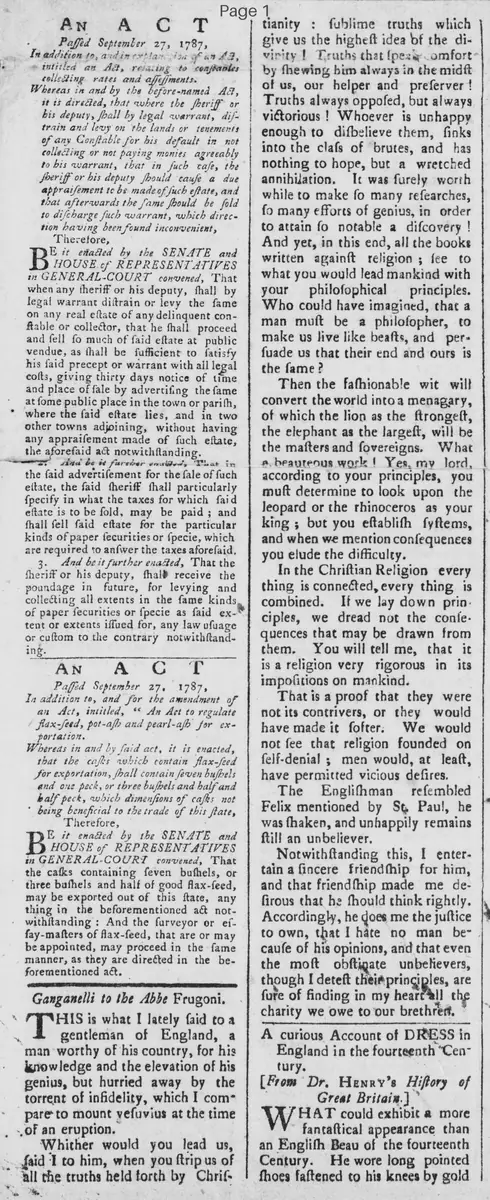
Ganganelli to the Abbe Frugoni.
This is what I lately said to a gentleman of England, a man worthy of his country, for his knowledge and the elevation of his genius, but hurried away by the torrent of infidelity, which I compare to mount Vesuvius at the time of an eruption.
Whither would you lead us, said I to him, when you strip us of all the truths held forth by Christianity: Sublime truths which give us the highest idea of the divinity! Truths that speak comfort by shewing him always in the midst of us, our helper and preserver! Truths always opposed, but always victorious! Whoever is unhappy enough to disbelieve them, sinks into the class of brutes, and has nothing to hope, but a wretched annihilation. It was surely worth while to make so many researches, so many efforts of genius, in order to attain so notable a discovery!
And yet, in this end, all the books written against religion; see to what you would lead mankind with your philosophical principles.
Who could have imagined, that a man must be a philosopher, to make us live like beasts, and persuade us that their end and ours is the same?
Then the fashionable wit will convert the world into a menagerie, of which the lion as the strongest, the elephant as the largest, will be the masters and sovereigns. What a beauteous work! Yes, my lord, according to your principles, you must determine to look upon the leopard or the rhinoceros as your king; but you establish systems, and when we mention consequences you elude the difficulty.
In the Christian Religion every thing is connected, every thing is combined. If we lay down principles, we dread not the consequences that may be drawn from them. You will tell me, that it is a religion very rigorous in its impositions on mankind.
That is a proof that they were not its contrivers, or they would have made it softer. We would not see that religion founded on self-denial; men would, at least, have permitted vicious desires.
The Englishman resembled Felix mentioned by St. Paul, he was shaken, and unhappily remains still an unbeliever.
Notwithstanding this, I entertain a sincere friendship for him, and that friendship made me desirous that he should think rightly. Accordingly, he does me the justice to own, that I hate no man because of his opinions, and that even the most obstinate unbelievers, though I detest their principles, are sure of finding in my heart all the charity we owe to our brethren.
This is what I lately said to a gentleman of England, a man worthy of his country, for his knowledge and the elevation of his genius, but hurried away by the torrent of infidelity, which I compare to mount Vesuvius at the time of an eruption.
Whither would you lead us, said I to him, when you strip us of all the truths held forth by Christianity: Sublime truths which give us the highest idea of the divinity! Truths that speak comfort by shewing him always in the midst of us, our helper and preserver! Truths always opposed, but always victorious! Whoever is unhappy enough to disbelieve them, sinks into the class of brutes, and has nothing to hope, but a wretched annihilation. It was surely worth while to make so many researches, so many efforts of genius, in order to attain so notable a discovery!
And yet, in this end, all the books written against religion; see to what you would lead mankind with your philosophical principles.
Who could have imagined, that a man must be a philosopher, to make us live like beasts, and persuade us that their end and ours is the same?
Then the fashionable wit will convert the world into a menagerie, of which the lion as the strongest, the elephant as the largest, will be the masters and sovereigns. What a beauteous work! Yes, my lord, according to your principles, you must determine to look upon the leopard or the rhinoceros as your king; but you establish systems, and when we mention consequences you elude the difficulty.
In the Christian Religion every thing is connected, every thing is combined. If we lay down principles, we dread not the consequences that may be drawn from them. You will tell me, that it is a religion very rigorous in its impositions on mankind.
That is a proof that they were not its contrivers, or they would have made it softer. We would not see that religion founded on self-denial; men would, at least, have permitted vicious desires.
The Englishman resembled Felix mentioned by St. Paul, he was shaken, and unhappily remains still an unbeliever.
Notwithstanding this, I entertain a sincere friendship for him, and that friendship made me desirous that he should think rightly. Accordingly, he does me the justice to own, that I hate no man because of his opinions, and that even the most obstinate unbelievers, though I detest their principles, are sure of finding in my heart all the charity we owe to our brethren.
What sub-type of article is it?
Epistolary
Essay
Dialogue
What themes does it cover?
Religious
Moral Virtue
Death Mortality
What keywords are associated?
Christianity
Infidelity
Philosophy
Religion
Unbelief
Charity
Literary Details
Title
Ganganelli To The Abbe Frugoni.
Subject
Conversation With An English Gentleman On Christianity Versus Infidelity
Key Lines
Whither Would You Lead Us, Said I To Him, When You Strip Us Of All The Truths Held Forth By Christianity: Sublime Truths Which Give Us The Highest Idea Of The Divinity!
Whoever Is Unhappy Enough To Disbelieve Them, Sinks Into The Class Of Brutes, And Has Nothing To Hope, But A Wretched Annihilation.
Who Could Have Imagined, That A Man Must Be A Philosopher, To Make Us Live Like Beasts, And Persuade Us That Their End And Ours Is The Same?
In The Christian Religion Every Thing Is Connected, Every Thing Is Combined. If We Lay Down Principles, We Dread Not The Consequences That May Be Drawn From Them.
I Hate No Man Because Of His Opinions, And That Even The Most Obstinate Unbelievers, Though I Detest Their Principles, Are Sure Of Finding In My Heart All The Charity We Owe To Our Brethren.