Thank you for visiting SNEWPapers!
Sign up free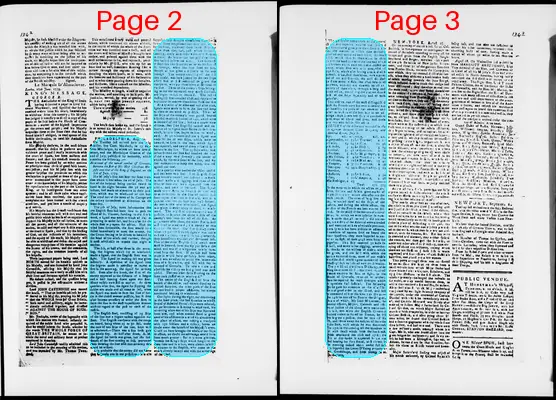
The Newport Gazette
Newport, Newport County, Rhode Island
What is this article about?
On July 6, 1779, French fleet under Count d'Estaing engaged and defeated the British fleet led by Admiral Byron off Grenada, securing the island after its capture. French casualties: 176 killed, 773 wounded. British ships heavily damaged, one separated.
Merged-components note: Continuation of the account of the naval combat off Grenada between French and English fleets across pages 2 and 3, with sequential reading order and text flowing directly from one to the next.
Clippings
1 of 2
OCR Quality
Full Text
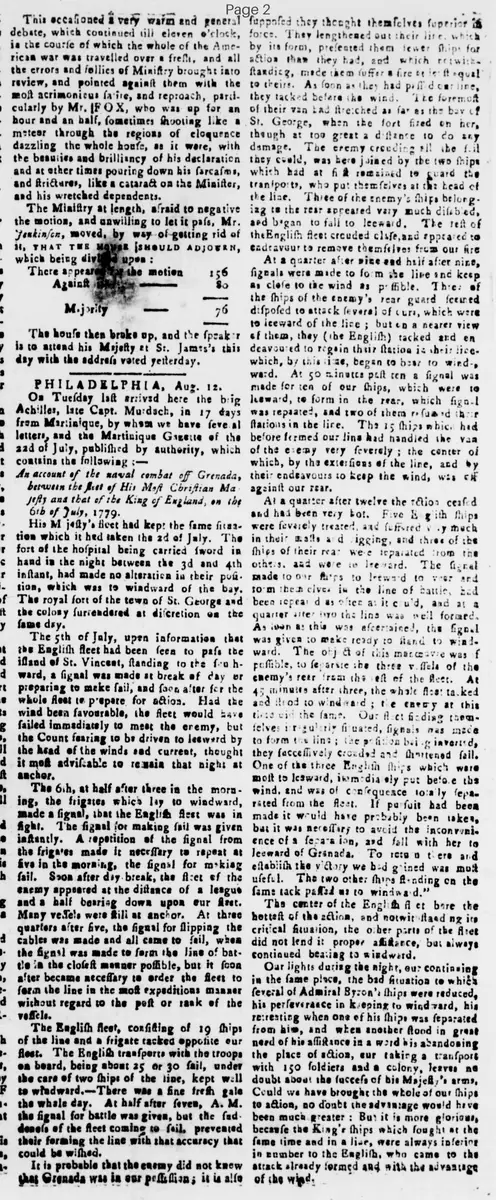
On Tuesday last arrived here the brig Achilles, late Capt. Mundsch, in 17 days from Martinique, by whom we have several letters, and the Martinique Gazette of the 22d of July, published by authority, which contains the following ;-
An account of the naval combat off Grenada, between the Fleet of His Most Christian Majesty and that of the King of England, on the 6th of July, 1779.
His Majesty's fleet had kept the same station which it had taken the 2d of July. The fort of the hospital being carried sword in hand in the night between the 3d and 4th instant, had made no alteration in their position, which was to windward of the bay.
The royal fort of the town of St. Georges and the colony surrendered at discretion on the same day.
The 6th of July, upon information that the English fleet had been seen to pass the island of St. Vincent, standing to the southward, a signal was made at break of day for preparing to make sail, and soon after for the whole fleet to prepare for action. Had the wind been favourable, the fleet would have sailed immediately to meet the enemy, but the Count fearing to be driven to leeward by the head of the winds and current, thought it not advisable to remain that night at anchor.
The 6th, at half after three in the morning, the frigates which lay to windward, made a signal, that the English Fleet was in sight. The signal for making sail was given instantly. A repetition of the signal from the frigates made it necessary to repeat at five in the morning, the signal for making sail. Soon after day-break, the fleet of the enemy appeared at the distance of a league and a half bearing down upon our Fleet.
Many vessels were still at anchor. At three quarters after five, the signal for slipping the cables was made and all came to sail, when the signal was made to form the line of battle in the closest manner possible, but it soon after became necessary to order the fleet to form the line in the most expeditious manner without regard to the port or rank of the vessels.
The English fleet, consisting of 19 Ships of the line and a frigate tacked opposite our fleet. The English transports with the troops on board, being about 25 or 30 sail, under the care of two ships of the line, kept well to windward.-There was a fine fresh gale the whole day. At half after seven, A. M. the signal for battle was given, but the bad sails of the fleet coming to sail. prevented their forming the line with that accuracy that could be wished.
It is probable that the enemy did not know that Grenada was in our possession; it is also supposed they thought themselves superior in force. They lengthened out their line, which by its form, presented them fewer ships for action than they had, and which remaining, made them suffer a fire equal to theirs. As soon as they had passed down our line, they tacked before the wind. The foremost of their van had stretched as far as the bay of St. George, when the fort fired on her, though at too great a distance to do any damage. The enemy crowding all the sail they could, was here joined by the two ships which had at first remained to guard the transport, who put themselves at the head of the line. Three of the enemy's ships, belonging to the rear appeared very much disabled, and began to fall to leeward. The rest of the English fleet crowded close, and appeared to endeavour to remove themselves from our fire
At a quarter after eight and half after nine. signals were made to form the line and keep as close to the wind as possible. The ships of the enemy's rear guard seemed disposed to attack several of ours, which were to leeward of the line : but on a nearer view of them, they (the English) tacked and endeavoured to regain their station in their line- which, by this time, began to bear to wind- ward. At 50 minutes past ten a signal was made for ten of our ships, which were to leeward, to form in the rear, which signal was repeated, and two of them refused their stations in the line. The ships which had before formed our line had mauled the van of the enemy very severely : the center of which, by the extensions of the line, and by their endeavours to keep the wind, was come againft our rear.
At a quarter after twelve the action ceased and had been very hot. Five English ships were severely treated, and suffered very much in their masts and rigging, and three of the ships of their rear were separated from the others. and were to leeward. The signal made to our ships to leeward to wear and form close. in the line of battle, had been repeated as often as it could, and at a quarter after two the line was well formed.
As soon as this was ascertained, the signal was given to make ready to stand to wind- ward. The object of this manoeuvre was if possible, to separate the three vessels of the enemy's rear from the rest of the Fleet. As 45 minutes after three, the whole fleet tacked and stood to windward ; the enemy at this time did the same. Our fleet finding ourselves irregularly situated, signals was made to form the line ; the position being inverted, they successively crowded and shortened sail.
One of the three English ships which were most to leeward, immediately put before the wind. and was of consequence totally sepa- rated from the Fleet. If pursuit had been made it would have probably been taken, but it was necessary to avoid the inconvenience of a separation, and sail with her to leeward of Grenada. To return there and establish the victory we had gained was most useful. The two other Ships standing on the same tack passed us to windward.
The center of the English Fleet bore the hottest of the action, and notwithstanding its critical situation, the other part of the Fleet did not lend it proper assistance, but always continued bearing to windward.
Our lights during the night, our continuing in the same place, the bad situation to which several of Admiral Byon's ships were reduced. his perseverance in keeping to windward, his retreating when one of his ships was separated from his, and when another stood in great need of his assistance in a word his abandoning the place of action, sur taking a transport with 150 soldiers and a colony, leaves no doubt about the success of his Majesty's arms,
Could we have brought the whole of our ships to action, no doubt the advantage would have been much greater : But it is more glorious because the King's ships which fought at the same time and in a line, were always inferior in number to the English, who came to the attack already formed and with the advantage of the wind,
The particular manoeuvres of the generals, officers and captains, who by their skill and zeal contributed greatly to the victory of this day, the manner in which they mutually sustained each other, the final crisis in which they found themselves in their posts at the head or rear of the line and which situations were not less critical as perilous, who fleet was only composed of large ships, which after having attacked with boldness, sustained themselves, with a great deal of art and firmness. The well disciplined crews, the cheerfulness of the crews, who did not commit an act of disorder of themselves, through a long and bloody action, would require that we should speak of them separately and of each particular.
This victory, one of the most distinguished which the French navy has ever obtained not only humbles the pride of our enemies and restores us masters of the seas. But is an advantage which it was necessary to purchase at the expense of blood and lives, and those brave men who fell in this action.
RETURN of the killed and wounded in the engagement between Count D'Estaing and Admiral Byron, July 6.
Ships, killed, wounded.
Languedoc, 10 54 Le Téméraire, 2 21
César, 19 64 Le Zélé. 11 36
Robuste, 5 41 Le Hector, 5 24
Annibal, 31 41 Le Guerrier. 1 18
Le Foudroyant, 3 61 Le Maintien, 9 34
Le Solitaire, 0 4 Le Protecteur, 1 14
Ville de Paris, 1 12 Le Dauphin Royal, 13 41
Vengeur, 9 37 La Provence, 6 16
Fantasque, 19 43 Le Dauphin Royal, 5 20
Artesien, 6 50 Le Sphinx, 9 50
Fier, 2 10 L'Amphion, 4 38
Le Rodrigue, 2 23
Total. 176 773
In the moment in which the action ceased, officers, soldiers and sailors, gave marks of that patriotic ardour which characterizes the French nation. The cries of long live the king, rebounded through all the ships of the squadron. And during the whole action, the bravery of the French marines was not distinguished. In the midst of the horrors of a naval combat, in which we were inferior in numbers, because that all our vessels did not engage, the orders of the Admiral were attended and executed with an admirable precision.
As early as it has been possible to estimate, number of cannon fired on board the enemy's squadron, they were supposed to amount to 60206. Of these 4148 were from the Languedoc. This ship received 32 balls in her hull, and many in her rigging, nevertheless, thanks to the wisdom of orders which the general, and the skill with which the pilots executed them, none of our vessels were dismantled. Whilst a great number of those the English, have suffered very considerably.
The 7th inst. the Count D'Estaing, after having convinced himself that there remained no more enemies for him to fight, in the latitude of Grenada, returned to anchor, where he repaired the small damages which his squadron had suffered. The following days he gave his attention to the establishment of good order in the island, and left the command of it to the Count de Grasse. On the 14th he set off for France. The Diligent, on board of which, My Lord Macartney, the Governor General, Majors, Colonels and officers of justice of the island were embarked.
On his landing, when the English Governor received orders to set off for France, he felt so great a passion, that he tore off his coat, and threw away the ensigns of the orders the Bath, with which he was decorated.
The 18th in the evening all the squadron set sail with small winds from the south east, which continued the 15th and 17th; towards the 18th at day-break it appeared by our current that we had bearing for Fort Royal, at 8 o'clock in the morning reached aboard under full sail.
It is supposed the Count D'Estaing proposes to visit Guadaloupe, and from thence to St. Philadelphia.
What sub-type of article is it?
What keywords are associated?
What entities or persons were involved?
Where did it happen?
Foreign News Details
Primary Location
Grenada
Event Date
6th Of July, 1779
Key Persons
Outcome
french: 176 killed, 773 wounded. british: five ships severely damaged in masts and rigging, three rear ships separated (one totally isolated), transports with 150 soldiers captured; french victory securing grenada.
Event Details
French fleet under Count d'Estaing, anchored off Grenada after capturing the island, engaged the approaching British fleet of 19 ships of the line under Admiral Byron on July 6, 1779. Despite being partially at anchor and inferior in numbers engaged, the French formed line and fought hotly, damaging British van and center severely. Action ceased around noon; British retreated to windward, abandoning the separated ships. D'Estaing repaired and left for France on July 14, leaving Count de Grasse in command of Grenada.