Thank you for visiting SNEWPapers!
Sign up free
Imperial Valley Press
El Centro, Imperial County, California
What is this article about?
Moscow, May 7: Russian Eugenics Society survey finds three children per family needed to pass on parental traits, but scientists and intellectuals often have fewer, leading to loss of exceptional characteristics. Prof. Koltsov notes highly educated delay marriage and have demanding wives, burdening talented men.
Clipping
OCR Quality
Full Text
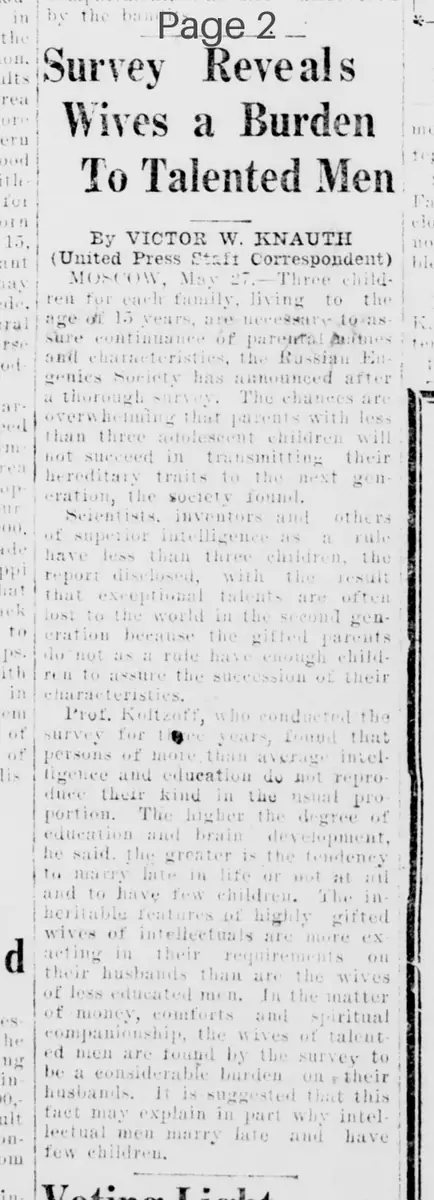
Wives a Burden
To Talented Men
By VICTOR W. KNAUTH
(United Press Staff Correspondent)
Moscow, May 7.--Three children to each family, living to the age of 15 years, are necessary as sure continuance of parental traits and characteristics, the Russian Eugenics Society has announced after a thorough survey. The chances are overwhelming that parents with less than three adolescent children will not succeed in transmitting their hereditary traits to the next generation, the society found.
Scientists, inventors and others of superior mentality as a rule have less than three children, the report disclosed, with the result that exceptional traits are often lost to the world in the second generation because the brightest parents do not as a rule have enough children to assure the succession of their characteristics.
Prof. Koltsov, who conducted the survey for the society, found that persons of higher than average intelligence and education do not reproduce their kind in the usual proportion. The higher the degree of education and brain development, he said, the greater is the tendency to marry late in life or not at all and to have few children. The unreliable features of highly gifted wives of intellectuals are more exacting in their requirements on their husbands than are the wives of less educated men. In the matter of money, comforts and spiritual companionship, the wives of talented men are found by the survey to be a considerable burden on their husbands. It is suggested that this fact may explain in part why intellectual men marry late and have few children.
What sub-type of article is it?
What keywords are associated?
What entities or persons were involved?
Where did it happen?
Foreign News Details
Primary Location
Moscow
Event Date
May 7
Key Persons
Outcome
parents need three children surviving to age 15 to transmit traits; talented individuals have fewer children, leading to loss of exceptional traits; highly educated marry late, have demanding wives burdening husbands.
Event Details
The Russian Eugenics Society announced survey results showing three children per family are necessary for transmitting hereditary traits. Scientists and intellectuals typically have fewer than three children, risking loss of superior traits. Prof. Koltsov found higher intelligence correlates with late marriage, fewer children, and wives of talented men imposing greater demands for money, comforts, and companionship.