Thank you for visiting SNEWPapers!
Sign up free
The Pulaskian
Little Rock, Pulaski County, Arkansas
What is this article about?
Agricultural advice from Arkansas county agents on storing cotton and corn, sowing clover, growing wheat, using fertilizers and lime, selecting seed potatoes, saving peas and beans for seed, and expanding boys' and girls' agricultural clubs to 30,000 members.
Clipping
OCR Quality
Full Text
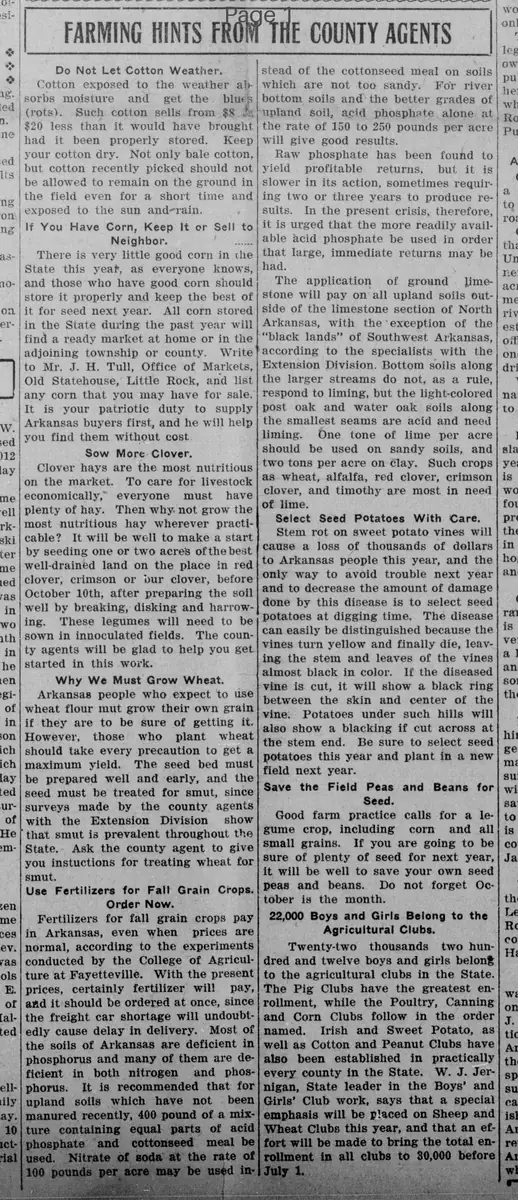
Do Not Let Cotton Weather.
Cotton exposed to the weather absorbs moisture and gets the blues (rots). Such cotton sells from $8 $20 less than it would have brought had it been properly stored. Keep your cotton dry. Not only bale cotton, but cotton recently picked should not be allowed to remain on the ground in the field even for a short time and exposed to the sun and rain.
If You Have Corn, Keep It or Sell to Neighbor.
There is very little good corn in the State this year, as everyone knows, and those who have good corn should store it properly and keep the best of it for seed next year. All corn stored in the State during the past year will find a ready market at home or in the adjoining township or county. Write to Mr. J. H. Tull, Office of Markets, Old Statehouse, Little Rock, and list any corn that you may have for sale. It is your patriotic duty to supply Arkansas buyers first, and he will help you find them without cost.
Sow More Clover.
Clover hays are the most nutritious on the market. To care for livestock economically, everyone must have plenty of hay. Then why not grow the most nutritious hay wherever practicable? It will be well to make a start by seeding one or two acres of the best well-drained land on the place in red clover, crimson or bur clover, before October 10th, after preparing the soil well by breaking, disking and harrowing. These legumes will need to be sown in inoculated fields. The county agents will be glad to help you get started in this work.
Why We Must Grow Wheat.
Arkansas people who expect to use wheat flour must grow their own grain if they are to be sure of getting it. However, those who plant wheat should take every precaution to get a maximum yield. The seed bed must be prepared well and early, and the seed must be treated for smut, since surveys made by the county agents with the Extension Division show that smut is prevalent throughout the State. Ask the county agent to give you instructions for treating wheat for smut.
Use Fertilizers for Fall Grain Crops.
Order Now.
Fertilizers for fall grain crops pay in Arkansas, even when prices are normal, according to the experiments conducted by the College of Agriculture at Fayetteville. With the present prices, certainly fertilizer will pay, and it should be ordered at once, since the freight car shortage will undoubtedly cause delay in delivery. Most of the soils of Arkansas are deficient in phosphorus and many of them are deficient in both nitrogen and phosphorus. It is recommended that for upland soils which have not been manured recently, 400 pounds of a mixture containing equal parts of acid phosphate and cottonseed meal be used. Nitrate of soda at the rate of 100 pounds per acre may be used instead of the cottonseed meal on soils which are not too sandy. For river bottom soils and the better grades of upland soil, acid phosphate alone at the rate of 150 to 250 pounds per acre will give good results.
Raw phosphate has been found to yield profitable returns, but it is slower in its action, sometimes requiring two or three years to produce results. In the present crisis, therefore, it is urged that the more readily available acid phosphate be used in order that large, immediate returns may be had.
The application of ground limestone will pay on all upland soils outside of the limestone section of North Arkansas, with the exception of the "black lands" of Southwest Arkansas, according to the specialists with the Extension Division. Bottom soils along the larger streams do not, as a rule, respond to liming, but the light-colored post oak and water oak soils along the smallest streams are acid and need liming. One ton of lime per acre should be used on sandy soils, and two tons per acre on clay. Such crops as wheat, alfalfa, red clover, crimson clover, and timothy are most in need of lime.
Select Seed Potatoes With Care.
Stem rot on sweet potato vines will cause a loss of thousands of dollars to Arkansas people this year, and the only way to avoid trouble next year and to decrease the amount of damage done by this disease is to select seed potatoes at digging time. The disease can easily be distinguished because the vines turn yellow and finally die, leaving the stem and leaves of the vines almost black in color. If the diseased vine is cut, it will show a black ring between the skin and center of the vine. Potatoes under such hills will also show a blacking if cut across at the stem end. Be sure to select seed potatoes this year and plant in a new field next year.
Save the Field Peas and Beans for Seed.
Good farm practice calls for a legume crop, including corn and all small grains. If you are going to be sure of plenty of seed for next year, it will be well to save your own seed peas and beans. Do not forget October is the month.
22,000 Boys and Girls Belong to the Agricultural Clubs.
Twenty-two thousand two hundred and twelve boys and girls belong to the agricultural clubs in the State. The Pig Clubs have the greatest enrollment, while the Poultry, Canning and Corn Clubs follow in the order named. Irish and Sweet Potato, as well as Cotton and Peanut Clubs have also been established in practically every county in the State. W. J. Jernigan, State leader in the Boys' and Girls' Club work, says that a special emphasis will be placed on Sheep and Wheat Clubs this year, and that an effort will be made to bring the total enrollment in all clubs to 30,000 before July 1.
What sub-type of article is it?
What keywords are associated?
What entities or persons were involved?
Where did it happen?
Domestic News Details
Primary Location
Arkansas
Key Persons
Event Details
Farming hints include: Do not let cotton weather or rot; store properly to avoid losses. Keep good corn for seed or sell locally via Mr. J. H. Tull. Sow clover before October 10th in inoculated fields. Grow wheat with treated seed and well-prepared beds due to smut prevalence. Use fertilizers like acid phosphate and cottonseed meal for fall grains; apply lime on acid soils. Select healthy seed potatoes to avoid stem rot. Save field peas and beans for seed in October. 22,212 boys and girls in agricultural clubs, aiming for 30,000 with emphasis on sheep and wheat clubs.