Thank you for visiting SNEWPapers!
Sign up free
Editorial
February 1, 1850
The Camden Journal
Camden, Kershaw County, South Carolina
What is this article about?
Southern editorial criticizes Northern-authored school books for subtly promoting abolitionism to children, urging the South to create its own textbooks to counter this influence. Cites 'The First Book of History' by Peter Parley as an example of biased content on slavery.
Clipping
OCR Quality
95%
Excellent
Full Text
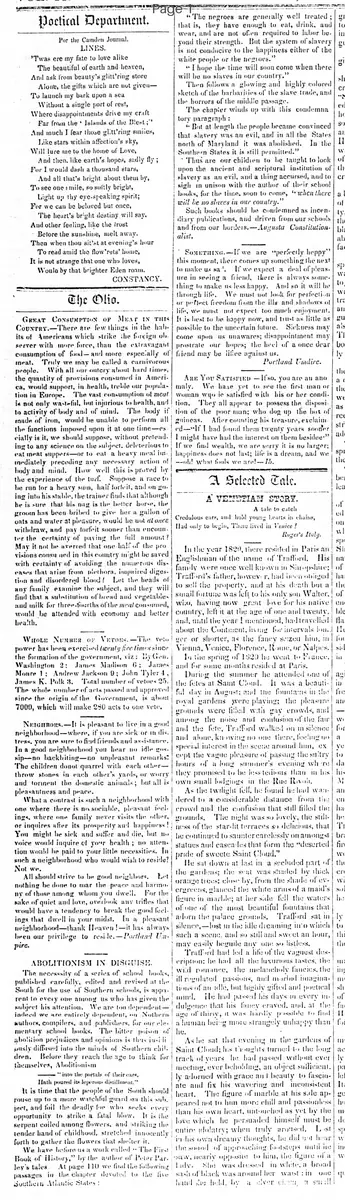
ABOLITIONISM IN DISGUISE.
The necessity of a series of school books, published carefully, edited and revised at the South for the use of Southern schools, is apparent to every one among us who has given the subject his attention. We are too dependent—indeed we are entirely dependent, on Northern authors, compilers, and publishers, for our elementary school books. The bitter poison of abolition prejudices and opinions is thus insidiously diffused into the minds of Southern children. Before they reach the age to think for themselves, Abolitionism
"into the portals of their ears,
Hath poured its leprous distillment."
It is time that the people of the South should rouse up to a more watchful guard on this subject, and foil the deadly foe who seeks every opportunity to strike a fatal blow. It is the serpent coiled among flowers, and striking the tender hand of childhood, stretched innocently forth to gather the flowers that shelter it. We have before us a work called "The First Book of History," by the author of Peter Parley's tales. At page 110 we find the following passages in the chapter devoted to the five Southern Atlantic States:
"The negroes are generally well treated; that is, they have enough to eat, drink, and wear, and are not often required to labor beyond their strength. But the system of slavery is not conducive to the happiness either of the white people or the negroes."
"I hope the time will soon come when there will be no slaves in our country."
Then follows a glowing and highly colored sketch of the barbarities of the slave trade, and the horrors of the middle passage. The chapter winds up with this condemnatory paragraph:
"But at length the people became convinced that slavery was an evil, and in all the States north of Maryland it was abolished. In the Southern States it is still permitted."
Thus are our children to be taught to look upon the ancient and scriptural institution of slavery as an evil, and a thing accursed, and to sigh in unison with the author of their school books, for the time, soon to come, "when there will be no slaves in our country." Such books should be condemned as incendiary publications, and driven from our schools and from our borders.—Augusta Constitutionalist.
The necessity of a series of school books, published carefully, edited and revised at the South for the use of Southern schools, is apparent to every one among us who has given the subject his attention. We are too dependent—indeed we are entirely dependent, on Northern authors, compilers, and publishers, for our elementary school books. The bitter poison of abolition prejudices and opinions is thus insidiously diffused into the minds of Southern children. Before they reach the age to think for themselves, Abolitionism
"into the portals of their ears,
Hath poured its leprous distillment."
It is time that the people of the South should rouse up to a more watchful guard on this subject, and foil the deadly foe who seeks every opportunity to strike a fatal blow. It is the serpent coiled among flowers, and striking the tender hand of childhood, stretched innocently forth to gather the flowers that shelter it. We have before us a work called "The First Book of History," by the author of Peter Parley's tales. At page 110 we find the following passages in the chapter devoted to the five Southern Atlantic States:
"The negroes are generally well treated; that is, they have enough to eat, drink, and wear, and are not often required to labor beyond their strength. But the system of slavery is not conducive to the happiness either of the white people or the negroes."
"I hope the time will soon come when there will be no slaves in our country."
Then follows a glowing and highly colored sketch of the barbarities of the slave trade, and the horrors of the middle passage. The chapter winds up with this condemnatory paragraph:
"But at length the people became convinced that slavery was an evil, and in all the States north of Maryland it was abolished. In the Southern States it is still permitted."
Thus are our children to be taught to look upon the ancient and scriptural institution of slavery as an evil, and a thing accursed, and to sigh in unison with the author of their school books, for the time, soon to come, "when there will be no slaves in our country." Such books should be condemned as incendiary publications, and driven from our schools and from our borders.—Augusta Constitutionalist.
What sub-type of article is it?
Slavery Abolition
Education
What keywords are associated?
Abolitionism
School Books
Southern Education
Northern Authors
Slavery Defense
Peter Parley
What entities or persons were involved?
Northern Authors
Peter Parley
Augusta Constitutionalist
Editorial Details
Primary Topic
Abolitionism In Northern School Books
Stance / Tone
Strongly Anti Abolitionist And Protective Of Southern Education
Key Figures
Northern Authors
Peter Parley
Augusta Constitutionalist
Key Arguments
Southern Schools Overly Dependent On Northern Textbooks
Northern Books Infuse Abolitionist Prejudices In Children
Example From 'The First Book Of History' Portrays Slavery As Evil
Slavery Described As Ancient And Scriptural Institution
Such Books Are Incendiary And Should Be Banned From Southern Schools