Thank you for visiting SNEWPapers!
Sign up free
Editorial
February 11, 1897
The Advance
Jamesburg, Middlesex County, New Jersey
What is this article about?
This editorial critiques three types of problematic workers: the fussy and distractible, the careless and slovenly, and the pessimistic complainer. It advises boys to cultivate focus, order, and harmony for success, warning that such flaws lead to failure and social rejection.
Clipping
OCR Quality
95%
Excellent
Full Text
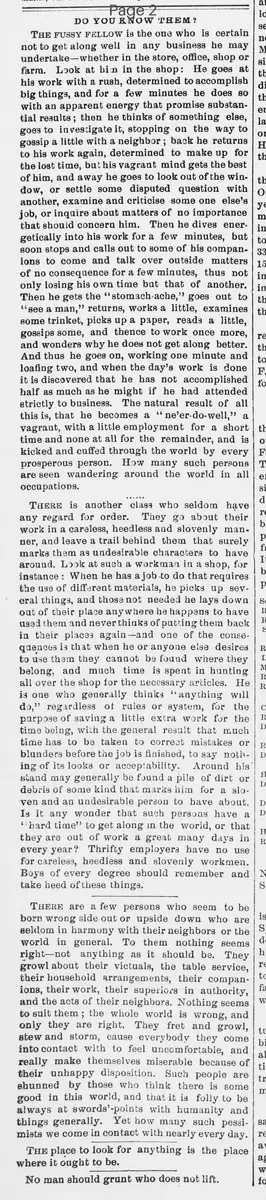
DO YOU KNOW THEM?
THE FUSSY FELLOW is the one who is certain
not to get along well in any business he may
undertake-whether in the store, office, shop or
farm. Look at him in the shop: He goes at
his work with a rush, determined to accomplish
big things, and for a few minutes he does so
with an apparent energy that promises substantial
results; then he thinks of something else,
goes to investigate it, stopping on the way to
gossip a little with a neighbor; back he returns
to his work again, determined to make up for
the lost time, but his vagrant mind gets the best
of him, and away he goes to look out of the window,
or settle some disputed question with
another, examine and criticise some one else's
job, or inquire about matters of no importance
that should concern him. Then he dives energetically
into his work for a few minutes, but
soon stops and calls out to some of his companions
to come and talk over outside matters
of no consequence for a few minutes, thus not
only losing his own time but that of another.
Then he gets the "stomach-ache," goes out to
"see a man," returns, works a little, examines
some trinket, picks up a paper, reads a little,
gossips some, and thence to work once more,
and wonders why he does not get along better.
And thus he goes on, working one minute and
loafing two, and when the day's work is done
it is discovered that he has not accomplished
half as much as he might if he had attended
strictly to business. The natural result of all
this is, that he becomes a "ne'er-do-well,"
a
vagrant, with a little employment for a short
time and none at all for the remainder, and is
kicked and cuffed through the world by every
prosperous person.
How many such persons
are seen wandering around the world in all
occupations.
There is another class who seldom have
any regard for order. They go about their
work in a careless, heedless and slovenly manner,
and leave a trail behind them that surely
marks them as undesirable characters to have
around. Look at such a workman in a shop, for
instance: When he has a job to do that requires
the use of different materials, he picks up several
things, and those not needed he lays down
out of their place anywhere he happens to have
used them and never thinks of putting them back
in their places again-and one of the consequences
is that when he or anyone else desires
to use them they cannot be found where they
belong, and much time is spent in hunting
all over the shop for the necessary articles. He
is one who generally thinks "anything will
do," regardless of rules or system, for the
purpose of saving a little extra work for the
time being, with the general result that much
time has to be taken to correct mistakes or
blunders before the job is finished, to say nothing
of its looks or acceptability. Around his
stand may generally be found a pile of dirt or
debris of some kind that marks him for a sloven
and an undesirable person to have about.
Is it any wonder that such persons have a
hard time to get along in the world, or that
they are out of work a great many days in
every year? Thrifty employers have no use
for careless, heedless and slovenly workmen.
Boys of every degree should remember and
take heed of these things.
THERE are a few persons who seem to be
born wrong side out or upside down who are
seldom in harmony with their neighbors or the
world in general. To them nothing seems
right-not anything as it should be. They
growl about their victuals, the table service,
their household arrangements, their companions,
their work, their superiors in authority,
and the acts of their neighbors. Nothing seems
to suit them; the whole world is wrong, and
only they are right. They fret and growl,
stew and storm, cause everybody they come
into contact with to feel uncomfortable, and
really make themselves miserable because of
their unhappy disposition. Such people are
shunned by those who think there is some
good in this world, and that it is folly to be
always at swords'-points with humanity and
things generally. Yet how many such pessimists
we come in contact with nearly every day.
THE place to look for anything is the place
where it ought to be.
No man should grunt who does not lift.
THE FUSSY FELLOW is the one who is certain
not to get along well in any business he may
undertake-whether in the store, office, shop or
farm. Look at him in the shop: He goes at
his work with a rush, determined to accomplish
big things, and for a few minutes he does so
with an apparent energy that promises substantial
results; then he thinks of something else,
goes to investigate it, stopping on the way to
gossip a little with a neighbor; back he returns
to his work again, determined to make up for
the lost time, but his vagrant mind gets the best
of him, and away he goes to look out of the window,
or settle some disputed question with
another, examine and criticise some one else's
job, or inquire about matters of no importance
that should concern him. Then he dives energetically
into his work for a few minutes, but
soon stops and calls out to some of his companions
to come and talk over outside matters
of no consequence for a few minutes, thus not
only losing his own time but that of another.
Then he gets the "stomach-ache," goes out to
"see a man," returns, works a little, examines
some trinket, picks up a paper, reads a little,
gossips some, and thence to work once more,
and wonders why he does not get along better.
And thus he goes on, working one minute and
loafing two, and when the day's work is done
it is discovered that he has not accomplished
half as much as he might if he had attended
strictly to business. The natural result of all
this is, that he becomes a "ne'er-do-well,"
a
vagrant, with a little employment for a short
time and none at all for the remainder, and is
kicked and cuffed through the world by every
prosperous person.
How many such persons
are seen wandering around the world in all
occupations.
There is another class who seldom have
any regard for order. They go about their
work in a careless, heedless and slovenly manner,
and leave a trail behind them that surely
marks them as undesirable characters to have
around. Look at such a workman in a shop, for
instance: When he has a job to do that requires
the use of different materials, he picks up several
things, and those not needed he lays down
out of their place anywhere he happens to have
used them and never thinks of putting them back
in their places again-and one of the consequences
is that when he or anyone else desires
to use them they cannot be found where they
belong, and much time is spent in hunting
all over the shop for the necessary articles. He
is one who generally thinks "anything will
do," regardless of rules or system, for the
purpose of saving a little extra work for the
time being, with the general result that much
time has to be taken to correct mistakes or
blunders before the job is finished, to say nothing
of its looks or acceptability. Around his
stand may generally be found a pile of dirt or
debris of some kind that marks him for a sloven
and an undesirable person to have about.
Is it any wonder that such persons have a
hard time to get along in the world, or that
they are out of work a great many days in
every year? Thrifty employers have no use
for careless, heedless and slovenly workmen.
Boys of every degree should remember and
take heed of these things.
THERE are a few persons who seem to be
born wrong side out or upside down who are
seldom in harmony with their neighbors or the
world in general. To them nothing seems
right-not anything as it should be. They
growl about their victuals, the table service,
their household arrangements, their companions,
their work, their superiors in authority,
and the acts of their neighbors. Nothing seems
to suit them; the whole world is wrong, and
only they are right. They fret and growl,
stew and storm, cause everybody they come
into contact with to feel uncomfortable, and
really make themselves miserable because of
their unhappy disposition. Such people are
shunned by those who think there is some
good in this world, and that it is folly to be
always at swords'-points with humanity and
things generally. Yet how many such pessimists
we come in contact with nearly every day.
THE place to look for anything is the place
where it ought to be.
No man should grunt who does not lift.
What sub-type of article is it?
Moral Or Religious
Social Reform
What keywords are associated?
Work Ethic
Fussy Fellow
Careless Worker
Pessimist
Orderliness
Distraction
Slovenliness
Success Habits
Editorial Details
Primary Topic
Advice Against Poor Work Habits And Attitudes
Stance / Tone
Cautionary Exhortation
Key Arguments
Fussy Workers Waste Time Through Distractions And Gossip, Achieving Little.
Careless Workers Create Disorder And Inefficiency, Leading To Mistakes And Unemployment.
Pessimistic Complainers Alienate Others And Make Themselves Miserable.
Boys Should Focus, Maintain Order, And Foster Positive Dispositions For Success.