Thank you for visiting SNEWPapers!
Sign up free
Story
September 6, 1821
Kentucky Gazette
Lexington, Fayette County, Kentucky
What is this article about?
In a congressional speech, Mr. Talbott critiques opponents' reliance on judicial enforcement of the Sedition Act, arguing that judges are fallible humans influenced by biases, and that other government branches must check unconstitutional laws despite reverence for the judiciary.
Clipping
OCR Quality
98%
Excellent
Full Text
MR TALBOTT'S SPEECH.
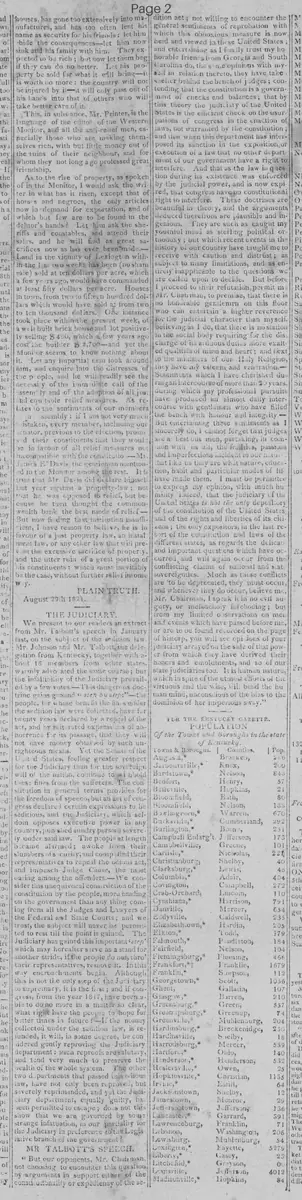
" But our opponents, Mr. Chairman, not choosing to encounter this question by arguments in support either of the constitutionality or expediency of the sedition act; not willing to encounter the general sentiments of reprobation with which this obnoxious measure is now held and viewed in these United States; and entertaining as I fondly trust my honorable friends from Georgia and South Carolina do, the same opinions with myself in relation thereto, they have taken shelter behind the bench of judges; contending that the constitution is a government of checks and balances; that by this theory the judiciary of the United States is the efficient check on the usurpations of congress in the enaction of laws, not warranted by the constitution; and that when this department has interposed its sanction in the exposition or execution of a law that no other department of our government have a right to interfere. And that as the law in question during its existence was enforced by the judicial power, and is now expounded, that congress have no constitutional right to interfere. These doctrines are beautiful in theory, and the arguments deduced therefrom are plausible and ingenious. They are such as caught my youthful mind as sterling political orthodoxy; but which recent events in the history of our country have taught me to receive with caution and distrust; as subject to many limitations, and as entirely inapplicable to the questions we are called upon to decide. But before I proceed to their refutation, permit me Mr. Chairman, to premise, that there is no honorable gentleman on this floor who can entertain a higher reverence for the judicial character than myself, believing as I do, that there is no station in the social body requiring for the discharge of its arduous duties more exalted qualities of mind and heart; and next to the ministers of our Holy Religion, they have my esteem and veneration.—Sentiments which I have cherished during an intercourse of more than 20 years, during which my professional pursuits have produced an almost daily intercourse with gentlemen who have filled the bench with honour and integrity—But entertaining these sentiments as I sincerely do, I cannot forget that judges are but flesh and blood men, partaking, in common with us all, the frailties, passions and imperfections incident to our nature. That like us they are what nature, education, habit and particular modes of life have made them. I must be permitted to express my opinion, with much humility indeed, that the judiciary of the United States is not the only depository of the constitution of the United States and of the rights and liberties of its citizens; the only expositors, in the last resort of the constitution and laws of the different states, as regards the delicate and important questions which have occurred and will again occur from the conflicting claims of national and state sovereignties. Much as these conflicts are to be deprecated, they must occur, and whenever they do occur, believe me, Mr. Chairman, I speak it in no evil augury, or melancholy foreboding; but from my limited observations on men and events which have passed before me, or are to be found recorded on the page of history, you will see opinions of your judiciary arrayed on the side of that power from which they have derived their honors and emoluments, and so of our state judiciaries too. It is human nature, which in spite of the utmost efforts of the virtuous and the wise, will bend the human mind, unconscious of the bias to the dominion of her imperious sway."
" But our opponents, Mr. Chairman, not choosing to encounter this question by arguments in support either of the constitutionality or expediency of the sedition act; not willing to encounter the general sentiments of reprobation with which this obnoxious measure is now held and viewed in these United States; and entertaining as I fondly trust my honorable friends from Georgia and South Carolina do, the same opinions with myself in relation thereto, they have taken shelter behind the bench of judges; contending that the constitution is a government of checks and balances; that by this theory the judiciary of the United States is the efficient check on the usurpations of congress in the enaction of laws, not warranted by the constitution; and that when this department has interposed its sanction in the exposition or execution of a law that no other department of our government have a right to interfere. And that as the law in question during its existence was enforced by the judicial power, and is now expounded, that congress have no constitutional right to interfere. These doctrines are beautiful in theory, and the arguments deduced therefrom are plausible and ingenious. They are such as caught my youthful mind as sterling political orthodoxy; but which recent events in the history of our country have taught me to receive with caution and distrust; as subject to many limitations, and as entirely inapplicable to the questions we are called upon to decide. But before I proceed to their refutation, permit me Mr. Chairman, to premise, that there is no honorable gentleman on this floor who can entertain a higher reverence for the judicial character than myself, believing as I do, that there is no station in the social body requiring for the discharge of its arduous duties more exalted qualities of mind and heart; and next to the ministers of our Holy Religion, they have my esteem and veneration.—Sentiments which I have cherished during an intercourse of more than 20 years, during which my professional pursuits have produced an almost daily intercourse with gentlemen who have filled the bench with honour and integrity—But entertaining these sentiments as I sincerely do, I cannot forget that judges are but flesh and blood men, partaking, in common with us all, the frailties, passions and imperfections incident to our nature. That like us they are what nature, education, habit and particular modes of life have made them. I must be permitted to express my opinion, with much humility indeed, that the judiciary of the United States is not the only depository of the constitution of the United States and of the rights and liberties of its citizens; the only expositors, in the last resort of the constitution and laws of the different states, as regards the delicate and important questions which have occurred and will again occur from the conflicting claims of national and state sovereignties. Much as these conflicts are to be deprecated, they must occur, and whenever they do occur, believe me, Mr. Chairman, I speak it in no evil augury, or melancholy foreboding; but from my limited observations on men and events which have passed before me, or are to be found recorded on the page of history, you will see opinions of your judiciary arrayed on the side of that power from which they have derived their honors and emoluments, and so of our state judiciaries too. It is human nature, which in spite of the utmost efforts of the virtuous and the wise, will bend the human mind, unconscious of the bias to the dominion of her imperious sway."
What sub-type of article is it?
Political Speech
What themes does it cover?
Justice
Moral Virtue
What keywords are associated?
Sedition Act
Judiciary
Constitution
Checks And Balances
Human Nature
Political Orthodoxy
What entities or persons were involved?
Mr. Talbott
Where did it happen?
United States Congress
Story Details
Key Persons
Mr. Talbott
Location
United States Congress
Story Details
Mr. Talbott argues against opponents who defend the Sedition Act by citing judicial enforcement and checks and balances, emphasizing judges' human fallibility and biases, and asserting that Congress must intervene on unconstitutional laws despite reverence for the judiciary.