Thank you for visiting SNEWPapers!
Sign up free
Story
June 20, 1927
The Daily Alaska Empire
Juneau, Juneau County, Alaska
What is this article about?
Professor Robert H. Goddard of Clark University in Boston proposes sending rockets to the moon, beginning with atmospheric tests using nitro-cellulose charges and instruments, followed by a larger rocket with a flare for lunar impact visibility, and ultimately a manned version with provisions for a 48-hour journey.
Clipping
OCR Quality
85%
Good
Full Text
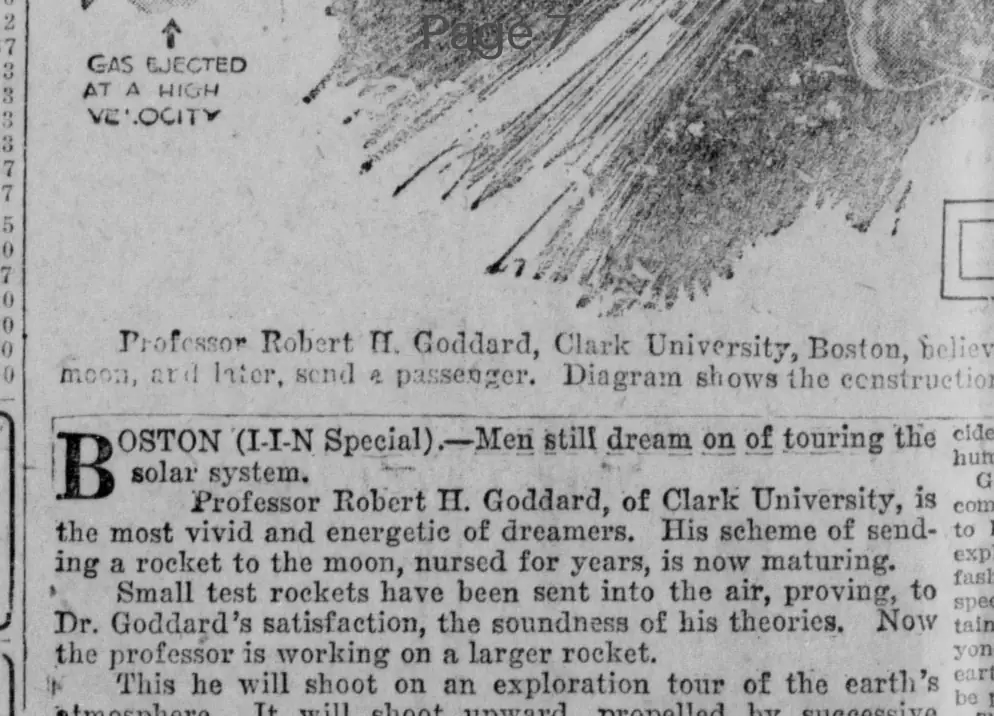
GAS EJECTED
AT A HIGH
VELOCITY
Professor Robert H. Goddard, Clark University, Boston, believes he can shoot a rocket to the moon, and later, send a passenger.
Diagram shows the construction.
BOSTON (A.P. Special).-Men still dream on of touring the solar system.
Professor Robert H. Goddard, of Clark University, is the most vivid and energetic of dreamers. His scheme of sending a rocket to the moon, nursed for years, is now maturing.
Small test rockets have been sent into the air, proving, to Dr. Goddard's satisfaction, the soundness of his theories. Now the professor is working on a larger rocket.
This he will shoot into the atmosphere. It will shoot up charges of nitro-cellulose, to the outer edge of the air, carrying with it a number of instruments to register the density of the atmosphere and the temperatures. It will drop back to the earth, its speed checked by a parachute arrangement invented by Goddard. The test will be made in some locality where the danger of the falling projectile will be at a minimum.
Should this test succeed, Goddard will construct an enormous replica and shoot it at the moon. Attached to it will be a flare that will be ignited by the rocket's impact with the moon-if it gets there. The flash will be large enough to be visible through telescopes on earth.
And should this second test succeed-it will be a long time yet if it does, as Goddard has spent eight years on his first rocket-the professor will make a new and larger rocket capable of carrying a person inside. By the time the last rocket is made, Goddard hopes to have invented some means of providing for the experimenter's return. The moon is without atmosphere, a decidedly unhealthy condition for a human.
Goddard's propulsion device is comparatively simple. The rocket is to kick itself along by a series of explosions, operating in machine gun fashion. Each explosion is to add speed to the projectile until it attains sufficient force to carry it beyond the gravity attraction of the earth. From that point on it will be pulled in by the moon.
The passenger-carrying rocket would make the journey in forty-eight hours, Goddard believes. Use of light metals would increase its range. The voyager would be in a small compartment ahead of the firing chamber. Oxygen, food and water would be available for the person with sufficient courage to make the flight.
Goddard has made no selection of the person who may make the first trip to the moon. A scientific education and a willingness to die are probably the only qualifications, though weight may figure.
AT A HIGH
VELOCITY
Professor Robert H. Goddard, Clark University, Boston, believes he can shoot a rocket to the moon, and later, send a passenger.
Diagram shows the construction.
BOSTON (A.P. Special).-Men still dream on of touring the solar system.
Professor Robert H. Goddard, of Clark University, is the most vivid and energetic of dreamers. His scheme of sending a rocket to the moon, nursed for years, is now maturing.
Small test rockets have been sent into the air, proving, to Dr. Goddard's satisfaction, the soundness of his theories. Now the professor is working on a larger rocket.
This he will shoot into the atmosphere. It will shoot up charges of nitro-cellulose, to the outer edge of the air, carrying with it a number of instruments to register the density of the atmosphere and the temperatures. It will drop back to the earth, its speed checked by a parachute arrangement invented by Goddard. The test will be made in some locality where the danger of the falling projectile will be at a minimum.
Should this test succeed, Goddard will construct an enormous replica and shoot it at the moon. Attached to it will be a flare that will be ignited by the rocket's impact with the moon-if it gets there. The flash will be large enough to be visible through telescopes on earth.
And should this second test succeed-it will be a long time yet if it does, as Goddard has spent eight years on his first rocket-the professor will make a new and larger rocket capable of carrying a person inside. By the time the last rocket is made, Goddard hopes to have invented some means of providing for the experimenter's return. The moon is without atmosphere, a decidedly unhealthy condition for a human.
Goddard's propulsion device is comparatively simple. The rocket is to kick itself along by a series of explosions, operating in machine gun fashion. Each explosion is to add speed to the projectile until it attains sufficient force to carry it beyond the gravity attraction of the earth. From that point on it will be pulled in by the moon.
The passenger-carrying rocket would make the journey in forty-eight hours, Goddard believes. Use of light metals would increase its range. The voyager would be in a small compartment ahead of the firing chamber. Oxygen, food and water would be available for the person with sufficient courage to make the flight.
Goddard has made no selection of the person who may make the first trip to the moon. A scientific education and a willingness to die are probably the only qualifications, though weight may figure.
What sub-type of article is it?
Curiosity
Extraordinary Event
Adventure
What themes does it cover?
Exploration
Bravery Heroism
Triumph
What keywords are associated?
Rocket To Moon
Robert Goddard
Space Exploration
Atmospheric Test
Lunar Flare
Manned Flight
What entities or persons were involved?
Robert H. Goddard
Where did it happen?
Boston
Story Details
Key Persons
Robert H. Goddard
Location
Boston
Story Details
Professor Goddard plans sequential rocket tests: small tests already done; larger atmospheric probe with instruments and parachute return; enormous moon rocket with impact flare for visibility; eventual manned rocket for 48-hour trip with life support, requiring courage and scientific knowledge.