Thank you for visiting SNEWPapers!
Sign up free
The Virginia Gazette
Richmond, Williamsburg, Richmond County, Virginia
What is this article about?
Account of debates in the British American Committee on February 20, 1775, where Lord North proposed a motion for American colonies to voluntarily contribute to imperial defense and government in exchange for relief from taxation (except commerce duties). Supported by ministry for fairness and policy; opposed by some for inconsistency and insidiousness. Passed narrowly 274-88.
Merged-components note: The text on page 7 continues directly from the account of debates in the American Committee on Lord North's motion, forming a single narrative story. Relabeling the second portion from foreign_news to story, as it is a full narrative article on parliamentary debates.
Clippings
1 of 2
OCR Quality
Full Text
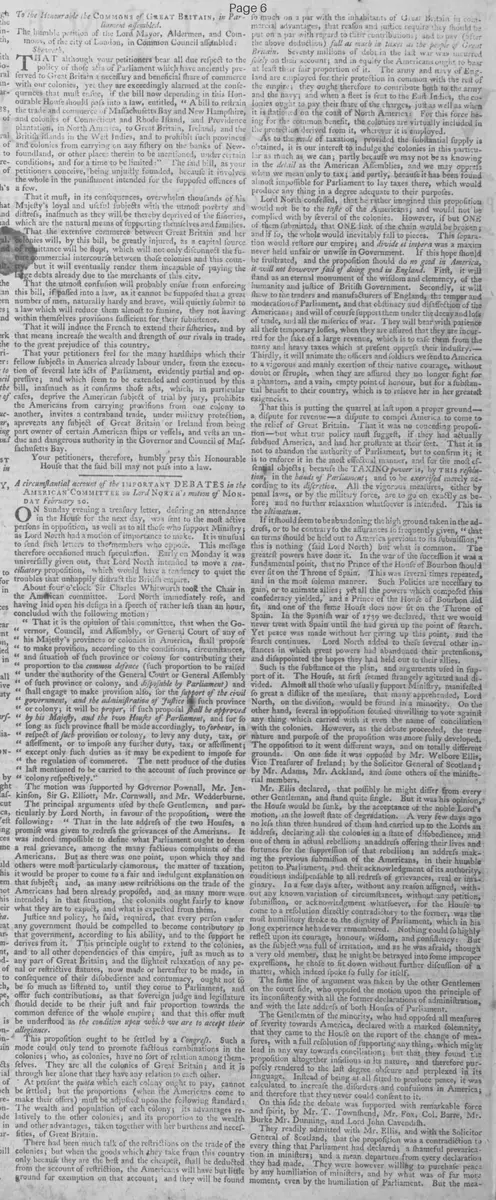
On Sunday evening a treasury letter, desiring an attendance in the House for the next day, was sent to the most active persons in opposition, as well as to all those who support Ministry; as Lord North had a motion of importance to make. It is unusual to send such letters to the members who oppose. This message therefore occasioned much speculation. Early on Monday it was universally given out, that Lord North intended to move a conciliatory proposition, which would have a tendency to quiet the troubles that unhappily distract the British empire.
About four o'clock Sir Charles Whitworth took the Chair in the American committee. Lord North immediately rose, and having laid open his design in a speech of rather less than an hour, concluded with the following motion:
"That it is the opinion of this committee, that when the Governor, Council, and Assembly, or General Court of any of his Majesty's provinces or colonies in America, shall propose to make provision, according to the conditions, circumstances, and situation of such province or colony, for contributing their proportion to the common defence (such proportion to be raised under the authority of the General Court or General Assembly of such province or colony, and disposable by Parliament) and shall engage to make provision also, for the support of the civil government, and the administration of justice in such province or colony; it will be proper, if such proposal shall be approved by his Majesty, and the two Houses of Parliament, and for so long as such provision shall be made accordingly, to forbear, in respect of such provision or colony, to levy any duty, tax, or assessment, or to impose any further duty, tax, or assessment; except only such duties as it may be expedient to impose for the regulation of commerce. The nett produce of the duties last mentioned to be carried to the account of such province or colony respectively."
The motion was supported by Governor Pownall, Mr. Jenkinson, Sir G. Elliott, Mr. Cornwall, and Mr. Wedderburn.
The principal arguments used by these Gentlemen, and particularly by Lord North, in favour of the proposition, were the following: "That in the late address of the two Houses, a promise was given to redress the grievances of the Americans. It was indeed impossible to define what Parliament ought to deem a real grievance, among the many factious complaints of the Americans. But as there was one point, upon which they and others were most particularly clamorous, the matter of taxation, it would be proper to come to a fair and indulgent explanation on that subject; and, as many new restrictions on the trade of the Americans had been already proposed, and as many more were intended; in that situation, the colonists ought fairly to know what they are to expect, and what is expected from them.
Justice and policy, he said, required, that every person under any government should be compelled to become contributory to that government, according to his ability, and to the support he derives from it. This principle ought to extend to the colonies, and to all other dependencies of this empire, just as much as to any part of Great Britain; and the slightest relaxation of any penal or restrictive statutes, now made or hereafter to be made, in consequence of their disobedience and contumacy, ought not to be so much as listened to, until they come to Parliament, and offer such contributions, as that sovereign judge and legislature should decide to be their just and fair proportion towards the common defence of the whole empire; and that this offer must be understood as the condition upon which we are to accept their allegiance.
This proposition ought to be settled by a Congress. Such a mode could only tend to promote factious combinations in the colonies; who, as colonies, have no sort of relation among themselves. They are all the colonies of Great Britain; and it is through her alone that they have any relation to each other.
At present the quota which each colony ought to pay, cannot be settled; but the proportions (when the Americans come to make their offers) must be adjusted upon the following standard: The wealth and population of each colony; its advantages relatively to the other colonies; and its proportion to the wealth and other advantages, taken together with her burthens and necessities, of Great Britain.
There had been much talk of the restrictions on the trade of the colonies; but when the goods which they take from this country only because they are the best and the cheapest, shall be deducted from the account of restriction, the Americans will have but little ground for exemption on that account; and they will be found so much on a par with the inhabitants of Great Britain in commercial advantages, that reason and justice require they should be put on a par with regard to their contributions; and to pay (after the above deduction) full as much in taxes as the people of Great Britain. Seventy millions of debt in the last war was incurred solely on their account; and in equity the Americans ought to bear at least their fair proportion of it. The army and navy of England are employed for their protection in common with the rest of the empire; they ought therefore to contribute both to the army and the navy; and when a fleet is sent to the East Indies, the colonies ought to pay their share of the charges, just as well as when it is stationed on the coast of North America: For this force being for the common benefit, the colonies are virtually included in the protection derived from it, wherever it is employed.
As to the mode of taxation, provided the substantial supply is obtained, it is our interest to indulge the colonies in this particular as much as we can; partly because we may not be as knowing in the detail as the American Assemblies, and we may oppress when we mean only to tax; and partly, because it has been found almost impossible for Parliament to lay taxes there, which would produce any thing in a degree adequate to their purposes.
Lord North confessed, that he rather imagined this proposition would not be to the taste of the Americans; and would not be complied with by several of the colonies. However, if but ONE of them submitted, that ONE link of the chain would be broken; and if so, the whole would inevitably fall to pieces. This separation would restore our empire; and divide et impera was a maxim never held unfair or unwise in Government. If this hope should be frustrated, and the proposition should do no good in America, it will not however fail of doing good in England. First, it will stand as an eternal monument of the wisdom and clemency, of the humanity and justice of British Government. Secondly, it will shew to the traders and manufacturers of England, the temper and moderation of Parliament, and that obstinacy and disaffection of the Americans: and will of course support them under the decay and loss of trade, and all the miseries of war. They will bear with patience all these temporary losses, when they are assured that they are incurred for the sake of a large revenue, which is to ease them from the many and heavy taxes which at present oppress their industry.
Thirdly, it will animate the officers and soldiers we send to America to a vigorous and manly exertion of their native courage, without doubt or scruple, when they are assured they no longer fight for a phantom, and a vain, empty point of honour, but for a substantial benefit to their country, which is to relieve her in her greatest exigencies.
That this is putting the quarrel at last upon a proper ground—a dispute for revenue—a dispute to compel America to come to the relief of Great Britain. That it was no conceding proposition—but what true policy must suggest, if they had actually subdued America, and had her prostrate at their feet. That it is not to abandon the authority of Parliament, but to confirm it; it is to enforce it in the most effectual manner, and for the most essential objects; because the TAXING power is, by THIS resolution, in the hands of Parliament; and to be exercised merely according to its discretion. All the vigorous measures, either by penal laws, or by the military force, are to go on exactly as before; and no further relaxation whatsoever is intended. This is the ultimatum.
If it should seem to be abandoning the high ground taken in the address, or to be contrary to the assurances so frequently given, "that no terms should be held out to America previous to its submission," this is nothing (said Lord North) but what is common. The greatest powers have done it. In the war of the succession it was a fundamental point, that no Prince of the House of Bourbon should ever sit on the Throne of Spain. This was several times repeated, and in the most solemn manner. Such Politics are necessary to gain, or to animate allies; yet all the powers which composed this confederacy yielded, and a Prince of the House of Bourbon did sit, and one of the same House does now sit on the Throne of Spain. In the Spanish war of 1739 we declared, that we would never treat with Spain until she had given up the point of search. Yet peace was made without her giving up this point, and the search continues. Lord North added to these several other instances in which great powers had abandoned their pretensions, and disappointed the hopes they had held out to their allies.
Such is the substance of the plan, and arguments used in support of it. The House, at first seemed strangely agitated and divided. Almost all those who usually support Ministry, manifested so great a dislike of the measure, that many apprehended, Lord North, on the division, would be found in a minority. On the other hand, several in opposition seemed unwilling to vote against any thing which carried with it even the name of conciliation with the colonies. However, as the debate proceeded, the true nature and purpose of the proposition was more fully developed.
The opposition to it went different ways, and on totally different grounds. On one side it was opposed by Mr. Welbore Ellis, Vice Treasurer of Ireland; by the Solicitor General of Scotland; by Mr. Adams, Mr. Ackland, and some others of the ministerial members.
Mr. Ellis declared, that possibly he might differ from every other Gentleman, and stand quite single. But it was his opinion, the House would be sunk, by the acceptance of the noble Lord's motion, in the lowest state of degradation. A very few days ago no less than three hundred of them had carried up to the Lords an address, declaring all the colonies in a state of disobedience, and one of them in actual rebellion; an address offering their lives and fortunes for the suppression of that rebellion; an address making the previous submission of the Americans, in their humble petition to Parliament, and their acknowledgment of its authority, conditions indispensable to all redress of grievances, real or imaginary. In a few days after, without any reason assigned, without any known variation of circumstances, without any petition, submission, or acknowledgment whatsoever, for the House to come to a resolution directly contradictory to the former, was the most humiliating stroke to the dignity of Parliament, which in his long experience he had ever remembered. Nothing could so highly reflect upon its courage, honour, wisdom, and consistency: But as the subject was full of irritation, and as he was afraid, though a very old member, that he might be betrayed into some improper expressions, he chose to sit down without further discussion of a matter, which indeed spoke so fully for itself.
The same line of argument was taken by the other Gentlemen on the court side, who opposed the motion upon the principle of its inconsistency with all the former declarations of administration, and with the late address of both Houses of Parliament.
The Gentlemen of the minority, who had opposed all measures of severity towards America, declared with a marked solemnity, that they came to the House on the report of the change of measures, with a full resolution of supporting any thing, which might lead in any way towards conciliation; but that they found the proposition altogether insidious in its nature, and therefore purposely rendered to the last degree obscure and perplexed in its language. Instead of being at all fitted to produce peace, it was calculated to increase the disorders and confusions in America; and therefore that they never could consent to it.
On this side the debate was supported with remarkable force and spirit, by Mr. T. Townshend, Mr. Fox, Col. Barre, Mr. Burke, Mr. Dunning, and Lord John Cavendish.
They readily admitted with Mr. Ellis, and with the Solicitor General of Scotland, that the proposition was a contradiction to every thing that Parliament had declared; a shameful prevarication in ministers; and a mean departure from every declaration they had made. They were however willing to purchase peace by any humiliation of ministers, and by what was of far more moment, even by the humiliation of Parliament. But the measure...
The measure was mean indeed, but not at all conciliatory. One benefit, however, was derived from it, for (said Mr. Fox) it has re-established the credit, and revitalized the power, of the true constitutional whig principle of resistance. This had already reduced the proudest tyranny; had made it renounce its high declarations, and stoop to meanness and fraud, the sure forerunner of rout and dismay. That as Lord North had already been staggered into this unnatural act of irresolution and inconstancy, there might be some hope of his proceeding to others which might be really lenient; if it were not the nature of inconstancy, not to proceed in any certain track; and that the same want of a fixed principle which led him to renounce his first plan, might induce him perhaps as suddenly to return to it.
That the mode of argument on the side of ministry was the most ridiculous that ever had been known in Parliament. They attempted to prove to one side of the House, that the measure was a concession; and to the other, that it was a strong assertion of authority, just on the silly principles of the Tea Act, which to Great Britain was to be a duty of supply, to the Americans a tax of regulation.
They were likewise (they said) astonished at another extraordinary phenomenon. To this day, during the whole course of the American debates, the ministry have daily and hourly denied their having any sort of contest about an American revenue. That the whole was a dispute for obedience to trade laws, and to the general legislative authority. Now they turn short, and to console our manufacturers, and animate our soldiers, they tell them for the first time, "the dispute is put on its true footing, and that the grand contest is, not for empty honour, but substantial revenue." But manufacturers and soldiers will not be so consoled, or so animated; because the revenue is as much an empty phantom, as the honour; and the whole scheme of the resolution is oppressive, absurd, and impracticable; and, what indeed the ministers confess the Americans will not accept. It is oppressive; because it was never the complaint of the Americans that the mode of taxation was not left to themselves; but that neither the amount and quantum of the grant, nor the application, was in their free choice. This was their complaint, and their complaint was just. What else is it to be taxed by Parliament in which they are not represented, but for Parliament to settle the proportion of the payment, and the application of the money? This is the purport of the present resolution. If an act of Parliament compelled the city of Amsterdam to raise a hundred thousand pounds, is not Amsterdam as effectually taxed without its consent, as if duties to that amount were laid upon that city? To leave them the mode may be of some ease as to the collection; but it is nothing to the freedom of granting; in which the colonies are so far from being relieved by this resolution, that their condition is to be ten times worse than ever. For the minority contended, that it is a far more oppressive mode of taxing than that hitherto used. For here no determinate demand is made. The colonies are to be held in durance by troops, fleets, and armies, until singly and separately they shall do - what? until they shall offer to contribute to a service which they cannot know, in a proportion which they cannot guess, on a standard, which they are so far from being able to ascertain, that Parliament which is to hold it, has not ventured to hint what it is they expect. They are to be held prisoners of war, unless they consent to a ransom, by bidding at an auction against each other and against themselves, until the King and Parliament shall strike down the hammer, and say "enough."
This species of auction to be terminated not at the discretion of the bidder, but at the will of the sovereign power, was a kind of absurd tyranny, which they challenged the ministers to produce any example of, in the practice of this or of any other nation. What was said to be most like this method of setting the colony Assemblies, at guessing what contribution might be most agreeable to us in some future time, was the tyranny of Nebuchadnezzar, who having forgot a dream of his, ordered the Assemblies of his wise men, on pain of death, not only to interpret his dream, but to tell him what his dream was.
To set the impracticability and absurdity of this scheme in the stronger light, they asked, in case an Assembly made an offer, which should not be thought sufficient by Parliament, was not the business to walk back again to America; and so on backwards and forwards as often as the offer displeased Parliament? And thus instead of obtaining Peace by this proposition, all our distractions and confusions will be increased ten fold, and continued forever.
It was said indeed by the Minister, that this scheme will disunite the colonies. Tricks in government had sometimes, it was admitted, been successful; but never, when they were known, avowed and hackneyed. That the Boston port bill was a declared cheat, and accordingly, far from succeeding, it was the very first thing that united all the colonies against us, from Nova Scotia to Georgia.
As to the pretended justice of this extorted contribution, from the debt incurred on the sole account of America, Col. Barre said, it was false and futile. We must defend our dominions wherever they are attacked by our enemies; but to charge the part attacked as the cause of the burden brought on by that defence, is ridiculous. It was not the ambition of the colonies, but the designs of France aiming at an Empire in America which caused that debt.
The idea of deducting the value of goods supposed to be taken by the colonists, because we sold cheap, at a time when we did not suffer the colonies to make the trial; and by such arithmetic to deduce the propriety of their paying in nearly an equal proportion with the people of England (they said) was of a piece with the rest of the policy and the argument of this profound project.
Mr. Burke strongly declared against any scheme, which began by any mode of extorting revenue. That every benefit, natural or political, must be had in the order of things, and in its proper season. Revenue from a free people must be the consequence of peace, not the condition on which it is to be obtained. That if we attempt to invert this order, we shall have neither peace nor revenue. If we are resolved to eat our grapes crude and sour, instead of obtaining nourishment, we shall only set an edge on our own teeth, and those our posterity forever.
They all urged, therefore, for the re-consideration until it could be brought to some agreement with common sense: They moved, "that the Chairman do now leave the Chair, and have leave to sit again."
The Minister, distracted by an opposition from such opposite quarters, seemed ready to sink under it. His allies seemed on the point of desertion, until the great BUTE STANDARD was displayed by Sir Gilbert Elliott, when most of them fell again into order, and though ashamed and mortified, voted with the Minister.
The instantaneous effect of the few words spoken by the STANDARD BEARER, after Lord North had been five times on his legs, and only made matters worse and worse, was painted by Mr. Dunning in a vein of the most delicate irony.
The numbers upon the division were: Ayes 274, Noes 88.
What sub-type of article is it?
What themes does it cover?
What keywords are associated?
What entities or persons were involved?
Where did it happen?
Story Details
Key Persons
Location
American Committee, House Of Commons, London
Event Date
Monday February 20
Story Details
Lord North's motion proposed American colonies provide voluntary contributions for defense and government support in exchange for tax forbearance except on commerce; debated intensely with arguments on justice, policy, and consistency; opposed from ministerial and opposition sides for inconsistency and insidiousness; passed 274-88.