Thank you for visiting SNEWPapers!
Sign up free
Poem
December 8, 1855
Saint Croix Union
Stillwater, Washington County, Minnesota
What is this article about?
A reflective poem contrasting the vibrant beauty of a summer meadow with its barren winter state, pondering the transience of earthly life and finding solace in the hope of immortality.
Clipping
OCR Quality
98%
Excellent
Full Text
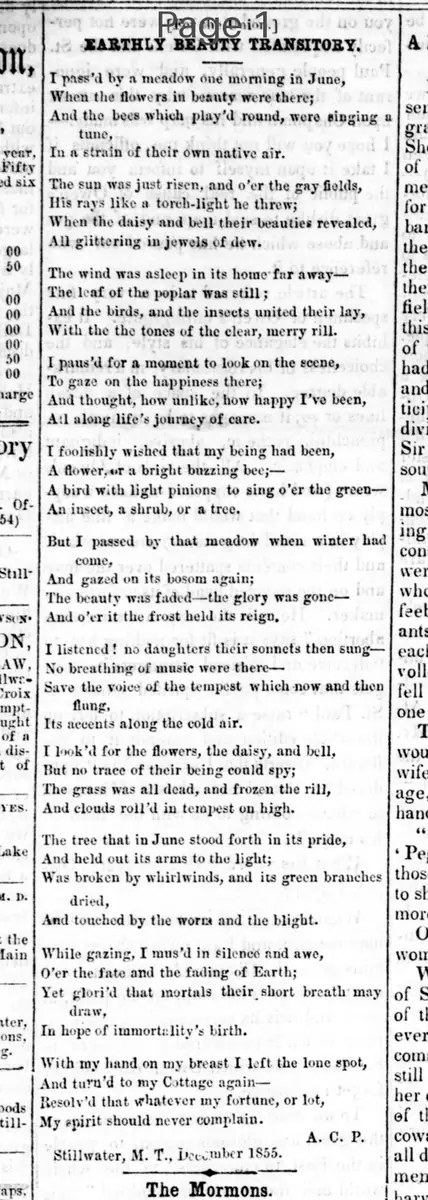
EARTHLY BEAUTY TRANSITORY.
I pass'd by a meadow one morning in June,
When the flowers in beauty were there;
And the bees which play'd round, were singing tune,
In a strain of their own native air.
The sun was just risen, and o'er the gay fields,
His rays like a torch-light he threw;
When the daisy and bell their beauties revealed,
All glittering in jewels of dew.
The wind was asleep in its home far away-
The leaf of the poplar was still;
And the birds, and the insects united their lay,
With the tones of the clear, merry rill.
I paus'd for a moment to look on the scene,
To gaze on the happiness there;
And thought, how unlike, how happy I've been,
All along life's journey of care.
I foolishly wished that my being had been,
A flower, or a bright buzzing bee;-
A bird with light pinions to sing o'er the green-
An insect, a shrub, or a tree.
But I passed by that meadow when winter had come,
And gazed on its bosom again:
The beauty was faded-the glory was gone-
And o'er it the frost held its reign.
I listen'd! no daughters their sonnets then sung
No breathing of music were there--
Save the voice of the tempest which-now and then flung,
Its accents along the cold air.
I look'd for the flowers, the daisy, and bell.
But no trace of their being could spy;
The grass was all dead, and frozen the rill,
And clouds roll'd in tempest on high.
The tree that in June stood forth in its pride,
And held out its arms to the light;
Was broken by whirlwinds, and its green branches dried,
And touched by the worm and the blight.
While gazing, I mus'd in silence and awe
O'er the fate and the fading of Earth:
Yet gloried that mortals their short breath may draw,
In hope of immortality's birth.
With my hand on my breast I left the lone spot,
And turn'd to my Cottage again-
Resolv'd that whatever my fortune, or lot,
My spirit should never complain.
A. C. P.
Stillwater. M. T., December 1855.
I pass'd by a meadow one morning in June,
When the flowers in beauty were there;
And the bees which play'd round, were singing tune,
In a strain of their own native air.
The sun was just risen, and o'er the gay fields,
His rays like a torch-light he threw;
When the daisy and bell their beauties revealed,
All glittering in jewels of dew.
The wind was asleep in its home far away-
The leaf of the poplar was still;
And the birds, and the insects united their lay,
With the tones of the clear, merry rill.
I paus'd for a moment to look on the scene,
To gaze on the happiness there;
And thought, how unlike, how happy I've been,
All along life's journey of care.
I foolishly wished that my being had been,
A flower, or a bright buzzing bee;-
A bird with light pinions to sing o'er the green-
An insect, a shrub, or a tree.
But I passed by that meadow when winter had come,
And gazed on its bosom again:
The beauty was faded-the glory was gone-
And o'er it the frost held its reign.
I listen'd! no daughters their sonnets then sung
No breathing of music were there--
Save the voice of the tempest which-now and then flung,
Its accents along the cold air.
I look'd for the flowers, the daisy, and bell.
But no trace of their being could spy;
The grass was all dead, and frozen the rill,
And clouds roll'd in tempest on high.
The tree that in June stood forth in its pride,
And held out its arms to the light;
Was broken by whirlwinds, and its green branches dried,
And touched by the worm and the blight.
While gazing, I mus'd in silence and awe
O'er the fate and the fading of Earth:
Yet gloried that mortals their short breath may draw,
In hope of immortality's birth.
With my hand on my breast I left the lone spot,
And turn'd to my Cottage again-
Resolv'd that whatever my fortune, or lot,
My spirit should never complain.
A. C. P.
Stillwater. M. T., December 1855.
What sub-type of article is it?
Pastoral
Ode
What themes does it cover?
Nature Seasons
Death Mourning
Religious Faith
What keywords are associated?
Earthly Beauty
Transitory
Meadow
Summer Winter
Immortality
Nature Reflection
What entities or persons were involved?
A. C. P.
Poem Details
Title
Earthly Beauty Transitory.
Author
A. C. P.
Subject
Transitory Nature Of Earthly Beauty
Form / Style
Rhymed Quatrains
Key Lines
I Pass'd By A Meadow One Morning In June,
When The Flowers In Beauty Were There;
Yet Gloried That Mortals Their Short Breath May Draw,
In Hope Of Immortality's Birth.