Thank you for visiting SNEWPapers!
Sign up free
The Virginia Gazette
Williamsburg, Virginia
What is this article about?
In a letter to the Virginia Gazette printer, 'A Virginian' critiques British ministry's insincere reconciliation overtures amid military buildup, recalling oppressions like taxes and trade curbs, and urges Americans to prepare for war while hoping for peace. References Lord Dunmore's actions and Public Advertiser extracts.
Merged-components note: These three components form a single continuous letter to the editor signed 'A VIRGINIAN', with text flowing directly from one to the next.
Clipping
OCR Quality
Full Text
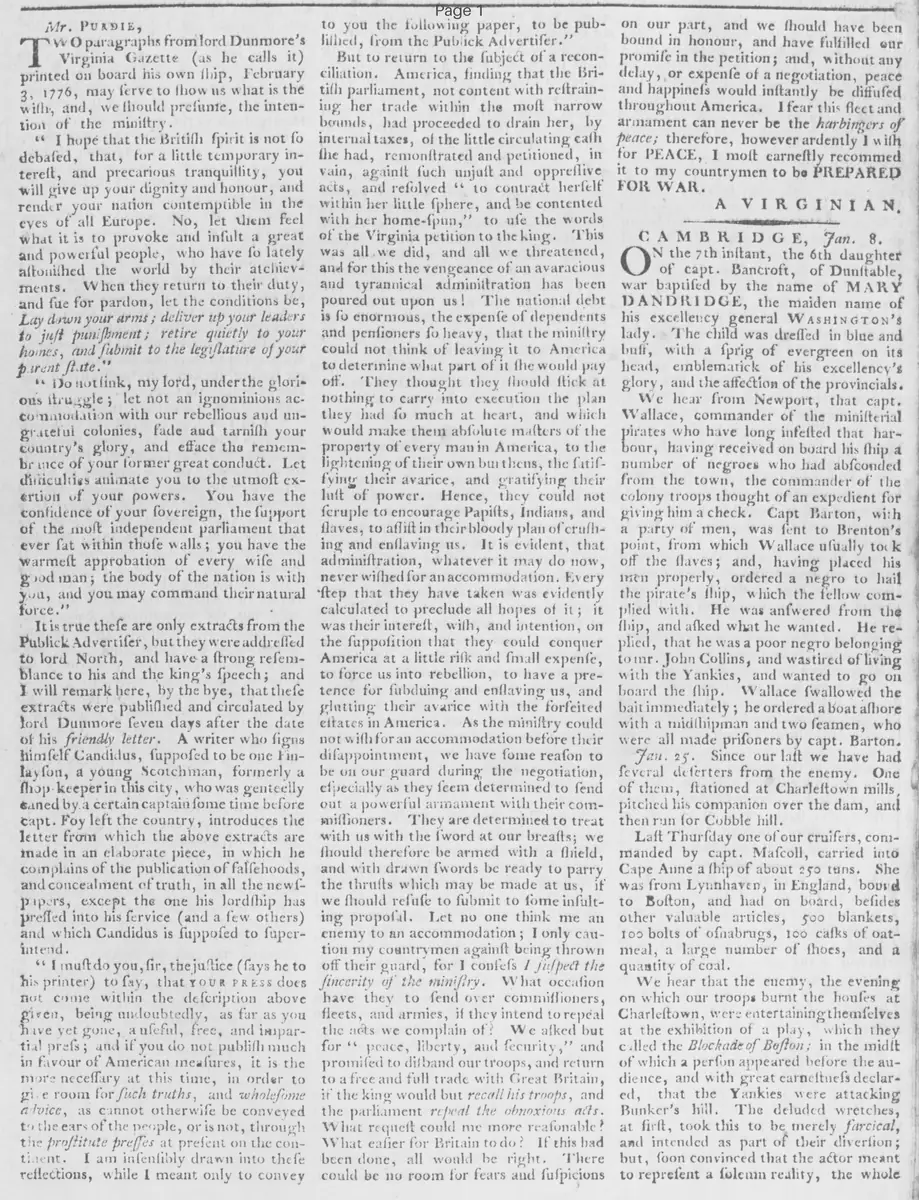
Virginia Gazette (as he calls it) printed on board his own ship, February 3, 1776, may serve to show us what is the will, and, we should presume, the intention of the ministry.
I hope that the British spirit is not so debased, that, for a little temporary interest, and precarious tranquillity, you will give up your dignity and honour, and render your nation contemptible in the eyes of all Europe. No, let them feel what it is to provoke and insult a great and powerful people, who have so lately astonished the world by their achievements. When they return to their duty, and sue for pardon, let the conditions be, Lay down your arms; deliver up your leaders to just punishment; retire quietly to your homes, and submit to the legislature of your parent state."
"Do not sink, my lord, under the glorious struggle; let not an ignominious accommodation with our rebellious and ungrateful colonies, sully and tarnish your country's glory, and efface the remembrance of your former great conduct. Let difficulties animate you to the utmost exertion of your powers. You have the confidence of your sovereign, the support of the most independent parliament that ever sat within those walls; you have the warmest approbation of every wise and good man; the body of the nation is with you, and you may command their natural force."
It is true these are only extracts from the Publick Advertiser, but they were addressed to lord North, and have a strong resemblance to his and the king's speech; and I will remark here, by the bye, that these extracts were published and circulated by Lord Dunmore seven days after the date of his friendly letter. A writer who signs himself Candidus, supposed to be one Finlayson, a young Scotchman, formerly a shop-keeper in this city, who was genteelly caned by a certain captain some time before capt. Foy left the country, introduces the letter from which the above extracts are made in an elaborate piece, in which he complains of the publication of falsehoods, and concealment of truth, in all the newspapers, except the one his lordship has pressed into his service (and a few others) and which Candidus is supposed to superintend.
"I must do you, sir, the justice (says he to his printer) to say, that YOUR PRESS does not come within the description above given, being undoubtedly, as far as you have yet gone, a useful, free, and impartial press; and if you do not publish much in favour of American measures, it is the more necessary at this time, in order to give room for such truths, and wholesome advice, as cannot otherwise be conveyed to the ears of the people, or is not, through the prostitute presses at present on the continent. I am insensibly drawn into these reflections, while I meant only to convey
to you the following paper, to be published, from the Publick Advertiser."
But to return to the subject of a reconciliation. America, finding that the British parliament, not content with restraining her trade within the most narrow bounds, had proceeded to drain her, by internal taxes, of the little circulating cash she had, remonstrated and petitioned, in vain, against such unjust and oppressive acts, and resolved "to contract herself within her little sphere, and be contented with her home-spun," to use the words of the Virginia petition to the king. This was all we did, and all we threatened, and for this the vengeance of an avaricious and tyrannical administration has been poured out upon us! The national debt is so enormous, the expense of dependents and pensioners so heavy, that the ministry could not think of leaving it to America to determine what part of it she would pay off. They thought they should stick at nothing to carry into execution the plan they had so much at heart, and which would make them absolute masters of the property of every man in America, to the lightening of their own burdens, the satisfying their avarice, and gratifying their lust of power. Hence, they could not scruple to encourage Papists, Indians, and slaves, to assist in their bloody plan of crushing and enslaving us. It is evident, that administration, whatever it may do now, never wished for an accommodation. Every step that they have taken was evidently calculated to preclude all hopes of it; it was their interest, wish, and intention, on the supposition that they could conquer America at a little risk and small expense, to force us into rebellion, to have a pretence for subduing and enslaving us, and glutting their avarice with the forfeited estates in America. As the ministry could not wish for an accommodation before their disappointment, we have some reason to be on our guard during the negotiation, especially as they seem determined to send out a powerful armament with their commissioners. They are determined to treat with us with the sword at our breasts; we should therefore be armed with a shield, and with drawn swords be ready to parry the thrusts which may be made at us, if we should refuse to submit to some insulting proposal. Let no one think me an enemy to an accommodation; I only caution my countrymen against being thrown off their guard, for I confess I suspect the sincerity of the ministry. What occasion have they to send over commissioners, fleets, and armies, if they intend to repeal the acts we complain of? We asked but for "peace, liberty, and security," and promised to disband our troops, and return to a free and full trade with Great Britain, if the king would but recall his troops, and the parliament repeal the obnoxious acts. What request could be more reasonable? What easier for Britain to do? If this had been done, all would be right.
on our part, and we should have been bound in honour, and have fulfilled our promise in the petition; and, without any delay, or expense of a negotiation, peace and happiness would instantly be diffused throughout America. I fear this fleet and armament can never be the harbingers of peace; therefore, however ardently I wish for PEACE, I most earnestly recommend it to my countrymen to be PREPARED FOR WAR.
A VIRGINIAN.
What sub-type of article is it?
What themes does it cover?
What keywords are associated?
What entities or persons were involved?
Letter to Editor Details
Author
A Virginian.
Recipient
Mr. Purdie
Main Argument
the british ministry's reconciliation efforts are insincere, as evidenced by past oppressions like trade restrictions and taxes, encouragement of enemies against america, and current military preparations; americans should desire peace but prepare for war to guard against betrayal.
Notable Details