Thank you for visiting SNEWPapers!
Sign up free
Editorial
December 14, 1796
Gazette Of The United States, & Philadelphia Daily Advertiser
Philadelphia, Philadelphia County, Pennsylvania
What is this article about?
Editorial sympathizes with victims of a major fire in central New York City on December 12, urging citizens and government to prevent future fires and diseases through better building regulations, use of brick over wood, and allocating space for fire engines to ensure public safety and urban growth.
Clipping
OCR Quality
98%
Excellent
Full Text
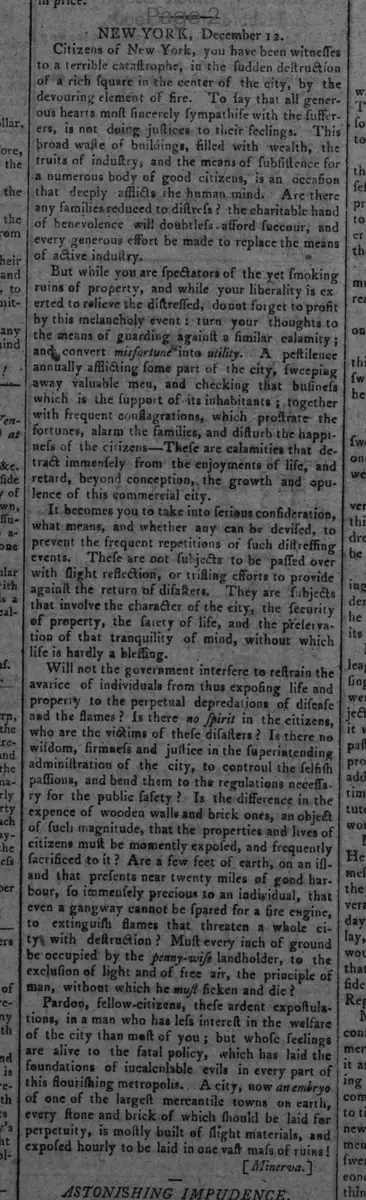
NEW YORK, December 12.
Citizens of New York, you have been witnesses to a terrible catastrophe, in the sudden destruction of a rich square in the center of the city, by the devouring element of fire. To say that all generous hearts most sincerely sympathize with the sufferers, is not doing justice to their feelings. This broad wave of buildings, filled with wealth, the fruits of industry, and the means of subsistence for a numerous body of good citizens, is an occasion that deeply afflicts the human mind. Are there any families reduced to distress? the charitable hand of benevolence will doubtless afford succour, and every generous effort be made to replace the means of active industry.
But while you are spectators of the yet smoking ruins of property, and while your liberality is exerted to relieve the distressed, do not forget to profit by this melancholy event: turn your thoughts to the means of guarding against a similar calamity; and convert misfortune into utility. A pestilence annually afflicting some part of the city, sweeping away valuable men, and checking that business which is the support of its inhabitants; together with frequent conflagrations, which prostrate the fortunes, alarm the families, and disturb the happiness of the citizens—These are calamities that detract immensely from the enjoyments of life, and retard, beyond conception, the growth and opulence of this commercial city.
It becomes you to take into serious consideration, what means, and whether any can be devised, to prevent the frequent repetitions of such distressing events. These are not subjects to be passed over with slight reflection, or trifling efforts to provide against the return of disasters. They are subjects that involve the character of the city, the security of property, the safety of life, and the preservation of that tranquility of mind, without which life is hardly a blessing.
Will not the government interfere to restrain the avarice of individuals from thus exposing life and property to the perpetual depredations of disease and the flames? Is there no spirit in the citizens, who are the victims of these disasters? Is there no wisdom, firmness and justice in the superintending administration of the city, to control the selfish passions, and bend them to the regulations necessary for the public safety? Is the difference in the expense of wooden walls and brick ones, an object of such magnitude, that the properties and lives of citizens must be momently exposed, and frequently sacrificed to it? Are a few feet of earth, on an island that presents near twenty miles of good harbour, so immensely precious to an individual, that even a gangway cannot be spared for a fire engine, to extinguish flames that threaten a whole city with destruction? Must every inch of ground be occupied by the penny-wise landholder, to the exclusion of light and of free air, the principle of man, without which he must sicken and die?
Pardon, fellow-citizens, these ardent expostulations, in a man who has less interest in the welfare of the city than most of you; but whose feelings are alive to the fatal policy, which has laid the foundations of incalculable evils in every part of this flourishing metropolis. A city, now an embryo of one of the largest mercantile towns on earth, every stone and brick of which should be laid for perpetuity, is mostly built of slight materials, and exposed hourly to be laid in one vast mass of ruins!
[Minerva.]
Citizens of New York, you have been witnesses to a terrible catastrophe, in the sudden destruction of a rich square in the center of the city, by the devouring element of fire. To say that all generous hearts most sincerely sympathize with the sufferers, is not doing justice to their feelings. This broad wave of buildings, filled with wealth, the fruits of industry, and the means of subsistence for a numerous body of good citizens, is an occasion that deeply afflicts the human mind. Are there any families reduced to distress? the charitable hand of benevolence will doubtless afford succour, and every generous effort be made to replace the means of active industry.
But while you are spectators of the yet smoking ruins of property, and while your liberality is exerted to relieve the distressed, do not forget to profit by this melancholy event: turn your thoughts to the means of guarding against a similar calamity; and convert misfortune into utility. A pestilence annually afflicting some part of the city, sweeping away valuable men, and checking that business which is the support of its inhabitants; together with frequent conflagrations, which prostrate the fortunes, alarm the families, and disturb the happiness of the citizens—These are calamities that detract immensely from the enjoyments of life, and retard, beyond conception, the growth and opulence of this commercial city.
It becomes you to take into serious consideration, what means, and whether any can be devised, to prevent the frequent repetitions of such distressing events. These are not subjects to be passed over with slight reflection, or trifling efforts to provide against the return of disasters. They are subjects that involve the character of the city, the security of property, the safety of life, and the preservation of that tranquility of mind, without which life is hardly a blessing.
Will not the government interfere to restrain the avarice of individuals from thus exposing life and property to the perpetual depredations of disease and the flames? Is there no spirit in the citizens, who are the victims of these disasters? Is there no wisdom, firmness and justice in the superintending administration of the city, to control the selfish passions, and bend them to the regulations necessary for the public safety? Is the difference in the expense of wooden walls and brick ones, an object of such magnitude, that the properties and lives of citizens must be momently exposed, and frequently sacrificed to it? Are a few feet of earth, on an island that presents near twenty miles of good harbour, so immensely precious to an individual, that even a gangway cannot be spared for a fire engine, to extinguish flames that threaten a whole city with destruction? Must every inch of ground be occupied by the penny-wise landholder, to the exclusion of light and of free air, the principle of man, without which he must sicken and die?
Pardon, fellow-citizens, these ardent expostulations, in a man who has less interest in the welfare of the city than most of you; but whose feelings are alive to the fatal policy, which has laid the foundations of incalculable evils in every part of this flourishing metropolis. A city, now an embryo of one of the largest mercantile towns on earth, every stone and brick of which should be laid for perpetuity, is mostly built of slight materials, and exposed hourly to be laid in one vast mass of ruins!
[Minerva.]
What sub-type of article is it?
Infrastructure
Social Reform
Legal Reform
What keywords are associated?
New York Fire
Fire Prevention
Urban Safety
Building Materials
Government Regulation
Public Health
Conflagrations
What entities or persons were involved?
Citizens Of New York
New York Government
City Administration
Landholders
Editorial Details
Primary Topic
Fire Prevention And Urban Building Regulations In New York
Stance / Tone
Urgent Exhortation For Government Intervention And Public Safety Measures
Key Figures
Citizens Of New York
New York Government
City Administration
Landholders
Key Arguments
Sympathize Deeply With Fire Victims And Offer Charitable Aid
Learn From The Fire To Prevent Future Calamities Like Fires And Pestilences
Criticize Use Of Wooden Buildings Over Durable Brick Due To Cost
Demand Space Allocation For Fire Engines And Access To Light And Air
Urge Government To Regulate Individual Avarice For Public Safety And Tranquility