Thank you for visiting SNEWPapers!
Sign up free
Editorial
December 29, 1787
The New York Journal, And Daily Patriotic Register
New York, New York County, New York
What is this article about?
The minority of the Pennsylvania ratifying convention issues an address dissenting from the US Constitution's ratification, criticizing the federal convention's secrecy and overreach, the legislature's improper call for a state convention, and the document's potential to consolidate power into a despotic national government at the expense of state sovereignty and rights.
Clipping
OCR Quality
95%
Excellent
Full Text
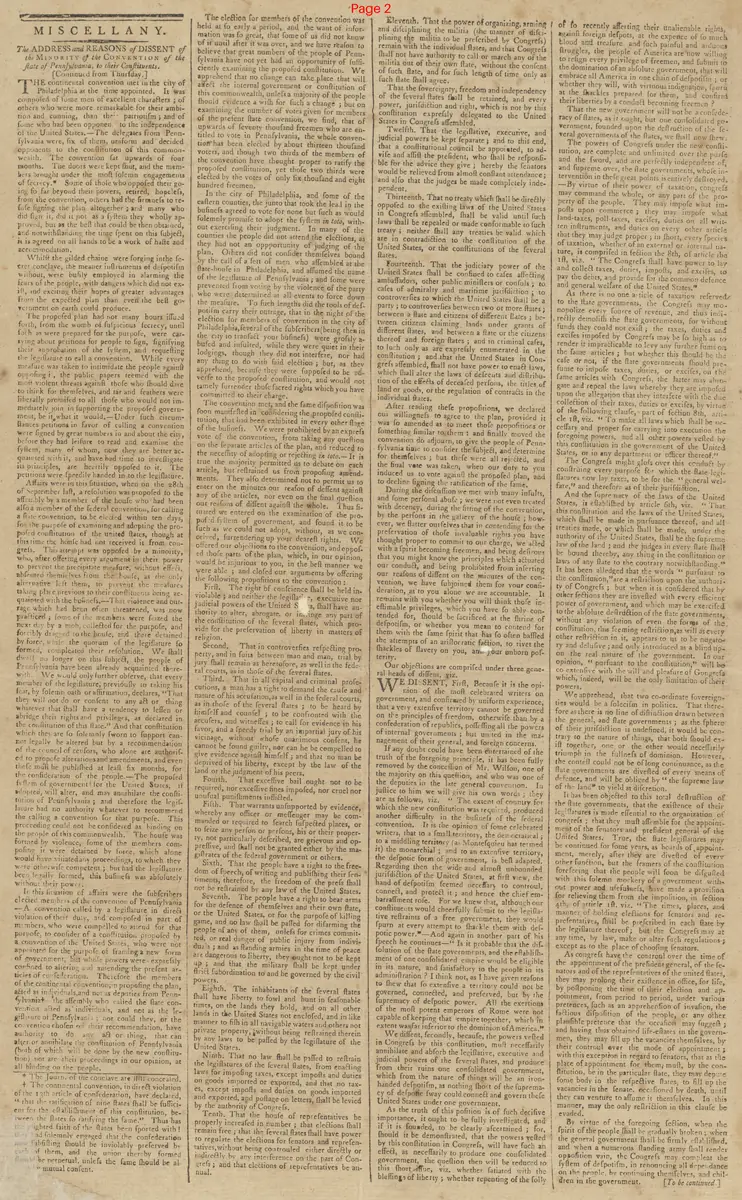
MISCELLANY.
The ADDRESS and REASONS of DISSENT of the MINORITY of the CONVENTION of the State of Pennsylvania, to their Constituents.
[Continued from Thursday.]
The continental convention met in the city of Philadelphia at the time appointed. It was composed of some men of excellent characters; of others who were more remarkable for their ambition and cunning, than their patriotism; and of some who had been opponents to the independence of the United States. The delegates from Pennsylvania were, six of them, uniform and decided opponents to the constitution of this commonwealth. The convention sat upwards of four months. The doors were kept shut, and the members bound under the most solemn engagements of secrecy.* Some of those who opposed their going so far beyond their powers, retired, hopeless, from the convention, others had the firmness to refuse signing the plan altogether; and many who did sign it, did it not as a system they wholly approved, but as the best that could be then obtained, and notwithstanding the time spent on this subject, it is agreed on all hands to be a work of haste and accommodation.
Whilst the gilded chains were forging in the secret conclave, the meaner instruments of despotism without, were busily employed in alarming the fears of the people, with dangers which did not exist, and exciting their hopes of greater advantages from the expected plan than even the best government on earth could produce.
The proposed plan had not many hours issued forth, from the womb of suspicious secrecy, until such as were prepared for the purpose, were carrying about petitions for people to sign, signifying their approbation of the system, and requesting the Legislature to call a convention. While every measure was taken to intimidate the people against opposing it, the public papers teemed with the most violent threats against those who should dare to think for themselves, and tar and feathers were liberally promised to all those who would not immediately join in supporting the proposed government, be it what it would. Under such circumstances petitions in favor of calling a convention were signed by great numbers in and about the city, before they had leisure to read and examine the system, many of whom, now they are better acquainted with it, and have had time to investigate its principles, are heartily opposed to it. The petitions were speedily handed in to the legislature.
Affairs were in this situation, when on the 28th of September last, a resolution was proposed to the assembly by a member of the house who had been also a member of the federal convention, for calling a state convention, to be elected within ten days, for the purpose of examining and adopting the proposed constitution of the united states, though at this time the house had not received it from congress. This attempt was opposed by a minority, who, after offering every argument in their power to prevent the precipitate measure, without effect, absented themselves from the house, as the only alternative left them, to prevent the measures taking place previous to their constituents being acquainted with the business. That violence and outrage which had been often threatened, was now practiced; some of the members were seized the next day by a mob, collected for the purpose, and forcibly dragged to the house, and there detained by force, while the quorum of the legislature so formed, completed their resolution. We shall dwell no longer on this subject, the people of Pennsylvania have been already acquainted therewith. We would only further observe, that every member of the legislature, previously to taking his seat, by solemn oath or affirmation, declares, "That they will not do or consent to any act or thing whatever that shall have a tendency to lessen or abridge their rights and privileges, as declared in the constitution of this state." And that constitution which they are so solemnly sworn to support cannot legally be altered but by a recommendation of the council of censors, who alone are authorized to propose alterations and amendments, and even these must be published at least six months, for the consideration of the people. The proposed system of government for the United States, if adopted, will alter, and may annihilate the constitution of Pennsylvania; and therefore the legislature had no authority whatever to recommend the calling a convention for that purpose. This proceeding could not be considered as binding on the people of this commonwealth. The house was formed by violence, some of the members composing it were detained by force, which alone would have vitiated any proceedings, to which they were otherwise competent; but had the legislature been legally formed, this business was absolutely without their power.
In this situation of affairs were the subscribers elected members of the convention of Pennsylvania —A convention called by a legislature in direct violation of their duty, and composed in part of members, who were compelled to attend for that purpose, to consider of a constitution proposed by a convention of the United States, who were not appointed for the purpose of framing a new form of government; but whose powers were expressly confined to altering and amending the present articles of confederation. Therefore the members of the continental convention, in proposing the plan, acted as individuals, and not as deputies from Pennsylvania; the assembly who called the state convention acted as individuals, and not as the legislature of Pennsylvania; nor could they, or the convention chosen on their recommendation, have authority to do any act or thing, that can alter or annihilate the constitution of Pennsylvania (both of which will be done by the new constitution) nor are their proceedings in our opinion, at all binding on the people.
* The Journals of the conclave are still concealed.
+ The continental convention, in direct violation of the 13th article of confederation, have declared, "that the ratification of nine states shall be sufficient for the establishment of this constitution, between the states so ratifying the same." Thus has the plighted faith of the states been sported with! It had solemnly engaged that the confederation now subsisting should be inviolably preserved by each of them, and the union thereby formed should be perpetual, unless the same should be altered by mutual consent.
The election for members of the convention was held at so early a period, and the want of information was so great, that some of us did not know of it until after it was over, and we have reason to believe that great numbers of the people of Pennsylvania have not yet had an opportunity of sufficiently examining the proposed constitution. We apprehend that no change can take place that will affect the internal government or constitution of this commonwealth, unless a majority of the people should evidence a wish for such a change; but on examining the number of votes given for members of the present state convention, we find, that of upwards of seventy thousand freemen who are entitled to vote in Pennsylvania, the whole convention has been elected by about thirteen thousand voters, and though two thirds of the members of the convention have thought proper to ratify the proposed constitution, yet those two thirds were elected by the votes of only six thousand and eight hundred freemen.
In the city of Philadelphia, and some of the eastern counties, the junto that took the lead in the business agreed to vote for none but such as would solemnly promise to adopt the system in toto, without exercising their judgment. In many of the counties the people did not attend the elections, as they had not an opportunity of judging of the plan. Others did not consider themselves bound by the call of a set of men who assembled at the state-house in Philadelphia, and assumed the name of the legislature of Pennsylvania; and some were prevented from voting by the violence of the party who were determined at all events to force down the measure. To such lengths did the tools of despotism carry their outrage, that in the night of the election for members of convention in the city of Philadelphia, several of the subscribers (being then in the city to transact your business) were grossly abused and insulted, while they were quiet in their lodgings, though they did not interfere, nor had any thing to do with said election; but, as they apprehend, because they were supposed to be adverse to the proposed constitution, and would not tamely surrender those sacred rights which you have committed to their charge.
The convention met, and the same disposition was soon manifested in considering the proposed constitution, that had been exhibited in every other stage of the business. We were prohibited by an express vote of the convention, from taking any question on the separate articles of the plan, and reduced to the necessity of adopting or rejecting in toto. It is true the majority permitted us to debate on each article, but restrained us from proposing amendments. They also determined not to permit us to enter on the minutes our reasons of dissent against any of the articles, nor even on the final question our reasons of dissent against the whole. Thus situated we entered on the examination of the proposed system of government, and found it to be such as we could not adopt, without, as we conceived, surrendering up your dearest rights. We offered our objections to the convention, and opposed those parts of the plan, which, in our opinion, would be injurious to you, in the best manner we were able; and closed our arguments by offering the following propositions to the convention:
First. The right of conscience shall be held inviolable; and neither the legislative, executive nor judicial powers of the United States, shall have authority to alter, abrogate, or infringe any part of the constitution of the several states, which provide for the preservation of liberty in matters of religion.
Second. That in controversies respecting property, and in suits between man and man, trial by jury shall remain as heretofore, as well in the federal courts, as in those of the several states.
Third. That in all capital and criminal prosecutions, a man has a right to demand the cause and nature of his accusation, as well in the federal courts, as in those of the several states; to be heard by himself and counsel: to be confronted with the accusers, and witnesses; to call for evidence in his favor, and a speedy trial by an impartial jury of his vicinage, without whose unanimous consent, he cannot be found guilty, nor can he be compelled to give evidence against himself; and that no man be deprived of his liberty, except by the law of the land or the judgment of his peers.
Fourth. That excessive bail ought not to be required, nor excessive fines imposed, nor cruel nor unusual punishments inflicted.
Fifth. That warrants unsupported by evidence, whereby any officer or messenger may be commanded or required to search suspected places, or to seize any person or persons, his or their property, not particularly described, are grievous and oppressive, and shall not be granted either by the magistrates of the federal government or others.
Sixth. That the people have a right to the freedom of speech, of writing and publishing their sentiments, therefore, the freedom of the press shall not be restrained by any law of the United States.
Seventh. The people have a right to bear arms for the defence of themselves and their own state, or the United States, or for the purpose of killing game, and no law shall be passed for disarming the people of any of them, unless for crimes committed, or real danger of public injury from individuals; and as standing armies in the time of peace are dangerous to liberty, they ought not to be kept up; and that the military shall be kept under strict subordination to and be governed by the civil powers.
Eighth. The inhabitants of the several states shall have liberty to fowl and hunt in seasonable times, on the lands they hold, and on all other lands in the United States not enclosed, and in like manner to fish in all navigable waters and others not private property, without being restrained therein by any laws to be passed by the legislature of the United States.
Ninth. That no law shall be passed to restrain the legislatures of the several States, from enacting laws for imposing taxes, except imposts and duties on goods imported or exported, and that no taxes, except imposts and duties on goods imported and exported, and postage on letters, shall be levied by the authority of Congress.
Tenth. That the house of representatives be properly increased in number: that elections shall remain free; that the several states shall have power to regulate the elections for senators and representatives, without being controlled either directly or indirectly by any interference on the part of Congress; and that elections of representatives be annual.
Eleventh. That the power of organizing, arming and disciplining the militia (the manner of disciplining the militia to be prescribed by Congress) remain with the individual states, and that Congress shall not have authority to call or march any of the militia out of their own state, without the consent of such state, and for such length of time only as such state shall agree,
That the sovereignty, freedom and independency of the several states shall be retained, and every power, jurisdiction and right, which is not by this constitution expressly delegated to the United States in Congress assembled.
Twelfth. That the legislative, executive, and judicial powers be kept separate; and to this end, that a constitutional council be appointed, to advise and assist the president, who shall be responsible for the advice they give; hereby the senators would be relieved from almost constant attendance; and also that the judges be made completely independent.
Thirteenth. That no treaty which shall be directly opposed to the existing laws of the United States in Congress assembled, shall be valid until such laws shall be repealed or made conformable to such treaty; neither shall any treaties be valid which are in contradiction to the constitution of the United States, or the constitutions of the several states.
Fourteenth. That the judiciary power of the United States shall be confined to cases affecting ambassadors, other public ministers or consuls; to cases of admiralty and maritime jurisdiction; to controversies to which the United States shall be a party; to controversies between two or more states; between a state and citizens of different states; between citizens claiming lands under grants of different states, and between a state or the citizens thereof and foreign states; and in criminal cases, to such only as are expressly enumerated in the constitution; and that the United States in Congress assembled, shall not have power to enact laws, which shall alter the laws of descents and distribution of the effects of deceased persons, the titles of lands or goods, or the regulation of contracts in the individual states.
After reading these propositions, we declared our willingness to agree to the plan, provided it was so amended as to meet those propositions or something similar to them: and finally moved the convention do adjourn, to give the people of Pennsylvania time to consider the subject, and determine for themselves; but these were all rejected, and the final vote was taken, when our duty to you induced us to vote against the proposed plan, and to decline signing the ratification of the same.
During the discussion we met with many insults and some personal abuse; we were not even treated with decency, during the sitting of the convention, by the persons in the gallery of the house; however, we flatter ourselves that in contending for the preservation of those invaluable rights you have thought proper to commit to our charge, we acted with a spirit becoming freemen, and being desirous that you might know the principles which actuated our conduct, and being prohibited from inserting our reasons of dissent on the minutes of the convention, we have subjoined them for your consideration, as to you alone we are accountable. It remains with you whether you will think those inestimable privileges, which you have so ably contended for, should be sacrificed at the shrine of despotism, or whether you mean to contend for them with the same spirit that has so often baffled the attempts of an aristocratic faction, to rivet the shackles of slavery on you, and our unborn posterity.
Our objections are comprised under three general heads of dissent, viz.
REASONS OF DISSENT, First, Because it is the opinion of the most celebrated writers on government, and confirmed by uniform experience, that a very extensive territory cannot be governed on the principles of freedom, otherwise than by a confederation of republics, possessing all the powers of internal governments; but united in the management of their general, and foreign concerns.
If any doubt could have been entertained of the truth of the foregoing principle, it has been fully removed by the concession of Mr. Wilson, one of the majority on this question, and who was one of the deputies in the late general convention. In justice to him we will give his own words; they are as follows, viz. "The extent of country for which the new constitution was required, produced another difficulty in the business of the federal convention. It is the opinion of some celebrated writers, that to a small territory, the democratical; to a middling territory (as Montesquieu has termed it) the monarchial; and to an extensive territory, the despotic form of government, is best adapted. Regarding then the wide and almost unbounded jurisdiction of the United States, at first view, the hand of despotism seemed necessary to control, connect, and protect it; and hence the chief embarrassment rose. For we knew that, although our constituents would cheerfully submit to the legislative restraints of a free government, they would spurn at every attempt to shackle them with despotic power.*" —And again in another part of his speech he continues—"Is it probable that the dissolution of the state governments, and the establishment of one consolidated empire would be eligible in its nature, and satisfactory to the people in its administration? I think not, as I have given reasons to show that so extensive a territory could not be governed, connected, and preserved, but by the supremacy of despotic power. All the exertions of the most potent emperors of Rome were not capable of keeping that empire together, which in extent was far inferior to the dominion of America."
We dissent, secondly, because, the powers vested in Congress by this constitution, must necessarily annihilate and absorb the legislative, executive and judicial powers of the several states, and produce from their ruins one consolidated government, which from the nature of things will be an iron-handed despotism, as nothing short of the supremacy of despotic sway could connect and govern these United States under one government.
As the truth of this position is of such decisive importance, it ought to be fully investigated, and if it is founded, to be clearly ascertained; for, should it be demonstrated, that the powers vested by this constitution in Congress, will have such an effect, as necessarily to produce one consolidated government, the question then will be reduced to this short issue, viz. whether elated with the blessings of liberty; whether repenting of the folly of so recently asserting their unalienable rights, against foreign despots, at the expense of so much blood and treasure, and such painful and arduous struggles, the people of America are now willing to resign every privilege of freemen, and submit to the domination of an absolute government, that will embrace all America in one chain of despotism; or whether they will, with virtuous indignation, spurn at the shackles prepared for them, and confirm their liberties by a conduct becoming freemen?
That the new government will not be a confederacy of states, as it ought, but one consolidated government, founded upon the destruction of the several governments of the states, we shall now show.
The powers of Congress under the new constitution, are complete and unlimited over the purse and the sword, and are perfectly independent of, and supreme over, the state governments, whose intervention in these great points is entirely destroyed. By virtue of their power of taxation, congress may command the whole, or any part of the property of the people. They may impose what imposts upon commerce; they may impose what land-taxes, poll-taxes, excises, duties on all written instruments, and duties on every other article that they may judge proper; in short, every species of taxation, whether of an external or internal nature, is comprised in section the 8th, of article the 1st, viz. "The Congress shall have power to lay and collect taxes, duties, imposts, and excises, to pay the debts, and provide for the common defence and general welfare of the United States."
As there is no one article of taxation reserved to the state governments, the Congress may monopolize every source of revenue, and thus indirectly demolish the state governments, for without funds they could not exist; the taxes, duties and excises imposed by Congress may be so high as to render it impracticable to levy any further sums on the same articles; but whether this should be the case or not, if the state governments should presume to impose taxes, duties, or excises, on the same articles with Congress, the latter may abrogate and repeal the laws whereby they are imposed upon the allegation that they interfere with the due collection of their taxes, duties or excises, by virtue of the following clause, part of section 8th, article 1st, viz. "To make all laws which shall be necessary and proper for carrying into execution the foregoing powers, and all other powers vested by this constitution in the government of the United States, or in any department or officer thereof."
The Congress might gloss over this conduct by construing every purpose for which the state legislatures now lay taxes, to be for the "general welfare," and therefore as of their jurisdiction. And the supremacy of the laws of the United States, is established by article 6th, viz. "That this constitution and the laws of the United States, which shall be made in pursuance thereof, and all treaties made, or which shall be made, under the authority of the United States, shall be the supreme law of the land; and the judges in every state shall be bound thereby, any thing in the constitution or laws of any state to the contrary notwithstanding."
It has been alleged that the words "pursuant to the constitution," are a restriction upon the authority of Congress; but when it is considered that by other sections they are invested with every efficient power of government, and which may be exercised to the absolute destruction of the state governments, without any violation of even the forms of the constitution, this seeming restriction, as well as every other restriction in it, appears to us to be nugatory and delusive; and only introduced as a blind upon the real nature of the government. In our opinion, "pursuant to the constitution," will be co-extensive with the will and pleasure of Congress which, indeed, will be the only limitation of their powers.
We apprehend, that two co-ordinate sovereignties would be a solecism in politics. That therefore as there is no line of distinction drawn between the general, and state governments; as the sphere of their jurisdiction is undefined, it would be contrary to the nature of things, that both should exist together, one or the other would necessarily triumph in the fullness of dominion. However, the contest could not be of long continuance, as the state governments are divested of every means of defence, and will be obliged by "the supreme law of the land" to yield at discretion.
It has been objected to this total destruction of the state governments, that the existence of their legislatures is made essential to the organization of congress; that they must assemble for the appointment of the senators and president general of the United States. True, the state legislatures may be continued for some years, as boards of appointment, merely, after they are divested of every other function, but the framers of the constitution foreseeing that the people will soon be disgusted with this solemn mockery of a government without power and usefulness, have made a provision for relieving them from the imposition, in section 4th. of article 1st, viz. "The times, places, and manner of holding elections for senators and representatives, shall be prescribed in each state by the legislature thereof; but the Congress may at any time, by law, make or alter such regulations; except as to the place of choosing senators."
As congress have the control over the time of the appointment of the president general, of the senators and of the representatives of the united states, they may prolong their existence in office, for life, by postponing the time of their election and appointment, from period to period, under various pretences, such as an apprehension of invasion, the factious disposition of the people, or any other plausible pretence that the occasion may suggest; and having thus obtained life-estates in the government, they may fill up the vacancies themselves, by their control over the mode of appointment; with this exception in regard to senators, that as the place of appointment for them, must, by the constitution, be in the particular state, they may depute some body in the respective states, to fill up the vacancies in the senate, occasioned by death, until they can venture to assume it themselves. In this manner, may the only restriction in this clause be evaded.
By virtue of the foregoing section, when the spirit of the people shall be gradually broken; when the general government shall be firmly established, and when a numerous standing army shall render opposition vain, the Congress may complete the system of despotism, in renouncing all dependence on the people, by continuing themselves, and children in the government.
[To be continued.]
The ADDRESS and REASONS of DISSENT of the MINORITY of the CONVENTION of the State of Pennsylvania, to their Constituents.
[Continued from Thursday.]
The continental convention met in the city of Philadelphia at the time appointed. It was composed of some men of excellent characters; of others who were more remarkable for their ambition and cunning, than their patriotism; and of some who had been opponents to the independence of the United States. The delegates from Pennsylvania were, six of them, uniform and decided opponents to the constitution of this commonwealth. The convention sat upwards of four months. The doors were kept shut, and the members bound under the most solemn engagements of secrecy.* Some of those who opposed their going so far beyond their powers, retired, hopeless, from the convention, others had the firmness to refuse signing the plan altogether; and many who did sign it, did it not as a system they wholly approved, but as the best that could be then obtained, and notwithstanding the time spent on this subject, it is agreed on all hands to be a work of haste and accommodation.
Whilst the gilded chains were forging in the secret conclave, the meaner instruments of despotism without, were busily employed in alarming the fears of the people, with dangers which did not exist, and exciting their hopes of greater advantages from the expected plan than even the best government on earth could produce.
The proposed plan had not many hours issued forth, from the womb of suspicious secrecy, until such as were prepared for the purpose, were carrying about petitions for people to sign, signifying their approbation of the system, and requesting the Legislature to call a convention. While every measure was taken to intimidate the people against opposing it, the public papers teemed with the most violent threats against those who should dare to think for themselves, and tar and feathers were liberally promised to all those who would not immediately join in supporting the proposed government, be it what it would. Under such circumstances petitions in favor of calling a convention were signed by great numbers in and about the city, before they had leisure to read and examine the system, many of whom, now they are better acquainted with it, and have had time to investigate its principles, are heartily opposed to it. The petitions were speedily handed in to the legislature.
Affairs were in this situation, when on the 28th of September last, a resolution was proposed to the assembly by a member of the house who had been also a member of the federal convention, for calling a state convention, to be elected within ten days, for the purpose of examining and adopting the proposed constitution of the united states, though at this time the house had not received it from congress. This attempt was opposed by a minority, who, after offering every argument in their power to prevent the precipitate measure, without effect, absented themselves from the house, as the only alternative left them, to prevent the measures taking place previous to their constituents being acquainted with the business. That violence and outrage which had been often threatened, was now practiced; some of the members were seized the next day by a mob, collected for the purpose, and forcibly dragged to the house, and there detained by force, while the quorum of the legislature so formed, completed their resolution. We shall dwell no longer on this subject, the people of Pennsylvania have been already acquainted therewith. We would only further observe, that every member of the legislature, previously to taking his seat, by solemn oath or affirmation, declares, "That they will not do or consent to any act or thing whatever that shall have a tendency to lessen or abridge their rights and privileges, as declared in the constitution of this state." And that constitution which they are so solemnly sworn to support cannot legally be altered but by a recommendation of the council of censors, who alone are authorized to propose alterations and amendments, and even these must be published at least six months, for the consideration of the people. The proposed system of government for the United States, if adopted, will alter, and may annihilate the constitution of Pennsylvania; and therefore the legislature had no authority whatever to recommend the calling a convention for that purpose. This proceeding could not be considered as binding on the people of this commonwealth. The house was formed by violence, some of the members composing it were detained by force, which alone would have vitiated any proceedings, to which they were otherwise competent; but had the legislature been legally formed, this business was absolutely without their power.
In this situation of affairs were the subscribers elected members of the convention of Pennsylvania —A convention called by a legislature in direct violation of their duty, and composed in part of members, who were compelled to attend for that purpose, to consider of a constitution proposed by a convention of the United States, who were not appointed for the purpose of framing a new form of government; but whose powers were expressly confined to altering and amending the present articles of confederation. Therefore the members of the continental convention, in proposing the plan, acted as individuals, and not as deputies from Pennsylvania; the assembly who called the state convention acted as individuals, and not as the legislature of Pennsylvania; nor could they, or the convention chosen on their recommendation, have authority to do any act or thing, that can alter or annihilate the constitution of Pennsylvania (both of which will be done by the new constitution) nor are their proceedings in our opinion, at all binding on the people.
* The Journals of the conclave are still concealed.
+ The continental convention, in direct violation of the 13th article of confederation, have declared, "that the ratification of nine states shall be sufficient for the establishment of this constitution, between the states so ratifying the same." Thus has the plighted faith of the states been sported with! It had solemnly engaged that the confederation now subsisting should be inviolably preserved by each of them, and the union thereby formed should be perpetual, unless the same should be altered by mutual consent.
The election for members of the convention was held at so early a period, and the want of information was so great, that some of us did not know of it until after it was over, and we have reason to believe that great numbers of the people of Pennsylvania have not yet had an opportunity of sufficiently examining the proposed constitution. We apprehend that no change can take place that will affect the internal government or constitution of this commonwealth, unless a majority of the people should evidence a wish for such a change; but on examining the number of votes given for members of the present state convention, we find, that of upwards of seventy thousand freemen who are entitled to vote in Pennsylvania, the whole convention has been elected by about thirteen thousand voters, and though two thirds of the members of the convention have thought proper to ratify the proposed constitution, yet those two thirds were elected by the votes of only six thousand and eight hundred freemen.
In the city of Philadelphia, and some of the eastern counties, the junto that took the lead in the business agreed to vote for none but such as would solemnly promise to adopt the system in toto, without exercising their judgment. In many of the counties the people did not attend the elections, as they had not an opportunity of judging of the plan. Others did not consider themselves bound by the call of a set of men who assembled at the state-house in Philadelphia, and assumed the name of the legislature of Pennsylvania; and some were prevented from voting by the violence of the party who were determined at all events to force down the measure. To such lengths did the tools of despotism carry their outrage, that in the night of the election for members of convention in the city of Philadelphia, several of the subscribers (being then in the city to transact your business) were grossly abused and insulted, while they were quiet in their lodgings, though they did not interfere, nor had any thing to do with said election; but, as they apprehend, because they were supposed to be adverse to the proposed constitution, and would not tamely surrender those sacred rights which you have committed to their charge.
The convention met, and the same disposition was soon manifested in considering the proposed constitution, that had been exhibited in every other stage of the business. We were prohibited by an express vote of the convention, from taking any question on the separate articles of the plan, and reduced to the necessity of adopting or rejecting in toto. It is true the majority permitted us to debate on each article, but restrained us from proposing amendments. They also determined not to permit us to enter on the minutes our reasons of dissent against any of the articles, nor even on the final question our reasons of dissent against the whole. Thus situated we entered on the examination of the proposed system of government, and found it to be such as we could not adopt, without, as we conceived, surrendering up your dearest rights. We offered our objections to the convention, and opposed those parts of the plan, which, in our opinion, would be injurious to you, in the best manner we were able; and closed our arguments by offering the following propositions to the convention:
First. The right of conscience shall be held inviolable; and neither the legislative, executive nor judicial powers of the United States, shall have authority to alter, abrogate, or infringe any part of the constitution of the several states, which provide for the preservation of liberty in matters of religion.
Second. That in controversies respecting property, and in suits between man and man, trial by jury shall remain as heretofore, as well in the federal courts, as in those of the several states.
Third. That in all capital and criminal prosecutions, a man has a right to demand the cause and nature of his accusation, as well in the federal courts, as in those of the several states; to be heard by himself and counsel: to be confronted with the accusers, and witnesses; to call for evidence in his favor, and a speedy trial by an impartial jury of his vicinage, without whose unanimous consent, he cannot be found guilty, nor can he be compelled to give evidence against himself; and that no man be deprived of his liberty, except by the law of the land or the judgment of his peers.
Fourth. That excessive bail ought not to be required, nor excessive fines imposed, nor cruel nor unusual punishments inflicted.
Fifth. That warrants unsupported by evidence, whereby any officer or messenger may be commanded or required to search suspected places, or to seize any person or persons, his or their property, not particularly described, are grievous and oppressive, and shall not be granted either by the magistrates of the federal government or others.
Sixth. That the people have a right to the freedom of speech, of writing and publishing their sentiments, therefore, the freedom of the press shall not be restrained by any law of the United States.
Seventh. The people have a right to bear arms for the defence of themselves and their own state, or the United States, or for the purpose of killing game, and no law shall be passed for disarming the people of any of them, unless for crimes committed, or real danger of public injury from individuals; and as standing armies in the time of peace are dangerous to liberty, they ought not to be kept up; and that the military shall be kept under strict subordination to and be governed by the civil powers.
Eighth. The inhabitants of the several states shall have liberty to fowl and hunt in seasonable times, on the lands they hold, and on all other lands in the United States not enclosed, and in like manner to fish in all navigable waters and others not private property, without being restrained therein by any laws to be passed by the legislature of the United States.
Ninth. That no law shall be passed to restrain the legislatures of the several States, from enacting laws for imposing taxes, except imposts and duties on goods imported or exported, and that no taxes, except imposts and duties on goods imported and exported, and postage on letters, shall be levied by the authority of Congress.
Tenth. That the house of representatives be properly increased in number: that elections shall remain free; that the several states shall have power to regulate the elections for senators and representatives, without being controlled either directly or indirectly by any interference on the part of Congress; and that elections of representatives be annual.
Eleventh. That the power of organizing, arming and disciplining the militia (the manner of disciplining the militia to be prescribed by Congress) remain with the individual states, and that Congress shall not have authority to call or march any of the militia out of their own state, without the consent of such state, and for such length of time only as such state shall agree,
That the sovereignty, freedom and independency of the several states shall be retained, and every power, jurisdiction and right, which is not by this constitution expressly delegated to the United States in Congress assembled.
Twelfth. That the legislative, executive, and judicial powers be kept separate; and to this end, that a constitutional council be appointed, to advise and assist the president, who shall be responsible for the advice they give; hereby the senators would be relieved from almost constant attendance; and also that the judges be made completely independent.
Thirteenth. That no treaty which shall be directly opposed to the existing laws of the United States in Congress assembled, shall be valid until such laws shall be repealed or made conformable to such treaty; neither shall any treaties be valid which are in contradiction to the constitution of the United States, or the constitutions of the several states.
Fourteenth. That the judiciary power of the United States shall be confined to cases affecting ambassadors, other public ministers or consuls; to cases of admiralty and maritime jurisdiction; to controversies to which the United States shall be a party; to controversies between two or more states; between a state and citizens of different states; between citizens claiming lands under grants of different states, and between a state or the citizens thereof and foreign states; and in criminal cases, to such only as are expressly enumerated in the constitution; and that the United States in Congress assembled, shall not have power to enact laws, which shall alter the laws of descents and distribution of the effects of deceased persons, the titles of lands or goods, or the regulation of contracts in the individual states.
After reading these propositions, we declared our willingness to agree to the plan, provided it was so amended as to meet those propositions or something similar to them: and finally moved the convention do adjourn, to give the people of Pennsylvania time to consider the subject, and determine for themselves; but these were all rejected, and the final vote was taken, when our duty to you induced us to vote against the proposed plan, and to decline signing the ratification of the same.
During the discussion we met with many insults and some personal abuse; we were not even treated with decency, during the sitting of the convention, by the persons in the gallery of the house; however, we flatter ourselves that in contending for the preservation of those invaluable rights you have thought proper to commit to our charge, we acted with a spirit becoming freemen, and being desirous that you might know the principles which actuated our conduct, and being prohibited from inserting our reasons of dissent on the minutes of the convention, we have subjoined them for your consideration, as to you alone we are accountable. It remains with you whether you will think those inestimable privileges, which you have so ably contended for, should be sacrificed at the shrine of despotism, or whether you mean to contend for them with the same spirit that has so often baffled the attempts of an aristocratic faction, to rivet the shackles of slavery on you, and our unborn posterity.
Our objections are comprised under three general heads of dissent, viz.
REASONS OF DISSENT, First, Because it is the opinion of the most celebrated writers on government, and confirmed by uniform experience, that a very extensive territory cannot be governed on the principles of freedom, otherwise than by a confederation of republics, possessing all the powers of internal governments; but united in the management of their general, and foreign concerns.
If any doubt could have been entertained of the truth of the foregoing principle, it has been fully removed by the concession of Mr. Wilson, one of the majority on this question, and who was one of the deputies in the late general convention. In justice to him we will give his own words; they are as follows, viz. "The extent of country for which the new constitution was required, produced another difficulty in the business of the federal convention. It is the opinion of some celebrated writers, that to a small territory, the democratical; to a middling territory (as Montesquieu has termed it) the monarchial; and to an extensive territory, the despotic form of government, is best adapted. Regarding then the wide and almost unbounded jurisdiction of the United States, at first view, the hand of despotism seemed necessary to control, connect, and protect it; and hence the chief embarrassment rose. For we knew that, although our constituents would cheerfully submit to the legislative restraints of a free government, they would spurn at every attempt to shackle them with despotic power.*" —And again in another part of his speech he continues—"Is it probable that the dissolution of the state governments, and the establishment of one consolidated empire would be eligible in its nature, and satisfactory to the people in its administration? I think not, as I have given reasons to show that so extensive a territory could not be governed, connected, and preserved, but by the supremacy of despotic power. All the exertions of the most potent emperors of Rome were not capable of keeping that empire together, which in extent was far inferior to the dominion of America."
We dissent, secondly, because, the powers vested in Congress by this constitution, must necessarily annihilate and absorb the legislative, executive and judicial powers of the several states, and produce from their ruins one consolidated government, which from the nature of things will be an iron-handed despotism, as nothing short of the supremacy of despotic sway could connect and govern these United States under one government.
As the truth of this position is of such decisive importance, it ought to be fully investigated, and if it is founded, to be clearly ascertained; for, should it be demonstrated, that the powers vested by this constitution in Congress, will have such an effect, as necessarily to produce one consolidated government, the question then will be reduced to this short issue, viz. whether elated with the blessings of liberty; whether repenting of the folly of so recently asserting their unalienable rights, against foreign despots, at the expense of so much blood and treasure, and such painful and arduous struggles, the people of America are now willing to resign every privilege of freemen, and submit to the domination of an absolute government, that will embrace all America in one chain of despotism; or whether they will, with virtuous indignation, spurn at the shackles prepared for them, and confirm their liberties by a conduct becoming freemen?
That the new government will not be a confederacy of states, as it ought, but one consolidated government, founded upon the destruction of the several governments of the states, we shall now show.
The powers of Congress under the new constitution, are complete and unlimited over the purse and the sword, and are perfectly independent of, and supreme over, the state governments, whose intervention in these great points is entirely destroyed. By virtue of their power of taxation, congress may command the whole, or any part of the property of the people. They may impose what imposts upon commerce; they may impose what land-taxes, poll-taxes, excises, duties on all written instruments, and duties on every other article that they may judge proper; in short, every species of taxation, whether of an external or internal nature, is comprised in section the 8th, of article the 1st, viz. "The Congress shall have power to lay and collect taxes, duties, imposts, and excises, to pay the debts, and provide for the common defence and general welfare of the United States."
As there is no one article of taxation reserved to the state governments, the Congress may monopolize every source of revenue, and thus indirectly demolish the state governments, for without funds they could not exist; the taxes, duties and excises imposed by Congress may be so high as to render it impracticable to levy any further sums on the same articles; but whether this should be the case or not, if the state governments should presume to impose taxes, duties, or excises, on the same articles with Congress, the latter may abrogate and repeal the laws whereby they are imposed upon the allegation that they interfere with the due collection of their taxes, duties or excises, by virtue of the following clause, part of section 8th, article 1st, viz. "To make all laws which shall be necessary and proper for carrying into execution the foregoing powers, and all other powers vested by this constitution in the government of the United States, or in any department or officer thereof."
The Congress might gloss over this conduct by construing every purpose for which the state legislatures now lay taxes, to be for the "general welfare," and therefore as of their jurisdiction. And the supremacy of the laws of the United States, is established by article 6th, viz. "That this constitution and the laws of the United States, which shall be made in pursuance thereof, and all treaties made, or which shall be made, under the authority of the United States, shall be the supreme law of the land; and the judges in every state shall be bound thereby, any thing in the constitution or laws of any state to the contrary notwithstanding."
It has been alleged that the words "pursuant to the constitution," are a restriction upon the authority of Congress; but when it is considered that by other sections they are invested with every efficient power of government, and which may be exercised to the absolute destruction of the state governments, without any violation of even the forms of the constitution, this seeming restriction, as well as every other restriction in it, appears to us to be nugatory and delusive; and only introduced as a blind upon the real nature of the government. In our opinion, "pursuant to the constitution," will be co-extensive with the will and pleasure of Congress which, indeed, will be the only limitation of their powers.
We apprehend, that two co-ordinate sovereignties would be a solecism in politics. That therefore as there is no line of distinction drawn between the general, and state governments; as the sphere of their jurisdiction is undefined, it would be contrary to the nature of things, that both should exist together, one or the other would necessarily triumph in the fullness of dominion. However, the contest could not be of long continuance, as the state governments are divested of every means of defence, and will be obliged by "the supreme law of the land" to yield at discretion.
It has been objected to this total destruction of the state governments, that the existence of their legislatures is made essential to the organization of congress; that they must assemble for the appointment of the senators and president general of the United States. True, the state legislatures may be continued for some years, as boards of appointment, merely, after they are divested of every other function, but the framers of the constitution foreseeing that the people will soon be disgusted with this solemn mockery of a government without power and usefulness, have made a provision for relieving them from the imposition, in section 4th. of article 1st, viz. "The times, places, and manner of holding elections for senators and representatives, shall be prescribed in each state by the legislature thereof; but the Congress may at any time, by law, make or alter such regulations; except as to the place of choosing senators."
As congress have the control over the time of the appointment of the president general, of the senators and of the representatives of the united states, they may prolong their existence in office, for life, by postponing the time of their election and appointment, from period to period, under various pretences, such as an apprehension of invasion, the factious disposition of the people, or any other plausible pretence that the occasion may suggest; and having thus obtained life-estates in the government, they may fill up the vacancies themselves, by their control over the mode of appointment; with this exception in regard to senators, that as the place of appointment for them, must, by the constitution, be in the particular state, they may depute some body in the respective states, to fill up the vacancies in the senate, occasioned by death, until they can venture to assume it themselves. In this manner, may the only restriction in this clause be evaded.
By virtue of the foregoing section, when the spirit of the people shall be gradually broken; when the general government shall be firmly established, and when a numerous standing army shall render opposition vain, the Congress may complete the system of despotism, in renouncing all dependence on the people, by continuing themselves, and children in the government.
[To be continued.]
What sub-type of article is it?
Constitutional
Partisan Politics
What keywords are associated?
Us Constitution Ratification
Pennsylvania Dissent
Federalism
State Sovereignty
Despotism
Anti Federalist Arguments
Constitutional Convention Secrecy
Taxation Powers
Standing Armies
Bill Of Rights
What entities or persons were involved?
Minority Of Pennsylvania Convention
James Wilson
Federal Convention
Pennsylvania Legislature
Congress
Editorial Details
Primary Topic
Dissent Against Ratification Of The Us Constitution
Stance / Tone
Strongly Opposed, Warning Of Despotism And Loss Of State Sovereignty
Key Figures
Minority Of Pennsylvania Convention
James Wilson
Federal Convention
Pennsylvania Legislature
Congress
Key Arguments
Federal Convention Exceeded Powers By Proposing New Government Instead Of Amending Confederation
State Convention Called Illegally Through Violence And Without Proper Process
Proposed Constitution Destroys State Governments And Creates Consolidated Despotism
Unlimited Congressional Powers Over Taxation And Military Threaten Liberty
Lack Of Bill Of Rights And Protections For Individual Freedoms
Elections Manipulated With Low Voter Turnout And Intimidation
Propositions For Amendments Rejected, Forcing All Or Nothing Vote
Extensive Territory Requires Confederation, Not Central Government Per Historical Principles
Supremacy Clause Makes Federal Law Override State Constitutions
Potential For Perpetual Government Through Control Of Elections