Thank you for visiting SNEWPapers!
Sign up free
Gazette Of The United States, & Philadelphia Daily Advertiser
Philadelphia, Philadelphia County, Pennsylvania
What is this article about?
Imprisoned French representative Drouet writes to the Legislative Body defending his arrest on 21 Floreal, affirming his republican zeal, criticizing the Directory's aristocratic leanings, and proposing that oppressed patriots emigrate to conquer enemy lands rather than fight fellow citizens. Dated 25 Floreal (14 May) from Abbaye prison.
Clipping
OCR Quality
Full Text
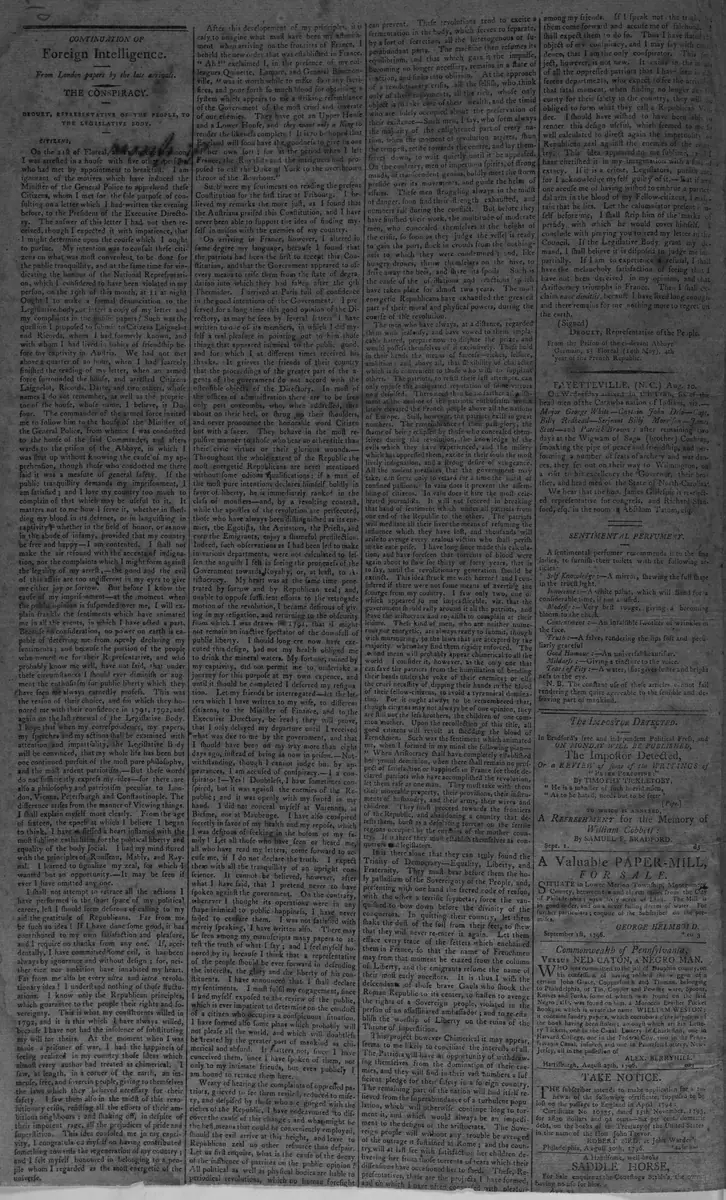
Foreign Intelligence.
From London papers by the late arrivals.
THE CONSPIRACY
DROUET, REPRESENTATIVE OF THE PEOPLE, TO
THE LEGISLATIVE BODY.
CITIZENS,
On the 21st of Floreal, at 11 in the forenoon, I was arrested in a house with five other persons, who had met by appointment to breakfast. I am ignorant of the motives which have induced the Minister of the General Police to apprehend these Citizens, whom I met for the sole purpose of consulting on a letter which I had written the evening before, to the President of the Executive Directory. The answer of this letter I had not then received, though I expected it with impatience, that I might determine upon the course which I ought to pursue. My intention was to consult these citizens on what was most convenient to be done for the public tranquillity, and at the same time for vindicating the honour of the National Representation, which I considered to have been violated in my person, on the 19th of this month, at 11 at night.
Ought I to make a formal denunciation to the Legislative body, or insert a copy of my letter and my complaints in the public papers? Such was the question I proposed to submit to Citizens Laignelot and Ricords, whom I had formerly known, and with whom I had lived in habits of friendship before my captivity in Austria. We had not met above a quarter of an hour, when I had scarcely finished the reading of my letter, when an armed force surrounded the house, and arrested Citizens Laignelot, Ricords, Darte, and two others, whose names I do not remember, as well as the proprietor of the house, whose name, I believe, is Dufour. The commander of the armed force invited me to follow him to the house of the Minister of the General Police, from whence I was conducted to the house of the said Commander, and afterwards to the prison of the Abbaye, in which I was shut up without knowing the cause of my apprehension, though those who conducted me there said it was a measure of general safety. If the public tranquillity demands my imprisonment, I am satisfied; and I love my country too much to complain of that which may be useful to it. It matters not to me how I serve it, whether in shedding my blood in its defence, or in languishing in captivity, whether in the field of honor, or as now in the abode of infamy, provided that my country be free and happy—I am contented. I shall not make the air resound with the accents of indignation, nor the complaints which I might form against the legality of my arrest—the good and the evil of this affair are too indifferent in my eyes to give me either joy or sorrow. But before I know the cause of my imprisonment—at the moment when the public opinion is suspended over me, I will explain frankly the sentiments which have animated me in all the events, in which I have acted a part.
Because no consideration, no power on earth is capable of deterring me from openly declaring my sentiments; and because the portion of the people who named me for their Representative, and who probably know me well, have not said, that under these circumstances I should ever diminish or augment the enthusiasm for public liberty which they have seen me always earnestly profess. This was the reason of their choice, and for which they honored me with their confidence in 1791, 1792, and again on the last renewal of the Legislative Body. I hope that when my correspondence, my papers, my speeches and my actions shall be examined with attention and impartiality, the Legislative Body will be convinced, that my whole life has been but one continued pursuit of the most pure philosophy, and the most ardent patriotism.—But these words do not sufficiently express my idea—for there are also a philosophy and patriotism peculiar to London, Vienna, Petersburg and Constantinople. The difference arises from the manner of viewing things.
I shall explain myself more clearly. From the age of sixteen, the epoch at which I believe I began to think, I have moved a heart inflamed with the most sublime enthusiasm for the political liberty and equality of the body social. I had my mind stored with the principles of Rousseau, Mably, and Raynal. I learned to signalize my zeal, for which I wanted but an opportunity.—It may be seen if ever I have omitted any one.
I shall not attempt to retrace all the actions I have performed in the short space of my political career, lest I should seem desirous of calling to my aid the gratitude of Republicans. Far from me be such an idea! If I have done some good, it has contributed to my own satisfaction and pleasure, and I require no thanks from any one. If, accidentally, I have committed some evil, it has been always by ignorance and without design; for, neither vice nor ambition have inhabited my heart. Far from me also be every ultra and intra revolutionary idea! I understand nothing of those fluctuations. I know only the Republican principles, which guarantee to the people their rights and sovereignty. This is what my constituents willed in 1792, and it is this which I have always willed, because I have not had the insolence of substituting my will for theirs. At the moment when I was made a prisoner of war, I had the happiness of seeing realized in my country those ideas which almost every author had treated as chimerical. I saw, at length, in a corner of the earth, an immense, free, and sovereign people, giving to themselves the laws which they believed necessary for their safety. I saw them also in the midst of this revolutionary crisis, resisting all these efforts of their ambitious neighbours; and shaking off, in despite of their impotent rage, all the prejudices of pride and superstition. This idea consoled me in my captivity, I congratulated myself on having contributed something towards the regeneration of my country; and I felt myself honored in belonging to a people whom I regarded as the most energetic of the universe.
After this development of my principles, it is easy to imagine what must have been my astonishment when arriving on the frontiers of France, I beheld the new order that was established in France.
"Ah!" exclaimed I, in the presence of my colleagues Quinette, Lamarck, and General Bournonville, "was it worth while to make so many sacrifices, and pour forth so much blood for obtaining a system which appears to me a striking resemblance of the Government of the most cruel and inveterate of our enemies. They have got an Upper House and a Lower House, and they want only a King to render the likeness complete! It is to be hoped that England will soon have the goodness to give us one of her own sort: for at the period when I left France, the Royalists and the intriguers had proposed to call the Duke of York to the overthrown throne of the Bourbons."
Such were my sentiments on reading the present Constitution for the first time at Fribourg. I believed my remarks the more just, as I found that the Austrians praised this Constitution, and I have never been able to support the idea of finding myself in union with the enemies of my country.
On arriving in France, however, I altered in some degree my language, because I found that the patriots had been the first to accept this Constitution, and that the Government appeared to use every means to raise them from the state of degradation into which they had fallen after the 9th Thermidor. I arrived at Paris full of confidence in the good intentions of the Government. I preserved for a long time this good opinion of the Directory, as may be seen by several letters I have written to one of its members, in which I did myself a real pleasure in pointing out to him those things that appeared inimical to the public good. and for which I at different times received his thanks. It grieves the friends of their country that the proceedings of the greater part of the agents of the government do not accord with the ostensible objects of the Directory. In most of the offices of administration there are to be seen only pert coxcombs, who, when addressed, turn about on their heel, or shrug up their shoulders, and never pronounce the honorable word Citizen but with a sneer. They behave in the most repulsive manner to those who bear no other title than their civic virtues or their glorious wounds.—
Throughout the whole extent of the Republic the most energetic Republicans are never mentioned without some odious qualifications: if a man of the most pure intentions declares himself boldly in favor of liberty, he is immediately ranked in the class of monsters—and, by a revolting contrast, while the apostles of the revolution are persecuted, those who have always been distinguished as its enemies, the Egotists, the Agitators, the Priests, and even the Emigrants, enjoy a shameful predilection. Indeed, such observations as I had been led to make in various departments, were not calculated to lessen the anguish I felt in seeing the proneness of the Government towards Royalty, or, at least, to Aristocracy. My heart was at the same time penetrated by sorrow and by Republican zeal; and, unable to oppose sufficient efforts to the retrograde motion of the revolution, I became desirous of giving in my resignation, and returning to the obscurity from which I was drawn in 1791, that I might not remain an inactive spectator of the downfall of public liberty. I should long ere now have executed this design, had not my health obliged me to drink the mineral waters. My fortune, ruined by my captivity, did not permit me to undertake a journey for this purpose at my own expense, and until it should be completed I deferred my resignation. Let my friends be interrogated—let the letters which I have written to my wife, to different citizens, to the Minister of Finance, and to the Executive Directory, be read; they will prove, that I only delayed my departure until I received what was due to me by the government, and that I should have been on my way more than eight days ago, instead of being as now in prison.—Notwithstanding, though I cannot judge but by appearances, I am accused of conspiracy.—I am a conspirator!—Yes! Doubtless, I have sometimes conspired, but it was against the enemies of the Republic; and it was openly with my sword in my hand. I did not conceal myself at Varennes, at Bieme, nor at Maubeuge. I have also conspired secretly in favor of my health and my repose, which I was desirous of seeking in the bosom of my family! Let all those who have seen or heard me, all who have read my letters, come forward to accuse me, if I do not declare the truth. I expect them with all the tranquillity of an upright conscience. It cannot be believed, however, after what I have said, that I pretend never to have spoken against the government. On the contrary, whenever I thought its operations were in any shape inimical to public happiness, I have never failed to censure them. I was not satisfied with merely speaking, I have written also. There may be seen among my manuscripts many papers to attest the truth of what I say; and I feel myself honored by it, because I think that a representative of the people should be ever forward in defending the interests, the glory and the liberty of his constituents. I have announced that. I shall declare my sentiments. I must fulfil my engagement, since I find myself exposed to the review of the public, which is ever impatient to determine on the conduct of a citizen who occupies a conspicuous situation.
I have formed also some plans which probably will not please all the world, and which will doubtless be treated by the greater part of mankind as chimerical and absurd. It matters not, since I have conceived them, since I have spoken of them, not only to my intimate friends, but even publicly I am bound to retrace them here.
Weary of hearing the complaints of oppressed patriots, grieved to see them reviled, reduced to misery, and despised by those who are gorged with the riches of the Republic, I have endeavoured to discover the cause of this change; and what might be the best means that could be conveniently employed, should the evil arrive at this height, and leave to Republican zeal no other resource than despair.
Let us first enquire, what is the cause of the decay of the influence of patriots on the public opinion? All political as well as physical bodies are liable to periodical revolutions, which no human foresight can prevent. These revolutions tend to excite a sort of secretion, all the heterogeneous or superabundant parts. The machine then resumes its equilibrium, and that which gave it the impulse, becoming no longer necessary, remains in a state of inaction, and sinks into oblivion. At the approach of a revolutionary crisis, all the selfish, who think only of taking care of their wealth, and the timid only of their enjoyments, all the rich, whose only object is to take care of their existence—Such men, I say, who form always the majority of the enlightened part of every nation, when the moment of revolution arrives, huddle down, to wait quietly until it be appeased. the tempest, retire towards the centre, and lay themselves down. On the contrary, men of impetuous spirits, of strong minds, of transcendent genius, boldly meet the storm preside over its movements, and guide the helm of affairs. These men struggling always in the midst of danger, soon find their strength exhausted, and numbers fall during the conflict. But before they have finished their work, the multitude of moderate men, who concealed themselves at the height of the crisis, so soon as they judge the vessel is ready to gain the port, flock in crowds from the nothing-ness to which they were condemned; and, like hungry drones, throw themselves on the hive, to drive away the bees, and share its spoils Such is the cause of the oscillations and reactions which have taken place for almost two years. The most energetic Republicans have exhausted the greatest part of their moral and physical powers, during the course of the revolution.
The men who have always, at a distance, regarded them with jealousy, and have vowed to them implacable hatred, prepare now to dispute the prize, and would possess themselves of it exclusively. These hold in their hands the means of success—riches, leisure, ambition; and above all, that flexibility of character which is so convenient to those who wish to supplant others. The patriots, to resist these last attempts, can only oppose the antiquated reputation of some virtues now despised. There need then be no further astonishment at the decline of the patriotic enthusiasm which lately elevated the French people above all the nations of Europe. Still, however, the patriots exist in great numbers. The remembrance of their past glory, the shame of being eclipsed by those who concealed themselves during the revolution, the knowledge of the evils which they have experienced, and the misery which has oppressed them, excite in their souls the most lively indignation, and a strong desire of vengeance. All the violent measures that the government may take, can serve only to retard for a time the burst of confined passions. In vain does it prevent the assembling of citizens. In vain does it hire the most celebrated journalists. It will not succeed in breaking that band of sentiment which unites all patriots from one end of the Republic to the other. The patriots will meditate all their lives the means of resuming the influence which they have lost, and thousands will arise to avenge every zealous victim who shall perish in the enterprize. I have long since made this calculation, and have foreseen that torrents of blood were again about to flow for thirty or forty years, that is to say, until the revolutionary generation should be extinct. This idea struck me with horror! and I considered if there were not some means of averting the scourge from my country. I saw only two, one of which appeared to me impracticable, viz. that the government should rally around it all the patriots, and leave the aristocrats and royalists to complain at their leisure. These kind of men, who are neither numerous nor energetic, are always ready to submit, though with murmuring, to the laws that are accepted by the majority when they find them rigidly enforced. The second means will probably appear chimerical to all the world I consider it, however, as the only one that can save the patriots from the humiliation of bending their heads under the yoke of their enemies; or else the cruel necessity of dipping their hands in the blood of their fellow-citizens, to avoid a tyrannical domination. For it ought always to be remembered that, though citizens may not always be of one opinion, they are still not the less brothers, the children of one common mother. Upon the recollection of this title, all good citizens will revolt at shedding the blood of Frenchmen. Such was the sentiment which animated me, when I formed in my mind the following plan—
"When Aristocracy shall have completely established her proud dominion, when there shall remain no prospect of satisfaction or happiness in France for those declared patriots who have accomplished the revolution, let them rise as one man. They must take with them their moveable property, their provisions, their instruments of husbandry, and their arms, their wives and children. They must proceed towards the frontiers of the Republic, and abandoning a country that detests them, burst as a desolating torrent on the fertile regions occupied by the enemies of the mother country. It is there they must establish themselves as conquerors and legislators.
It is there alone that they can truly found the Trinity of Democracy—Equality, Liberty, and Fraternity. They must bear before them the holy palladium of the Sovereignty of the People, and, presenting with one hand the sacred code of reason, with the other a terrific scymetar, force the vanquished to bow down before the divinity of the conquerors. In quitting their country, let them shake the dust of the soil from their feet, to show that they will never re-enter it again. Let them efface every trace of the fetters which enchained them in France, so that the name of Frenchmen may from that moment be erased from the column of Liberty, and the emigrants resume the name of their most early ancestors. It is thus I wish the descendants of those brave Gauls who shook the Roman Republic to its center, to hasten to avenge the rights of a Sovereign people, violated in the person of an assassinated ambassador; and to re-establish the worship of Liberty on the ruins of the Throne of superstition."
This project however Chimerical it may appear, seems to me likely to conciliate the interests of all. The Patriots will have an opportunity of withdrawing themselves from the domination of their enemies, and they will find in their vast numbers a sufficient pledge for their safety in a foreign country. The remaining part of the nation will find itself relieved from the superabundance of a turbulent population, which will otherwise continue long to torment it, and which would always be an impediment to the designs of the aristocrats. The Sovereign people will without any trouble be avenged of the outrage it sustained at Rome; and the country will at last see with satisfaction her children delivering her from those torrents of tears which their dissensions have occasioned her to shed. These, Representatives, these are the projects I have formed. and on which I have often
among my friends. If I speak not the truth, let them come forward and accuse me of falsehood. I shall expect them to do so. Thus I have stated the object of my conspiracy, and I may say with confidence, that I am the only conspirator. This project, however, is not new. It exists in the minds of all the oppressed patriots that I have seen in different departments, who expect to see the arrival of that fatal moment, when finding no longer any security for their safety in the country, they will be obliged to form what they call a Republican Vaudois. I should have wished to have been able to render this design useful, which seemed to me well calculated to direct again the impetuosity of Republican zeal against the enemies of the country. This idea appeared to me sublime and I have cherished it in my imagination with a sort of ecstasy. If it is a crime, Legislators, punish me, for I acknowledge myself guilty of it.—But if any one accuse me of having wished to embrue a fraternal arm in the blood of my Fellow-citizens, I maintain that he lies. Let the calumniator present himself before me, I shall strip him of the marks of perfidy with which he would cover himself. I conclude with praying you to read my letter in the Council. If the Legislative Body grant my demand, I shall believe it is disposed to judge me impartially. If I am to experience a refusal, I shall have the melancholy satisfaction of seeing that I have not been deceived in my opinion, and that Aristocracy triumphs in France. Then I shall exclaim nunc dimittis, because I have lived long enough and there remains for me nothing more to regret on the earth.
(Signed)
DROUET, Representative of the People.
From the Prison of the ci-devant Abbaye Germain, 25 Floreal (14th May), 4th year of the French Republic.
What sub-type of article is it?
What keywords are associated?
What entities or persons were involved?
Where did it happen?
Foreign News Details
Primary Location
France
Event Date
21st Of Floreal To 25 Floreal (14th May), 4th Year Of The French Republic
Key Persons
Outcome
drouet and associates arrested and imprisoned in abbaye prison as a measure of general safety; drouet defends himself against conspiracy charges and proposes emigration plan for patriots.
Event Details
Drouet, arrested on 21 Floreal while consulting friends on a letter to the Directory regarding violation of his honor, explains his republican principles, criticizes the government's aristocratic tendencies, and outlines a plan for patriots to emigrate en masse to conquer enemy territories instead of internal conflict.