Thank you for visiting SNEWPapers!
Sign up free
Letter to Editor
April 8, 1875
Shenandoah Herald
Woodstock, Shenandoah County, Virginia
What is this article about?
A letter to the editor defending free trade against protectionism, arguing it benefits manufacturers, farmers, and the economy overall. The writer critiques tariffs for causing market instability, references economists like John Bright and Adam Smith, and urges farmers to oppose protective policies.
Clipping
OCR Quality
95%
Excellent
Full Text
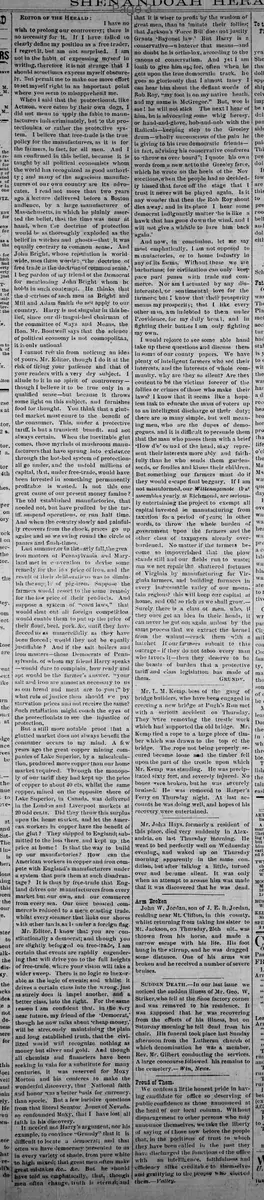
Editor of The Herald:
I have no wish to prolong our controversy; there is no necessity for it. If I have failed to clearly define my position as a free trader, I regret it, but am not surprised. I am not in the habit of expressing myself in writing, therefore it is not strange that I should sometimes express myself obscurely. But permit me to make one more effort to set myself right in an important point where you seem to misapprehend me.
When I said that the protectionists, like Actaeon, were eaten by their own dogs, I did not mean to apply the fable to manufacturers indiscriminately, but to the protectionists, or rather the protective system. I believe that free-trade is the true policy for the manufacturers, as it is for the farmers, in fact, for all men. And I am confirmed in this belief, because it is taught by all political economists whom the world has recognized as good authority; and many of the sagacious manufacturers of our own country are its advocates. I read not more than two years ago a lecture delivered before a Boston audience, by a large manufacturer of Massachusetts, in which he plainly asserted the belief, that the time was near at hand, when the doctrine of protection would be as thoroughly exploded as the belief in witches and ghosts-that it was equally contrary to common sense. And John Bright, whose reputation is world-wide, uses these words: "the doctrine of free trade is the doctrine of common sense."
I beg pardon of my friend of the Democrat for mentioning John Bright whom he holds in such contempt. He thinks that the doctrines of such men as Bright and Mill and Adam Smith do not apply to our country. Harry is not singular in this belief, since our distinguished chairman of the committee of Ways and Means, the Hon. Mr. Boutwell says that the science of political economy is not cosmopolitan, it is only national.
I cannot refrain from noticing an idea of yours, Mr. Editor, though I do it at the risk of tiring your patience and that of your readers with a very dry subject. I allude to it in no spirit of controversy- though I believe it to be true only in a qualified sense-but because it throws some light on this subject, and furnishes food for thought. You think that a glutted market must enure to the benefit of the consumer. This, under a protective tariff, is but a transient benefit, and not always certain. When the inevitable glut comes, those myriads of mushroom manufacturers that have sprung into existence through the hot-bed system of protection all go under, and the untold millions of capital, that, under free-trade, would have been invested in something permanently profitable is wasted. Is not this one great cause of our present money famine? The old established manufactories, that needed not, but have profited by the tariff, suspend operations, or run half time. And when the country slowly and painfully recovers from the shock, prices go up again and so we swing round the circle of panics and flush-times.
Last summer, or in the early fall, the great iron masters of Pennsylvania and Maryland met in convention to devise some remedy for the low price of iron, and the result of their deliberations was to diminish the supply of pig-iron. Suppose the farmers would resort to the same remedy for the low price of their products. And suppose a system of "corn laws," that would shut out all foreign competition would enable them to put up the price of their flour, beef, pork, &c., until they have fleeced us as unmercifully as they have been fleeced; would they not be equally justifiable? And if the salt boilers and iron masters-those Democrats of Pennsylvania, of whom my friend Harry speaks -would dare to complain, how ready and apt would be the farmer's answer. "your salt and iron are almost as necessary to us as our bread and meat are to you;" by what rule of justice then should we pay starvation prices and not receive the same? Such retaliation might couch the eyes of the protectionists to see the injustice of protection.
But a still more notable proof that a glutted market does not always benefit the consumer occurs to my mind. A few years ago the great copper mining companies of Lake Superior, by a miscalculation, produced more copper than our home market required. Through the monopoly of our tariff they had kept up the price of copper to about 40 cts, whilst the same copper, mined on the opposite shore of Lake Superior, in Canada, was delivered in the London and Liverpool markets at 20 odd cents. Did they throw this surplus upon the home market, and let the American workers in copper have the benefit of the glut? They shipped to England, submitted to the loss there, and kept up the price at home! Is that the way to build up our manufactories? How can the American workers in copper and iron compete with England's manufacturers under a system that puts them at such disadvantage? It is thus by free-trade that England drives our manufacturers from every market but our own, and our commerce from every sea. Our once boasted commerce is reduced to a mere coasting trade, whilst every steamer that links our shores with other lands sails under a foreign flag.
Mr. Editor, I know that you are constitutionally a democrat; and though you are slightly befogged on free-trade, I am certain that events are rapidly engendering that will drive you to the full heights of free-trade, where your vision will take a wider sweep. There is no logic so inexorable as the logic of events and whilst it drives a certain class into the wrong, just as surely does it impel another, and a better class, into the right. For the same reason I am confident that, in the very near future, my friend of the Democrat, though he now talks about 'cheap money,' will be strenuously maintaining the plain and long established truth, that the civilized world will recognize nothing as money but silver and gold. And though all chemists and financiers have been seeking in vain for a substitute for many centuries, it was reserved for Moxy Morton and his confreres to make the wonderful discovery, that National faith and honor was a better basis for currency than specie. But a few incisive questions from that literal Senator Jones of Nevada, so confounded Moxy, that I have lost all faith in his discovery.
It needed not Harry's argument, nor his example, to convince "Grundy" that it is difficult to locate a democrat; and that often we have democracy presented to us in every variety of shade, from pure white to high mixed; that great men often make great mistakes &c., &c. But he should have told us emphatically, that, though men often change, truth is eternal; and that it is wiser to profit by the wisdom of great men, than to imitate their follies that Jackson's 'Force Bill' does not justify Grants 'Bayonet law.' But Harry is a conservative-whatever that means-and no doubt he is orthodox, according to the canons of conservatism. And yet I am loath to give him up; for, often when he gets upon the true democratic track, he goes so gloriously that I almost fancy I can hear him shout the defiant words of Rob Roy, "my foot is on my native heath, and my name is MacGregor." But, woe is me! he will not stick. The next I hear of him, he is advocating some whig heresy, or hand-and-glove, hob-and-nob with the Radicals-keeping step to the Greeley drum-wholly unconscious of the pain he is giving to his true democratic friends- in fact, advising his conservative confreres to "throw us over board"; I quote his own words from a new act to the Greeley farce, which he wrote on the heels of the Nov elections, when the people had so decidedly hissed that farce off the stage that I trust it never will be played again. Is it any wonder that then the Rob Roy shout dies away, and in its place I hear some democrat indignantly mutter 'he is like a hawk that has gone down the wind, and I will not give a whistle to lure him back again.'
And now, in conclusion, let me say most emphatically, I am not opposed to manufactories, or to home industry in any of its forms. Without these we are barbarians; for civilization can only keep pace pari passu with trade and commerce: Nor am I actuated by any dis- interested, or sentimental love for the farmers; but I know that their prosperity means my prosperity; that I like every other man, am indebted to them under Providence, for my daily bread, and in fighting their battles I am only fighting my own.
I would rejoice to see some able hand take up these questions and discuss them in some of our county papers. We have plenty of intelligent farmers who see their interests, and the interests of whole community. why are they so silent? Are they content to be the victims forever of the follies or crimes of those who make their laws? I know that it seems like a hopeless task to educate the mass of voters up to an intelligent discharge of their duty; there are so many simple, but well meaning men, who are the dupes of demagogues, and it is difficult to persuade them that the man who passes them with a brief How d'ye do nod of the head, may represent their interests more ably and faithfully than he who sends them garden- seeds, or fondles and kisses their children. But something our farmers must do if they would escape final beggary. If I am not misinformed, our witenagemote, that assembles yearly at Richmond, are seriously entertaining the project to exempt all capital invested in manufacturing from taxation for a period of years; in other words, to throw the whole burden of government upon the farmers and the other class of taxpayers already over- burdened. No matter if the farmers become so impoverished that the plow stands still and our fields run to waste; can we not repair the shattered fortunes of Virginia by manufacturing for Virginia farmers, and building furnaces in every inaccessible valley of our mountain regions? this will keep our capital at home, and Oh! so rich as we shall grow. Surely there is a class of men, who, if they once get an idea in their heads, it can never be got out again unless by the same process that we extract the kernel from the walnut-crack them with a hatchet If our farmers submit to this outrage-if they do not taboo every man who favors it-then they deserve to be the beasts of burden that a protective tariff and class legislation has made of them.
GRUNDY.
I have no wish to prolong our controversy; there is no necessity for it. If I have failed to clearly define my position as a free trader, I regret it, but am not surprised. I am not in the habit of expressing myself in writing, therefore it is not strange that I should sometimes express myself obscurely. But permit me to make one more effort to set myself right in an important point where you seem to misapprehend me.
When I said that the protectionists, like Actaeon, were eaten by their own dogs, I did not mean to apply the fable to manufacturers indiscriminately, but to the protectionists, or rather the protective system. I believe that free-trade is the true policy for the manufacturers, as it is for the farmers, in fact, for all men. And I am confirmed in this belief, because it is taught by all political economists whom the world has recognized as good authority; and many of the sagacious manufacturers of our own country are its advocates. I read not more than two years ago a lecture delivered before a Boston audience, by a large manufacturer of Massachusetts, in which he plainly asserted the belief, that the time was near at hand, when the doctrine of protection would be as thoroughly exploded as the belief in witches and ghosts-that it was equally contrary to common sense. And John Bright, whose reputation is world-wide, uses these words: "the doctrine of free trade is the doctrine of common sense."
I beg pardon of my friend of the Democrat for mentioning John Bright whom he holds in such contempt. He thinks that the doctrines of such men as Bright and Mill and Adam Smith do not apply to our country. Harry is not singular in this belief, since our distinguished chairman of the committee of Ways and Means, the Hon. Mr. Boutwell says that the science of political economy is not cosmopolitan, it is only national.
I cannot refrain from noticing an idea of yours, Mr. Editor, though I do it at the risk of tiring your patience and that of your readers with a very dry subject. I allude to it in no spirit of controversy- though I believe it to be true only in a qualified sense-but because it throws some light on this subject, and furnishes food for thought. You think that a glutted market must enure to the benefit of the consumer. This, under a protective tariff, is but a transient benefit, and not always certain. When the inevitable glut comes, those myriads of mushroom manufacturers that have sprung into existence through the hot-bed system of protection all go under, and the untold millions of capital, that, under free-trade, would have been invested in something permanently profitable is wasted. Is not this one great cause of our present money famine? The old established manufactories, that needed not, but have profited by the tariff, suspend operations, or run half time. And when the country slowly and painfully recovers from the shock, prices go up again and so we swing round the circle of panics and flush-times.
Last summer, or in the early fall, the great iron masters of Pennsylvania and Maryland met in convention to devise some remedy for the low price of iron, and the result of their deliberations was to diminish the supply of pig-iron. Suppose the farmers would resort to the same remedy for the low price of their products. And suppose a system of "corn laws," that would shut out all foreign competition would enable them to put up the price of their flour, beef, pork, &c., until they have fleeced us as unmercifully as they have been fleeced; would they not be equally justifiable? And if the salt boilers and iron masters-those Democrats of Pennsylvania, of whom my friend Harry speaks -would dare to complain, how ready and apt would be the farmer's answer. "your salt and iron are almost as necessary to us as our bread and meat are to you;" by what rule of justice then should we pay starvation prices and not receive the same? Such retaliation might couch the eyes of the protectionists to see the injustice of protection.
But a still more notable proof that a glutted market does not always benefit the consumer occurs to my mind. A few years ago the great copper mining companies of Lake Superior, by a miscalculation, produced more copper than our home market required. Through the monopoly of our tariff they had kept up the price of copper to about 40 cts, whilst the same copper, mined on the opposite shore of Lake Superior, in Canada, was delivered in the London and Liverpool markets at 20 odd cents. Did they throw this surplus upon the home market, and let the American workers in copper have the benefit of the glut? They shipped to England, submitted to the loss there, and kept up the price at home! Is that the way to build up our manufactories? How can the American workers in copper and iron compete with England's manufacturers under a system that puts them at such disadvantage? It is thus by free-trade that England drives our manufacturers from every market but our own, and our commerce from every sea. Our once boasted commerce is reduced to a mere coasting trade, whilst every steamer that links our shores with other lands sails under a foreign flag.
Mr. Editor, I know that you are constitutionally a democrat; and though you are slightly befogged on free-trade, I am certain that events are rapidly engendering that will drive you to the full heights of free-trade, where your vision will take a wider sweep. There is no logic so inexorable as the logic of events and whilst it drives a certain class into the wrong, just as surely does it impel another, and a better class, into the right. For the same reason I am confident that, in the very near future, my friend of the Democrat, though he now talks about 'cheap money,' will be strenuously maintaining the plain and long established truth, that the civilized world will recognize nothing as money but silver and gold. And though all chemists and financiers have been seeking in vain for a substitute for many centuries, it was reserved for Moxy Morton and his confreres to make the wonderful discovery, that National faith and honor was a better basis for currency than specie. But a few incisive questions from that literal Senator Jones of Nevada, so confounded Moxy, that I have lost all faith in his discovery.
It needed not Harry's argument, nor his example, to convince "Grundy" that it is difficult to locate a democrat; and that often we have democracy presented to us in every variety of shade, from pure white to high mixed; that great men often make great mistakes &c., &c. But he should have told us emphatically, that, though men often change, truth is eternal; and that it is wiser to profit by the wisdom of great men, than to imitate their follies that Jackson's 'Force Bill' does not justify Grants 'Bayonet law.' But Harry is a conservative-whatever that means-and no doubt he is orthodox, according to the canons of conservatism. And yet I am loath to give him up; for, often when he gets upon the true democratic track, he goes so gloriously that I almost fancy I can hear him shout the defiant words of Rob Roy, "my foot is on my native heath, and my name is MacGregor." But, woe is me! he will not stick. The next I hear of him, he is advocating some whig heresy, or hand-and-glove, hob-and-nob with the Radicals-keeping step to the Greeley drum-wholly unconscious of the pain he is giving to his true democratic friends- in fact, advising his conservative confreres to "throw us over board"; I quote his own words from a new act to the Greeley farce, which he wrote on the heels of the Nov elections, when the people had so decidedly hissed that farce off the stage that I trust it never will be played again. Is it any wonder that then the Rob Roy shout dies away, and in its place I hear some democrat indignantly mutter 'he is like a hawk that has gone down the wind, and I will not give a whistle to lure him back again.'
And now, in conclusion, let me say most emphatically, I am not opposed to manufactories, or to home industry in any of its forms. Without these we are barbarians; for civilization can only keep pace pari passu with trade and commerce: Nor am I actuated by any dis- interested, or sentimental love for the farmers; but I know that their prosperity means my prosperity; that I like every other man, am indebted to them under Providence, for my daily bread, and in fighting their battles I am only fighting my own.
I would rejoice to see some able hand take up these questions and discuss them in some of our county papers. We have plenty of intelligent farmers who see their interests, and the interests of whole community. why are they so silent? Are they content to be the victims forever of the follies or crimes of those who make their laws? I know that it seems like a hopeless task to educate the mass of voters up to an intelligent discharge of their duty; there are so many simple, but well meaning men, who are the dupes of demagogues, and it is difficult to persuade them that the man who passes them with a brief How d'ye do nod of the head, may represent their interests more ably and faithfully than he who sends them garden- seeds, or fondles and kisses their children. But something our farmers must do if they would escape final beggary. If I am not misinformed, our witenagemote, that assembles yearly at Richmond, are seriously entertaining the project to exempt all capital invested in manufacturing from taxation for a period of years; in other words, to throw the whole burden of government upon the farmers and the other class of taxpayers already over- burdened. No matter if the farmers become so impoverished that the plow stands still and our fields run to waste; can we not repair the shattered fortunes of Virginia by manufacturing for Virginia farmers, and building furnaces in every inaccessible valley of our mountain regions? this will keep our capital at home, and Oh! so rich as we shall grow. Surely there is a class of men, who, if they once get an idea in their heads, it can never be got out again unless by the same process that we extract the kernel from the walnut-crack them with a hatchet If our farmers submit to this outrage-if they do not taboo every man who favors it-then they deserve to be the beasts of burden that a protective tariff and class legislation has made of them.
GRUNDY.
What sub-type of article is it?
Persuasive
Political
Informative
What themes does it cover?
Economic Policy
Commerce Trade
Politics
What keywords are associated?
Free Trade
Protectionism
Tariffs
Manufacturers
Farmers
Political Economy
John Bright
Adam Smith
Economic Panics
Democracy
What entities or persons were involved?
Grundy.
Editor Of The Herald
Letter to Editor Details
Author
Grundy.
Recipient
Editor Of The Herald
Main Argument
free trade is the true policy for manufacturers, farmers, and all, as supported by economists like john bright, adam smith, and mill; protectionism causes economic instability, gluts, panics, and injustice, harming consumers and the nation.
Notable Details
Actaeon Fable Analogy For Protectionists
Reference To Massachusetts Manufacturer's Lecture
John Bright Quote On Free Trade
Copper Mining Surplus Example From Lake Superior
Iron Masters Convention In Pennsylvania And Maryland
Critique Of Boutwell On Political Economy
References To Jackson's Force Bill And Grant's Bayonet Law