Thank you for visiting SNEWPapers!
Sign up free
Literary
July 24, 1801
The National Intelligencer And Washington Advertiser
Washington, District Of Columbia
What is this article about?
The National Intelligencer presents extracts from Dugald Stewart's 'Elements of the Philosophy of the Human Mind,' arguing that moral science fosters republican principles. It discusses political wisdom, the limitations of experience in governance, the role of public opinion, and the need for gradual reforms to adapt institutions to progress, referencing Turgot, Oxenstiern, Johnson, and Bacon.
Clipping
OCR Quality
95%
Excellent
Full Text
NATIONAL INTELLIGENCER.
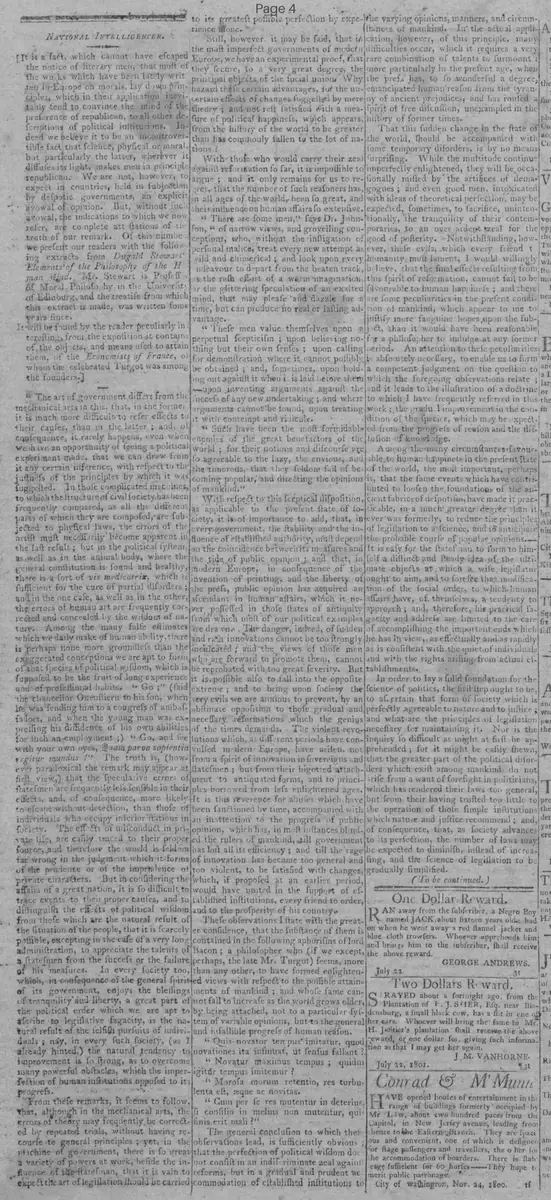
It is a fact, which cannot have escaped the notice of literary men, that most of the works which have been lately written in Europe on morals, lay down principles, which in their application inevitably tend to convince the mind of the preference of republican, to all other descriptions of political institutions. Indeed we believe it to be an incontrovertible fact that science, physical or moral, but particularly the latter, wherever it diffuses its light, makes men in principle republican. We are not, however, to expect in countries, held in subjection by despotic governments, an explicit avowal of opinion. But, without judicial avowal, the indications to which we now refer, are complete attestations of the truth of our remark. Of this number we present our readers with the following extracts from Dugald Stewart's 'Elements of the Philosophy of the Human Mind,' Mr. Stewart is Professor of Moral Philosophy in the University of Edinburgh, and the treatise from which this extract is made, was written some years since.
It will be found by the reader peculiarly interesting, from the exposition it contains of the objects, and means used to attain them, of the Economists of France, of whom the celebrated Turgot was among the founders.
The art of government differs from the mechanical arts in this, that, in the former it is much more difficult to refer effects to their causes, than in the latter; and, of consequence, it rarely happens, even when we have an opportunity of seeing a political experiment made, that we can draw from it any certain inference, with respect to the justness of the principles by which it was suggested. In those complicated machines, to the structure of civil society has been frequently compared, as all the different parts of which they are composed, are subjected to physical laws, the errors of the artist must necessarily become apparent in the last result; but in the political system, as well as in the animal body, where the general constitution is sound and healthy, there is a sort of vis medicatrix, which is sufficient for the cure of partial disorders; and in the one case, as well as in the other, the errors of human art are frequently corrected and concealed by the wisdom of nature. Among the many false estimates which we daily make of human ability, there is perhaps none more groundless than the exaggerated conceptions we are apt to form of that species of political wisdom, which is supposed to be the fruit of long experience and of professional habits. 'Go;' (said the chancellor Oxenstiern to his son, when he was sending him to a congress of ambassadors, and when the young man was expressing his diffidence of his own abilities for such an employment;) 'Go, and see with your own eyes, Quam parva sapientia regitur mundus!' The truth is, (however paradoxical the remark may appear at first view,) that the speculative errors of statesmen are frequently less sensible in their effects, and, of consequence, more likely to escape without detection, than those of individuals who occupy inferior stations in society. The effects of misconduct in private life, are easily traced to their proper source, and therefore the world is seldom far wrong in the judgment which it forms of the prudence or of the imprudence of private characters. But in considering the affairs of a great nation, it is so difficult to trace events to their proper causes, and to distinguish the effects of political wisdom from those which are the natural result of the situation of the people, that it is scarcely possible, excepting in the case of a very long administration, to appreciate the talents of a statesman from the success or the failure of his measures. In every Society too, which, in consequence of the general spirit of its government, enjoys the blessings of tranquility and liberty, a great part of the political order which we are apt to ascribe to legislative sagacity, is the natural result of the selfish pursuits of individuals; nay, in every such society, (as I have already hinted,) the natural tendency to improvement is so strong, as to overcome many powerful obstacles, which the imperfection of human institutions opposed to its progress.
From these remarks, it seems to follow, that, although in the mechanical arts, the errors of theory may frequently be corrected by repeated trials, without having recourse to general principles; yet, in the machine of government, there is so great a variety of powers at work, beside the influence of the statesman, that it is vain to expect the art of legislation should be carried to its greatest possible perfection by experience alone.
Still, however it may be said, that in the most imperfect governments of modern Europe, we have an experimental proof, that they secure, to a very great degree, the principal objects of the social union Why hazard these certain advantages, for the uncertain effects of changes suggested by mere theory; and not rest satisfied with a measure of political happiness, which appears, from the history of the world to be greater than has commonly fallen to the lot of nations?
With those who would carry their zeal against reformation so far, it is impossible to argue; and it only remains for us to regret, that the number of such reasoners has, in all ages of the world, been so great, and their influence on human affairs so extensive.
'There are some men,' says Dr. Johnson, 'of narrow views, and grovelling conceptions, who, without the instigation of personal malice, treat every new attempt as wild and chimerical; and look upon every endeavour to depart from the beaten track, as the rash effort of a warm imagination, or else a glittering speculation of an exalted mind, that may please and dazzle for a time, but can produce no real or lasting advantage.
'These men value themselves upon a perpetual scepticism; upon believing nothing but their own senses; upon calling for demonstration where it cannot possibly be obtained; and, sometimes, upon holding out against it when it is laid before them -upon inventing arguments against the success of any new undertaking; and where arguments cannot be found, upon treating it with contempt and ridicule.
'Such have been the most formidable enemies of the great benefactors of the world; for their notions and discourses are so agreeable to the lazy, the envious, and the timorous, that they seldom fail of becoming popular, and diverting the opinions of mankind.'
With respect to this sceptical disposition, as applicable to the present state of society, it is of importance to add, that, in every government, the stability and the influence of established authority, must depend on the coincidence between its measures and the tide of public opinion; and that, in modern Europe, in consequence of the invention of printing, and the liberty of the press, public opinion has acquired an ascendant in human affairs, which it never possessed in those states of antiquity from which most of our political examples are drawn. The danger, indeed, of sudden and rash innovations cannot be too strongly inculcated; and the views of those men who are forward to promote them, cannot be reprobated with too great severity. But it is possible also to fall into the opposite extreme; and to bring upon society the very evils we are anxious to prevent, by an obstinate opposition to those gradual and necessary reformations which the genius of the times demands. The violent revolutions which, at different periods have convulsed modern Europe, have arisen, not from a spirit of innovation in sovereigns and statesmen; but from their bigotted attachment to antiquated forms, and to principles borrowed from less enlightened ages. It is this reverence for abuses which have been sanctioned by time, accompanied with an inattention to the progress of public opinion, which has, in most instances blinded the rulers of mankind, till government has lost all its efficiency; and till the rage of innovation has become too general and too violent, to be satisfied with changes; which, if proposed at an earlier period, would have united in the support of established institutions, every friend to order, and to the prosperity of his country.
These observations I state with the greater confidence, that the substance of them is contained in the following aphorisms of Lord Bacon; a philosopher who (if we except, perhaps, the late Mr. Turgot) seems, more than any other, to have formed enlightened views with respect to the possible attainments of mankind; and whose fame cannot fail to increase as the world grows older, by being attached, not to a particular system of variable opinions, but to the general and infallible progress of human reason.
'Quis novator ter pus imitatur, quod novationes ita insinuat, ut sensus fallant?
'Novatur maxiums tempus; quidni ligitar tempus imitemur?
'Morosa morum retentio, res turbulentae et, aeque ac novitas.
'Cum per se res mutentur in deterius, si consilio in melius non mutentur, quis finis erit mali?'
The general conclusion to which these observations lead, is sufficiently obvious; that the perfection of political wisdom does not consist in an indiscriminate zeal against reforms, but in a gradual and prudent accommodation of established institutions to the varying opinions, manners, and circumstances of mankind. In the actual application, however, of this principle, many difficulties occur, which it requires a very rare combination of talents to surmount: more particularly in the present age, when the press has, to so wonderful a degree, emancipated human reason from the tyranny of ancient prejudices, and has roused a spirit of free discussion, unexampled in the history of former times.
That this sudden change in the state of the world, should be accompanied with some temporary disorders, is by no means surprising. While the multitude continue imperfectly enlightened, they will be occasionally misled by the artifices of demagogues; and even good men, intoxicated with ideas of theoretical perfection, may be expected, sometimes, to sacrifice, unintentionally, the tranquility of their contemporaries, to an over ardent zeal for the good of posterity. -Notwithstanding, however, these evils, which every friend to humanity, must lament, I would willingly believe, that the final effects resulting from this spirit of reformation, cannot fail to be favourable to human happiness; and there are some peculiarities in the present condition of mankind, which appear to me to justify more sanguine hopes upon the subject, than it would have been reasonable for a philosopher to indulge at any former period. An attention to these peculiarities is absolutely necessary, to enable us to form a competent judgment on the question to which the foregoing observations relate; and it leads to the illustration of a doctrine to which I have frequently referred in this work; the gradual improvement in the condition of the species, which may be expected from the progress of reason and the diffusion of knowledge.
Among the many circumstances favourable to human happiness in the present state of the world, the most important, perhaps is, that the same events which have contributed to loosen the foundations of the ancient fabrics of despotism, have made it practicable, in a much greater degree than it ever was formerly, to reduce the principles of legislation to a science, and to anticipate the probable course of popular opinions. It is easy for the statesman to form to himself a distinct and steady idea of the ultimate objects at which a wise legislator ought to aim, and to foresee that modification of the social order, to which human affairs have, of themselves, a tendency to approach; and, therefore, his practical sagacity and address are limited to the care of accomplishing the important ends which he has in view, as effectually and as rapidly as is consistent with the quiet of individuals and with the rights arising from actual establishments.
In order to lay a solid foundation for the science of politics, the first step ought to be, to ascertain that form of society which is perfectly agreeable to nature and to justice; and what are the principles of legislation necessary for maintaining it. Nor is the inquiry so difficult as might at first be apprehended; for it might be easily shewn, that the greater part of the political disorders which exist among mankind do not arise from a want of foresight in politicians, which has rendered their laws too general, but from their having trusted too little to the operation of those simple institutions which nature and justice recommend; and, of consequence, that, as society advances to its perfection, the number of laws may be expected to diminish, instead of increasing, and the science of legislation to be gradually simplified.
(To be continued.)
It is a fact, which cannot have escaped the notice of literary men, that most of the works which have been lately written in Europe on morals, lay down principles, which in their application inevitably tend to convince the mind of the preference of republican, to all other descriptions of political institutions. Indeed we believe it to be an incontrovertible fact that science, physical or moral, but particularly the latter, wherever it diffuses its light, makes men in principle republican. We are not, however, to expect in countries, held in subjection by despotic governments, an explicit avowal of opinion. But, without judicial avowal, the indications to which we now refer, are complete attestations of the truth of our remark. Of this number we present our readers with the following extracts from Dugald Stewart's 'Elements of the Philosophy of the Human Mind,' Mr. Stewart is Professor of Moral Philosophy in the University of Edinburgh, and the treatise from which this extract is made, was written some years since.
It will be found by the reader peculiarly interesting, from the exposition it contains of the objects, and means used to attain them, of the Economists of France, of whom the celebrated Turgot was among the founders.
The art of government differs from the mechanical arts in this, that, in the former it is much more difficult to refer effects to their causes, than in the latter; and, of consequence, it rarely happens, even when we have an opportunity of seeing a political experiment made, that we can draw from it any certain inference, with respect to the justness of the principles by which it was suggested. In those complicated machines, to the structure of civil society has been frequently compared, as all the different parts of which they are composed, are subjected to physical laws, the errors of the artist must necessarily become apparent in the last result; but in the political system, as well as in the animal body, where the general constitution is sound and healthy, there is a sort of vis medicatrix, which is sufficient for the cure of partial disorders; and in the one case, as well as in the other, the errors of human art are frequently corrected and concealed by the wisdom of nature. Among the many false estimates which we daily make of human ability, there is perhaps none more groundless than the exaggerated conceptions we are apt to form of that species of political wisdom, which is supposed to be the fruit of long experience and of professional habits. 'Go;' (said the chancellor Oxenstiern to his son, when he was sending him to a congress of ambassadors, and when the young man was expressing his diffidence of his own abilities for such an employment;) 'Go, and see with your own eyes, Quam parva sapientia regitur mundus!' The truth is, (however paradoxical the remark may appear at first view,) that the speculative errors of statesmen are frequently less sensible in their effects, and, of consequence, more likely to escape without detection, than those of individuals who occupy inferior stations in society. The effects of misconduct in private life, are easily traced to their proper source, and therefore the world is seldom far wrong in the judgment which it forms of the prudence or of the imprudence of private characters. But in considering the affairs of a great nation, it is so difficult to trace events to their proper causes, and to distinguish the effects of political wisdom from those which are the natural result of the situation of the people, that it is scarcely possible, excepting in the case of a very long administration, to appreciate the talents of a statesman from the success or the failure of his measures. In every Society too, which, in consequence of the general spirit of its government, enjoys the blessings of tranquility and liberty, a great part of the political order which we are apt to ascribe to legislative sagacity, is the natural result of the selfish pursuits of individuals; nay, in every such society, (as I have already hinted,) the natural tendency to improvement is so strong, as to overcome many powerful obstacles, which the imperfection of human institutions opposed to its progress.
From these remarks, it seems to follow, that, although in the mechanical arts, the errors of theory may frequently be corrected by repeated trials, without having recourse to general principles; yet, in the machine of government, there is so great a variety of powers at work, beside the influence of the statesman, that it is vain to expect the art of legislation should be carried to its greatest possible perfection by experience alone.
Still, however it may be said, that in the most imperfect governments of modern Europe, we have an experimental proof, that they secure, to a very great degree, the principal objects of the social union Why hazard these certain advantages, for the uncertain effects of changes suggested by mere theory; and not rest satisfied with a measure of political happiness, which appears, from the history of the world to be greater than has commonly fallen to the lot of nations?
With those who would carry their zeal against reformation so far, it is impossible to argue; and it only remains for us to regret, that the number of such reasoners has, in all ages of the world, been so great, and their influence on human affairs so extensive.
'There are some men,' says Dr. Johnson, 'of narrow views, and grovelling conceptions, who, without the instigation of personal malice, treat every new attempt as wild and chimerical; and look upon every endeavour to depart from the beaten track, as the rash effort of a warm imagination, or else a glittering speculation of an exalted mind, that may please and dazzle for a time, but can produce no real or lasting advantage.
'These men value themselves upon a perpetual scepticism; upon believing nothing but their own senses; upon calling for demonstration where it cannot possibly be obtained; and, sometimes, upon holding out against it when it is laid before them -upon inventing arguments against the success of any new undertaking; and where arguments cannot be found, upon treating it with contempt and ridicule.
'Such have been the most formidable enemies of the great benefactors of the world; for their notions and discourses are so agreeable to the lazy, the envious, and the timorous, that they seldom fail of becoming popular, and diverting the opinions of mankind.'
With respect to this sceptical disposition, as applicable to the present state of society, it is of importance to add, that, in every government, the stability and the influence of established authority, must depend on the coincidence between its measures and the tide of public opinion; and that, in modern Europe, in consequence of the invention of printing, and the liberty of the press, public opinion has acquired an ascendant in human affairs, which it never possessed in those states of antiquity from which most of our political examples are drawn. The danger, indeed, of sudden and rash innovations cannot be too strongly inculcated; and the views of those men who are forward to promote them, cannot be reprobated with too great severity. But it is possible also to fall into the opposite extreme; and to bring upon society the very evils we are anxious to prevent, by an obstinate opposition to those gradual and necessary reformations which the genius of the times demands. The violent revolutions which, at different periods have convulsed modern Europe, have arisen, not from a spirit of innovation in sovereigns and statesmen; but from their bigotted attachment to antiquated forms, and to principles borrowed from less enlightened ages. It is this reverence for abuses which have been sanctioned by time, accompanied with an inattention to the progress of public opinion, which has, in most instances blinded the rulers of mankind, till government has lost all its efficiency; and till the rage of innovation has become too general and too violent, to be satisfied with changes; which, if proposed at an earlier period, would have united in the support of established institutions, every friend to order, and to the prosperity of his country.
These observations I state with the greater confidence, that the substance of them is contained in the following aphorisms of Lord Bacon; a philosopher who (if we except, perhaps, the late Mr. Turgot) seems, more than any other, to have formed enlightened views with respect to the possible attainments of mankind; and whose fame cannot fail to increase as the world grows older, by being attached, not to a particular system of variable opinions, but to the general and infallible progress of human reason.
'Quis novator ter pus imitatur, quod novationes ita insinuat, ut sensus fallant?
'Novatur maxiums tempus; quidni ligitar tempus imitemur?
'Morosa morum retentio, res turbulentae et, aeque ac novitas.
'Cum per se res mutentur in deterius, si consilio in melius non mutentur, quis finis erit mali?'
The general conclusion to which these observations lead, is sufficiently obvious; that the perfection of political wisdom does not consist in an indiscriminate zeal against reforms, but in a gradual and prudent accommodation of established institutions to the varying opinions, manners, and circumstances of mankind. In the actual application, however, of this principle, many difficulties occur, which it requires a very rare combination of talents to surmount: more particularly in the present age, when the press has, to so wonderful a degree, emancipated human reason from the tyranny of ancient prejudices, and has roused a spirit of free discussion, unexampled in the history of former times.
That this sudden change in the state of the world, should be accompanied with some temporary disorders, is by no means surprising. While the multitude continue imperfectly enlightened, they will be occasionally misled by the artifices of demagogues; and even good men, intoxicated with ideas of theoretical perfection, may be expected, sometimes, to sacrifice, unintentionally, the tranquility of their contemporaries, to an over ardent zeal for the good of posterity. -Notwithstanding, however, these evils, which every friend to humanity, must lament, I would willingly believe, that the final effects resulting from this spirit of reformation, cannot fail to be favourable to human happiness; and there are some peculiarities in the present condition of mankind, which appear to me to justify more sanguine hopes upon the subject, than it would have been reasonable for a philosopher to indulge at any former period. An attention to these peculiarities is absolutely necessary, to enable us to form a competent judgment on the question to which the foregoing observations relate; and it leads to the illustration of a doctrine to which I have frequently referred in this work; the gradual improvement in the condition of the species, which may be expected from the progress of reason and the diffusion of knowledge.
Among the many circumstances favourable to human happiness in the present state of the world, the most important, perhaps is, that the same events which have contributed to loosen the foundations of the ancient fabrics of despotism, have made it practicable, in a much greater degree than it ever was formerly, to reduce the principles of legislation to a science, and to anticipate the probable course of popular opinions. It is easy for the statesman to form to himself a distinct and steady idea of the ultimate objects at which a wise legislator ought to aim, and to foresee that modification of the social order, to which human affairs have, of themselves, a tendency to approach; and, therefore, his practical sagacity and address are limited to the care of accomplishing the important ends which he has in view, as effectually and as rapidly as is consistent with the quiet of individuals and with the rights arising from actual establishments.
In order to lay a solid foundation for the science of politics, the first step ought to be, to ascertain that form of society which is perfectly agreeable to nature and to justice; and what are the principles of legislation necessary for maintaining it. Nor is the inquiry so difficult as might at first be apprehended; for it might be easily shewn, that the greater part of the political disorders which exist among mankind do not arise from a want of foresight in politicians, which has rendered their laws too general, but from their having trusted too little to the operation of those simple institutions which nature and justice recommend; and, of consequence, that, as society advances to its perfection, the number of laws may be expected to diminish, instead of increasing, and the science of legislation to be gradually simplified.
(To be continued.)
What sub-type of article is it?
Essay
What themes does it cover?
Political
Liberty Freedom
Moral Virtue
What keywords are associated?
Political Philosophy
Republicanism
Government Reform
Public Opinion
Dugald Stewart
Turgot
Liberty
Moral Science
Political Wisdom
What entities or persons were involved?
Dugald Stewart
Literary Details
Author
Dugald Stewart
Subject
On Political Wisdom, Reform, And The Progress Of Society
Key Lines
'Go, And See With Your Own Eyes, Quam Parva Sapientia Regitur Mundus!'
'There Are Some Men,' Says Dr. Johnson, 'Of Narrow Views, And Grovelling Conceptions, Who, Without The Instigation Of Personal Malice, Treat Every New Attempt As Wild And Chimerical;'
'Quis Novator Ter Pus Imitatur, Quod Novationes Ita Insinuat, Ut Sensus Fallant?\N\N'novatur Maxiums Tempus; Quidni Ligitar Tempus Imitemur?\N\N'morosa Morum Retentio, Res Turbulentae Et, Aeque Ac Novitas.\N\N'cum Per Se Res Mutentur In Deterius, Si Consilio In Melius Non Mutentur, Quis Finis Erit Mali?'
The Perfection Of Political Wisdom Does Not Consist In An Indiscriminate Zeal Against Reforms, But In A Gradual And Prudent Accommodation Of Established Institutions To The Varying Opinions, Manners, And Circumstances Of Mankind.
The Gradual Improvement In The Condition Of The Species, Which May Be Expected From The Progress Of Reason And The Diffusion Of Knowledge.