Thank you for visiting SNEWPapers!
Sign up free
Literary
January 19, 1889
Pullman Herald
Pullman, Whitman County, Washington
What is this article about?
During Carnival in Nice, Sydney Neal falls for Margery Moore amid the Battle of the Flowers. He tracks her for a Corniche road trip to Mentone, where a rockfall traps their carriage driven by blind coachman Old Brix, who confesses substituting for his grandson. Neal rescues them, sparking romance leading to marriage.
Clipping
OCR Quality
95%
Excellent
Full Text
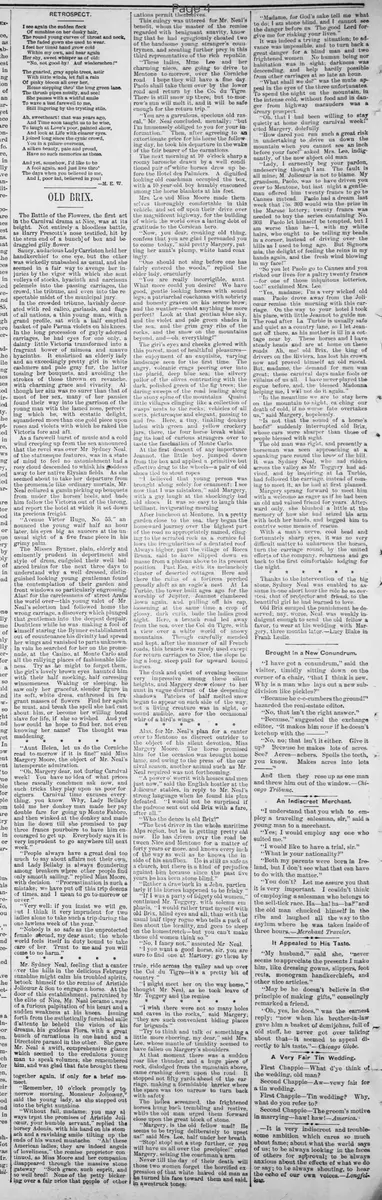
OLD BRIX.
The Battle of the Flowers, the first act in the Carnival drama at Nice, was at its height. Not entirely a bloodless battle, as Harry Prescott's nose testified, hit by the stem end of a bunch of box and bedraggled gilly flower.
Saucy, audacious Lady Carriston held her handkerchief to one eye, but the other was wickedly unabashed as usual, and she seemed in a fair way to avenge her injuries by the vigor with which she sent volleys of stocks, hyacinth and narcissus pêle-mêle into the passing carriages, the crowd, the tribune, and even into the respectable midst of the municipal jury.
In the crowded tribune, lavishly decorated with red calico, garlands, and flags of all nations, a thin young man, with a grand profile, sat with a half emptied basket of pale Parma violets on his knees.
In the long procession of gayly adorned carriages, he had eyes for one only, a dainty little Victoria transformed into a fragrant bower of mimosa and mauve hyacinths. It enshrined an elderly lady and an exceedingly pretty girl in white cashmere and pale gray fur, the latter tossing her bouquets, and avoiding the strokes of those thrown en revanche, with charming grace and vivacity. Although her aim was no surer than that of most of her sex, many of her pansies found their way into the garrison of the young man with the lamed nose, perceiving which he, with ecstatic delight, squandered more than one gold piece upon roses and violets with which he raked the Victoria fore and aft.
As a farewell burst of music and a cold wind creeping up from the sea announced that the revel was over Mr. Sydney Neal of the statuesque features, was in a state of mind to feel no astonishment had a rosy cloud descended to whisk his goddess away to her native Elysian fields. As she seemed about to take her departure from the promenade like ordinary mortals, Mr. Neal collared a gamin picking up bouquets from under the horses' heels, and bade him follow the Victoria out of the throng and report the hotel at which it set down its precious freight.
"Avenue Victor Hugo, No. 53," announced the young waif half an hour later, his eyes big as saucers at the unusual sight of a five franc piece in his grimy palm.
The Misses Bynner, plain, elderly and eminently prudent in deportment and style of dress, cudgeled their well balanced brains for the next three days to understand why a well dressed, distinguished looking young gentleman found the contemplation of their garden and front windows so particularly engrossing. Alas! for the carelessness of street Arabs the world over-this young valet of Mr. Neal's selection had followed home the wrong carriage, a discovery which plunged that gentleman into the deepest despair. Doubtless while he was making a fool of himself staring the Bynner establishment out of countenance his divinity had spread her wings and vanished to parts unknown.
In vain he searched for her on the promenade, at the Casino, at Monte Carlo and all the rallying places of fashionable idleness.
Try as he might to forget them, the girl's lovely brown eyes haunted him with their half mocking, half caressing winsomeness. Waking or sleeping, he saw only her graceful, slender figure in its soft, white dress, enthroned in fragrant masses of flowers. Find her again he must, and break the spell she had cast about him, or become her willing bond slave for life, if she so wished. And yet how could he hope to find her, not even knowing her name? The thought was maddening.
"Aunt Helen, let us do the Corniche road to-morrow if it is fine?" said Miss Margery Moore, the object of Mr. Neal's intemperate admiration.
"Oh, Margery dear, not during Carnival week! You have no idea of what prices these rascally coachmen ask now, and such tricks they play upon us poor foreigners. Carnival time excuses everything, you know. Why, Lady Bellaby told me her donkey man made her pay double fare for going up Monte Fabbro, and then winked at the donkey and made him lie down till she promised to pay three francs pourboire to have him encouraged to get up. Everybody says it is very imprudent to go anywhere till next week."
"People always have a great deal too much to say about affairs not their own, and Lady Bellaby is always foundering among breakers where other people find only smooth sailing," replied Miss Moore, with decision. "Procrastination is such a mistake; we have put off this trip dozens of times, and I mean to go to-morrow or never."
"Very well: if you insist we will go, but I think it very imprudent for two ladies alone to take such a trip during the one lawless week of the year."
"Nobody is so safe as the unprotected female abroad, my dear aunt; the whole world feels itself in duty bound to take care of her. Trust to me and you will come to no harm."
Mr. Sydney Neal, feeling that a canter over the hills in the delicious February sunshine might calm his troubled spirits, betook himself to the remise of Aristide Jolicœur & Son to engage a horse. At the door of this establishment, patronized by the elite of Nice, Mr. Neal became aware of a furious palpitation of his heart and a sudden weakness at his knees. Issuing forth from the aesthetically furnished salle d'attente he beheld the vision of his dreams, his goddess Flora, with a great bunch of carnations in one hand and a Directoire parasol in the other. She gave Mr. Neal a swift, comprehensive glance which seemed to the credulous young man to speak volumes; she remembered him, and was glad that fate brought them together again, if only for a brief moment.
"Remember, 10 o'clock promptly to-morrow morning, Monsieur Jolicœur," said the young lady, as she stepped out into the bright sunshine.
"Without fail, madame; you may always trust the promises of Aristide Jolicœur, your humble servant," replied the horsey Adonis, with his hand on his stomach and a ravishing smile tilting up the ends of his waxed mustache. "Ah! these American ladies: they are indeed angels of loveliness," the remise proprietor continued, as Miss Moore and her companion disappeared through the massive stone gateway. "Such grace, such esprit, and so well bred! None of the petty bickering over a fair price that people of other nations permit themselves."
This eulogy was uttered for Mr. Neal's benefit, whom the master of the remise regarded with benignant suavity, knowing that he had egregiously cheated two of the handsome young stranger's countrymen, and scenting further prey in this third representative of the rich republic.
"These ladies, Mme. Lee and her charming niece, are going to drive to Mentone to-morrow, over the Corniche road. I hope they will have a fine day. Paolo shall take them over by the lower road and return by the Col du Tigre. There is still snow up there: but to-morrow's sun will melt it, and it will be safe enough for the return trip."
"You are a garrulous, specious old rascal," Mr. Neal concluded, mentally; "but I'm immensely obliged to you for your information." Then, after agreeing to an extortionate price for his horse the following day, he took his departure in the wake of the fair bearer of the carnations.
The next morning at 10 o'clock sharp a roomy barouche drawn by a well conditioned pair of white horses drew up before the Hotel des Palmiers. A dignified looking old coachman occupied the box with a 10 year-old boy humbly ensconced among the horse blankets at his feet.
Mrs. Lee and Miss Moore made themselves thoroughly comfortable in this vehicle, and set off upon their drive over the magnificent highway, for the building of which the world owes a lasting debt of gratitude to the Corsican hero.
"Now, you dear, croaking old thing, confess that you are glad I persuaded you to come to-day," said pretty Margery, patting her aunt's plump, white hand coaxingly.
"One should not sing before one has fairly entered the woods," replied the elder lady, oracularly.
"You are really incorrigible, aunt. What more could you desire? We have good, gentle looking horses with sound legs; a patriarchal coachman with sobriety and honesty graven on his serene brow; and the weather-could anything be more perfect? Look at that gentian blue sky, and the violet and pale green shades in the sea, and the grim gray ribs of the rocks, and the snow on the mountains beyond, and-oh, everything!"
The girl's eyes and cheeks glowed with this purest, most of healthful pleasures—the enjoyment of an exquisite, varying landscape seen for the first time. The angry, volcanic crags peering over into the placid, deep blue sea; the silvery pallor of the olives contrasting with the dark, polished green of the fig trees; the daring sweeps of the road leading along the stony spine of the mountains. Quaint little villages clinging like a collection of wasps' nests to the rocks; vehicles of all sorts, picturesque and elegant, passing to and fro. Here, a tiny, tinkling donkey laden with green and yellow crockery jars, there, the four horse break whisking its load of curious strangers over to taste the fascination of Monte Carlo.
At the first descent of any importance Jeannot, the little boy, jumped down from the box and applied a primitive but effective drag to the wheels-a pair of old shoes tied to stout ropes.
"I believed that young person was brought along solely for ornament: I see now that I was mistaken," said Margery, with a gay laugh at the shockingly bad old shoes. It was so easy to laugh this brilliant, invigorating morning.
After luncheon at Mentone, in a pretty garden close to the sea, they began the homeward journey over the highest part of the road so appropriately named, clinging to the serrated rock as a cornice follows the irregularities of a dentated roof. Always higher, past the village of Rocca Bruna, said to have slipped down en masse from a plateau above to its present position. Past Eze, with its melancholy cluster of deserted cottages. Here and there the ruins of a fortress perched proudly aloft as an eagle's nest. At La Turbie, the tower built ages ago for the worship of Jupiter, Jeannot clambered down again, and, pulling off his cap, loosening at the same time a crop of glossy, dark curls, bade the ladies good night. Here, a branch road led away from the sea, over the Col du Tigre, with a view over a white world of snowy mountains. Though carefully mended and kept, after the manner of all French roads, this branch was rarely used except for return carriages to Nice, the slope being a long, steep pull for upward bound horses.
The dusk and quiet of evening became very impressive among these silent heights, and Margery drew closer to her aunt in vague distrust of the deepening shadows. Patches of half melted snow began to appear on each side of the way, not a living creature was in sight, or sound audible, save for the occasional whir of a bird's wings.
Alas, for Mr. Neal's plan for a canter over to Mentone as discreet outrider to the object of his silent devotion, Miss Margery Moore. The horse promised him for the occasion was brought home lame, and owing to the press of the carnival season, another animal such as Mr. Neal required was not forthcoming.
"A power o' worrit with hosses and men just now," said the English hostler at the Jolicœur stables, in reply to Mr. Neal's strong language when he found his plan defeated. "I would not be surprised if the padrone sent out old Brix with a fare, after all."
"Who the deuce is old Brix?"
"The best driver in the whole maritime Alps region, but he is getting pretty old now. He has driven over the road between Nice and Mentone for a matter of forty years or more, and knows every inch of the way as well as he knows the inside of his snuffbox. He is still as safe as a church, but there is a kind of prejudice against him because since the past five years he has been stone blind."
"Rather a drawback in a Jehu, particularly if his horses happened to be frisky."
"If I was a party of fidgety old women," continued Mr. Toggery, with solemn emphasis, "I would rather trust myself with old Brix, blind eyes and all, than with the usual half tipsy rogue who tells a pack of lies about the locality, and goes to sleep on the homestretch-but you can't make those old women think so."
"No, I fancy not," assented Mr. Neal.
"If you want a good horse, sir, you are sure to find one at Martory: go there by train, ride across the valley and up over the Col du Tigre-it's a pretty bit of country."
"I might meet her on the way home," thought Mr. Neal, as he took leave of Mr. Toggery and the remise.
"I wish there were not so many holes and caves in the rocks," said Margery; "they are such convenient hiding places for brigands."
"Try to think and talk of something a little more cheering, my dear," said Mrs. Lee, whose mantle of timidity seemed to have fallen on Margery's shoulders.
At that moment there was a sudden roar like thunder, and a huge piece of rock, dislodged from the mountain above, came crashing down upon the road. It stopped not fifty yards ahead of the carriage, making a formidable barrier where the space was too narrow to turn back with safety.
The ladies screamed, the frightened horses hung back trembling and restive, while the old man urged them forward close upon the great block of stone.
"Margery, is the old fellow mad? He seems to be trying deliberately to upset us!" said Mrs. Lee, half under her breath.
"Stop! stop! not a step further, or you will have us all over the precipice!" cried Margery, seizing the coachman's arm.
Never till the day of their death will those two women forget the horrified expression of that white haired old man as he turned his face toward them and said, in awestruck tones:
"Madame, for God's sake tell me what to do; I am stone blind, and I cannot see the danger before us. The good Lord forgive me for risking your lives."
It was indeed a trying situation: to advance was impossible, and to turn back a great danger for a blind man and two frightened women. No human being nor habitation was in sight; darkness was descending, and help hardly possible from other carriages at so late an hour.
What shall we do? was the mute appeal in the eyes of the three unfortunates.
To spend the night on the mountain, in the intense cold, without food and in danger from highway marauders was a dreary prospect.
"Oh, that I had been willing to stay quietly at home during carnival week!" cried Margery, dolefully.
"How dared you run such a great risk in undertaking to drive us down the mountain when you cannot see an inch before your face?" asked Mrs. Lee, indignantly, of the now abject old man.
"Lady, I earnestly beg your pardon, undeserving though I am. The fault is all mine; M. Jolicœur is not to blame. My grandson, Paolo, was to have driven you over to Mentone, but last night a gentleman offered him twenty francs to go to Cannes instead. Paolo had a dream last week that No. 303 would win the prize in the Marsac lottery: twenty francs was needed to buy the series containing No. 303. Paolo let himself be tempted, but I am worse than he-I, with my white hairs, who ought to be telling my beads in a corner, instead of driving over the hills as I used to long ago. But Signora mia, the delight of feeling the reins in my hands again, and the fresh wind blowing in my face!"
"So you let Paolo go to Cannes and you risked our lives for a paltry twenty francs -for one of those iniquitous lotteries, too!" exclaimed Mrs. Lee.
"Yes, madame; I'm a very wicked old man. Paolo drove away from the Jolicœur remise this morning with this carriage. On the way to your hotel I took his place, with little Jeannot to guide me. The road after La Turbie is usually safe and quiet as a country lane, so I let Jeannot off there, as his mother is ill in a cottage near by. These horses and I have steady heads and are at home on these roads. Ah, me! old Brix, the king of drivers on the Riviera, has lost his crown now and proved himself an old rascal. But, madame, the demand for men was great; these carnival days make fools or villains of us all. I have never played the rogue before, and, the blessed Madonna helping me, I will not do it again."
"In the meantime we are to stay here on the mountain to night, catching our death of cold, if no worse fate overtakes us," said Margery, hopelessly.
"Is not that the sound of a horse's hoofs?" suddenly interrupted old Brix, whose ears were sharper than those of people blessed with sight.
The old man was right, and presently a horseman was seen approaching at a spanking pace round the brow of the hill. It was Sydney Neal, who had ridden across the valley as Mr. Toggery had advised, and by inquiring at La Turbie, had followed the carriage, instead of coming to meet it, as he had at first planned.
Margery sprang forward to meet him with a welcome as eager as if he had been an old and valued friend for years. Afterward only, she blushed a little at the memory of how she had seized his arm with both her hands, and begged him to contrive some means of rescue.
With a man's nerve, cool head and fortunately sharp eyes, it was no very difficult matter to unharness the horses, turn the carriage round, by the united efforts of the company, reharness and go back to the first comfortable lodging for the night.
Thanks to the intervention of the big stone, Sydney Neal was enabled to assume in one short hour the role he so coveted, that of protector and friend, to the beautiful girl he had learned to love.
Old Brix escaped the punishment he deserved; nay, worse, Neal was weakly indulgent enough to send the old fellow a favor, to wear at his wedding with Margery, three months later.-Lucy Blake in Frank Leslie.
The Battle of the Flowers, the first act in the Carnival drama at Nice, was at its height. Not entirely a bloodless battle, as Harry Prescott's nose testified, hit by the stem end of a bunch of box and bedraggled gilly flower.
Saucy, audacious Lady Carriston held her handkerchief to one eye, but the other was wickedly unabashed as usual, and she seemed in a fair way to avenge her injuries by the vigor with which she sent volleys of stocks, hyacinth and narcissus pêle-mêle into the passing carriages, the crowd, the tribune, and even into the respectable midst of the municipal jury.
In the crowded tribune, lavishly decorated with red calico, garlands, and flags of all nations, a thin young man, with a grand profile, sat with a half emptied basket of pale Parma violets on his knees.
In the long procession of gayly adorned carriages, he had eyes for one only, a dainty little Victoria transformed into a fragrant bower of mimosa and mauve hyacinths. It enshrined an elderly lady and an exceedingly pretty girl in white cashmere and pale gray fur, the latter tossing her bouquets, and avoiding the strokes of those thrown en revanche, with charming grace and vivacity. Although her aim was no surer than that of most of her sex, many of her pansies found their way into the garrison of the young man with the lamed nose, perceiving which he, with ecstatic delight, squandered more than one gold piece upon roses and violets with which he raked the Victoria fore and aft.
As a farewell burst of music and a cold wind creeping up from the sea announced that the revel was over Mr. Sydney Neal of the statuesque features, was in a state of mind to feel no astonishment had a rosy cloud descended to whisk his goddess away to her native Elysian fields. As she seemed about to take her departure from the promenade like ordinary mortals, Mr. Neal collared a gamin picking up bouquets from under the horses' heels, and bade him follow the Victoria out of the throng and report the hotel at which it set down its precious freight.
"Avenue Victor Hugo, No. 53," announced the young waif half an hour later, his eyes big as saucers at the unusual sight of a five franc piece in his grimy palm.
The Misses Bynner, plain, elderly and eminently prudent in deportment and style of dress, cudgeled their well balanced brains for the next three days to understand why a well dressed, distinguished looking young gentleman found the contemplation of their garden and front windows so particularly engrossing. Alas! for the carelessness of street Arabs the world over-this young valet of Mr. Neal's selection had followed home the wrong carriage, a discovery which plunged that gentleman into the deepest despair. Doubtless while he was making a fool of himself staring the Bynner establishment out of countenance his divinity had spread her wings and vanished to parts unknown.
In vain he searched for her on the promenade, at the Casino, at Monte Carlo and all the rallying places of fashionable idleness.
Try as he might to forget them, the girl's lovely brown eyes haunted him with their half mocking, half caressing winsomeness. Waking or sleeping, he saw only her graceful, slender figure in its soft, white dress, enthroned in fragrant masses of flowers. Find her again he must, and break the spell she had cast about him, or become her willing bond slave for life, if she so wished. And yet how could he hope to find her, not even knowing her name? The thought was maddening.
"Aunt Helen, let us do the Corniche road to-morrow if it is fine?" said Miss Margery Moore, the object of Mr. Neal's intemperate admiration.
"Oh, Margery dear, not during Carnival week! You have no idea of what prices these rascally coachmen ask now, and such tricks they play upon us poor foreigners. Carnival time excuses everything, you know. Why, Lady Bellaby told me her donkey man made her pay double fare for going up Monte Fabbro, and then winked at the donkey and made him lie down till she promised to pay three francs pourboire to have him encouraged to get up. Everybody says it is very imprudent to go anywhere till next week."
"People always have a great deal too much to say about affairs not their own, and Lady Bellaby is always foundering among breakers where other people find only smooth sailing," replied Miss Moore, with decision. "Procrastination is such a mistake; we have put off this trip dozens of times, and I mean to go to-morrow or never."
"Very well: if you insist we will go, but I think it very imprudent for two ladies alone to take such a trip during the one lawless week of the year."
"Nobody is so safe as the unprotected female abroad, my dear aunt; the whole world feels itself in duty bound to take care of her. Trust to me and you will come to no harm."
Mr. Sydney Neal, feeling that a canter over the hills in the delicious February sunshine might calm his troubled spirits, betook himself to the remise of Aristide Jolicœur & Son to engage a horse. At the door of this establishment, patronized by the elite of Nice, Mr. Neal became aware of a furious palpitation of his heart and a sudden weakness at his knees. Issuing forth from the aesthetically furnished salle d'attente he beheld the vision of his dreams, his goddess Flora, with a great bunch of carnations in one hand and a Directoire parasol in the other. She gave Mr. Neal a swift, comprehensive glance which seemed to the credulous young man to speak volumes; she remembered him, and was glad that fate brought them together again, if only for a brief moment.
"Remember, 10 o'clock promptly to-morrow morning, Monsieur Jolicœur," said the young lady, as she stepped out into the bright sunshine.
"Without fail, madame; you may always trust the promises of Aristide Jolicœur, your humble servant," replied the horsey Adonis, with his hand on his stomach and a ravishing smile tilting up the ends of his waxed mustache. "Ah! these American ladies: they are indeed angels of loveliness," the remise proprietor continued, as Miss Moore and her companion disappeared through the massive stone gateway. "Such grace, such esprit, and so well bred! None of the petty bickering over a fair price that people of other nations permit themselves."
This eulogy was uttered for Mr. Neal's benefit, whom the master of the remise regarded with benignant suavity, knowing that he had egregiously cheated two of the handsome young stranger's countrymen, and scenting further prey in this third representative of the rich republic.
"These ladies, Mme. Lee and her charming niece, are going to drive to Mentone to-morrow, over the Corniche road. I hope they will have a fine day. Paolo shall take them over by the lower road and return by the Col du Tigre. There is still snow up there: but to-morrow's sun will melt it, and it will be safe enough for the return trip."
"You are a garrulous, specious old rascal," Mr. Neal concluded, mentally; "but I'm immensely obliged to you for your information." Then, after agreeing to an extortionate price for his horse the following day, he took his departure in the wake of the fair bearer of the carnations.
The next morning at 10 o'clock sharp a roomy barouche drawn by a well conditioned pair of white horses drew up before the Hotel des Palmiers. A dignified looking old coachman occupied the box with a 10 year-old boy humbly ensconced among the horse blankets at his feet.
Mrs. Lee and Miss Moore made themselves thoroughly comfortable in this vehicle, and set off upon their drive over the magnificent highway, for the building of which the world owes a lasting debt of gratitude to the Corsican hero.
"Now, you dear, croaking old thing, confess that you are glad I persuaded you to come to-day," said pretty Margery, patting her aunt's plump, white hand coaxingly.
"One should not sing before one has fairly entered the woods," replied the elder lady, oracularly.
"You are really incorrigible, aunt. What more could you desire? We have good, gentle looking horses with sound legs; a patriarchal coachman with sobriety and honesty graven on his serene brow; and the weather-could anything be more perfect? Look at that gentian blue sky, and the violet and pale green shades in the sea, and the grim gray ribs of the rocks, and the snow on the mountains beyond, and-oh, everything!"
The girl's eyes and cheeks glowed with this purest, most of healthful pleasures—the enjoyment of an exquisite, varying landscape seen for the first time. The angry, volcanic crags peering over into the placid, deep blue sea; the silvery pallor of the olives contrasting with the dark, polished green of the fig trees; the daring sweeps of the road leading along the stony spine of the mountains. Quaint little villages clinging like a collection of wasps' nests to the rocks; vehicles of all sorts, picturesque and elegant, passing to and fro. Here, a tiny, tinkling donkey laden with green and yellow crockery jars, there, the four horse break whisking its load of curious strangers over to taste the fascination of Monte Carlo.
At the first descent of any importance Jeannot, the little boy, jumped down from the box and applied a primitive but effective drag to the wheels-a pair of old shoes tied to stout ropes.
"I believed that young person was brought along solely for ornament: I see now that I was mistaken," said Margery, with a gay laugh at the shockingly bad old shoes. It was so easy to laugh this brilliant, invigorating morning.
After luncheon at Mentone, in a pretty garden close to the sea, they began the homeward journey over the highest part of the road so appropriately named, clinging to the serrated rock as a cornice follows the irregularities of a dentated roof. Always higher, past the village of Rocca Bruna, said to have slipped down en masse from a plateau above to its present position. Past Eze, with its melancholy cluster of deserted cottages. Here and there the ruins of a fortress perched proudly aloft as an eagle's nest. At La Turbie, the tower built ages ago for the worship of Jupiter, Jeannot clambered down again, and, pulling off his cap, loosening at the same time a crop of glossy, dark curls, bade the ladies good night. Here, a branch road led away from the sea, over the Col du Tigre, with a view over a white world of snowy mountains. Though carefully mended and kept, after the manner of all French roads, this branch was rarely used except for return carriages to Nice, the slope being a long, steep pull for upward bound horses.
The dusk and quiet of evening became very impressive among these silent heights, and Margery drew closer to her aunt in vague distrust of the deepening shadows. Patches of half melted snow began to appear on each side of the way, not a living creature was in sight, or sound audible, save for the occasional whir of a bird's wings.
Alas, for Mr. Neal's plan for a canter over to Mentone as discreet outrider to the object of his silent devotion, Miss Margery Moore. The horse promised him for the occasion was brought home lame, and owing to the press of the carnival season, another animal such as Mr. Neal required was not forthcoming.
"A power o' worrit with hosses and men just now," said the English hostler at the Jolicœur stables, in reply to Mr. Neal's strong language when he found his plan defeated. "I would not be surprised if the padrone sent out old Brix with a fare, after all."
"Who the deuce is old Brix?"
"The best driver in the whole maritime Alps region, but he is getting pretty old now. He has driven over the road between Nice and Mentone for a matter of forty years or more, and knows every inch of the way as well as he knows the inside of his snuffbox. He is still as safe as a church, but there is a kind of prejudice against him because since the past five years he has been stone blind."
"Rather a drawback in a Jehu, particularly if his horses happened to be frisky."
"If I was a party of fidgety old women," continued Mr. Toggery, with solemn emphasis, "I would rather trust myself with old Brix, blind eyes and all, than with the usual half tipsy rogue who tells a pack of lies about the locality, and goes to sleep on the homestretch-but you can't make those old women think so."
"No, I fancy not," assented Mr. Neal.
"If you want a good horse, sir, you are sure to find one at Martory: go there by train, ride across the valley and up over the Col du Tigre-it's a pretty bit of country."
"I might meet her on the way home," thought Mr. Neal, as he took leave of Mr. Toggery and the remise.
"I wish there were not so many holes and caves in the rocks," said Margery; "they are such convenient hiding places for brigands."
"Try to think and talk of something a little more cheering, my dear," said Mrs. Lee, whose mantle of timidity seemed to have fallen on Margery's shoulders.
At that moment there was a sudden roar like thunder, and a huge piece of rock, dislodged from the mountain above, came crashing down upon the road. It stopped not fifty yards ahead of the carriage, making a formidable barrier where the space was too narrow to turn back with safety.
The ladies screamed, the frightened horses hung back trembling and restive, while the old man urged them forward close upon the great block of stone.
"Margery, is the old fellow mad? He seems to be trying deliberately to upset us!" said Mrs. Lee, half under her breath.
"Stop! stop! not a step further, or you will have us all over the precipice!" cried Margery, seizing the coachman's arm.
Never till the day of their death will those two women forget the horrified expression of that white haired old man as he turned his face toward them and said, in awestruck tones:
"Madame, for God's sake tell me what to do; I am stone blind, and I cannot see the danger before us. The good Lord forgive me for risking your lives."
It was indeed a trying situation: to advance was impossible, and to turn back a great danger for a blind man and two frightened women. No human being nor habitation was in sight; darkness was descending, and help hardly possible from other carriages at so late an hour.
What shall we do? was the mute appeal in the eyes of the three unfortunates.
To spend the night on the mountain, in the intense cold, without food and in danger from highway marauders was a dreary prospect.
"Oh, that I had been willing to stay quietly at home during carnival week!" cried Margery, dolefully.
"How dared you run such a great risk in undertaking to drive us down the mountain when you cannot see an inch before your face?" asked Mrs. Lee, indignantly, of the now abject old man.
"Lady, I earnestly beg your pardon, undeserving though I am. The fault is all mine; M. Jolicœur is not to blame. My grandson, Paolo, was to have driven you over to Mentone, but last night a gentleman offered him twenty francs to go to Cannes instead. Paolo had a dream last week that No. 303 would win the prize in the Marsac lottery: twenty francs was needed to buy the series containing No. 303. Paolo let himself be tempted, but I am worse than he-I, with my white hairs, who ought to be telling my beads in a corner, instead of driving over the hills as I used to long ago. But Signora mia, the delight of feeling the reins in my hands again, and the fresh wind blowing in my face!"
"So you let Paolo go to Cannes and you risked our lives for a paltry twenty francs -for one of those iniquitous lotteries, too!" exclaimed Mrs. Lee.
"Yes, madame; I'm a very wicked old man. Paolo drove away from the Jolicœur remise this morning with this carriage. On the way to your hotel I took his place, with little Jeannot to guide me. The road after La Turbie is usually safe and quiet as a country lane, so I let Jeannot off there, as his mother is ill in a cottage near by. These horses and I have steady heads and are at home on these roads. Ah, me! old Brix, the king of drivers on the Riviera, has lost his crown now and proved himself an old rascal. But, madame, the demand for men was great; these carnival days make fools or villains of us all. I have never played the rogue before, and, the blessed Madonna helping me, I will not do it again."
"In the meantime we are to stay here on the mountain to night, catching our death of cold, if no worse fate overtakes us," said Margery, hopelessly.
"Is not that the sound of a horse's hoofs?" suddenly interrupted old Brix, whose ears were sharper than those of people blessed with sight.
The old man was right, and presently a horseman was seen approaching at a spanking pace round the brow of the hill. It was Sydney Neal, who had ridden across the valley as Mr. Toggery had advised, and by inquiring at La Turbie, had followed the carriage, instead of coming to meet it, as he had at first planned.
Margery sprang forward to meet him with a welcome as eager as if he had been an old and valued friend for years. Afterward only, she blushed a little at the memory of how she had seized his arm with both her hands, and begged him to contrive some means of rescue.
With a man's nerve, cool head and fortunately sharp eyes, it was no very difficult matter to unharness the horses, turn the carriage round, by the united efforts of the company, reharness and go back to the first comfortable lodging for the night.
Thanks to the intervention of the big stone, Sydney Neal was enabled to assume in one short hour the role he so coveted, that of protector and friend, to the beautiful girl he had learned to love.
Old Brix escaped the punishment he deserved; nay, worse, Neal was weakly indulgent enough to send the old fellow a favor, to wear at his wedding with Margery, three months later.-Lucy Blake in Frank Leslie.
What sub-type of article is it?
Prose Fiction
What themes does it cover?
Love Romance
Moral Virtue
Social Manners
What keywords are associated?
Carnival Nice
Battle Of Flowers
Corniche Road
Blind Coachman
Old Brix
Romance Margery Moore
Sydney Neal
What entities or persons were involved?
Lucy Blake In Frank Leslie
Literary Details
Title
Old Brix.
Author
Lucy Blake In Frank Leslie
Key Lines
"Madame, For God's Sake Tell Me What To Do; I Am Stone Blind, And I Cannot See The Danger Before Us. The Good Lord Forgive Me For Risking Your Lives."
"So You Let Paolo Go To Cannes And You Risked Our Lives For A Paltry Twenty Francs For One Of Those Iniquitous Lotteries, Too!"
Thanks To The Intervention Of The Big Stone, Sydney Neal Was Enabled To Assume In One Short Hour The Role He So Coveted, That Of Protector And Friend, To The Beautiful Girl He Had Learned To Love.
Old Brix Escaped The Punishment He Deserved; Nay, Worse, Neal Was Weakly Indulgent Enough To Send The Old Fellow A Favor, To Wear At His Wedding With Margery, Three Months Later.