Thank you for visiting SNEWPapers!
Sign up free
The Rhode Island American, And General Advertiser
Providence, Providence County, Rhode Island
What is this article about?
Public dispute between Generals Andrew Jackson and Winfield Scott over Jackson's military order, sparked by an anonymous letter accusing Scott of mutiny claims, with suspicions on Governor DeWitt Clinton, leading to heated correspondence, challenge refusal, and Clinton's denial. (1818-1819)
Clipping
OCR Quality
Full Text
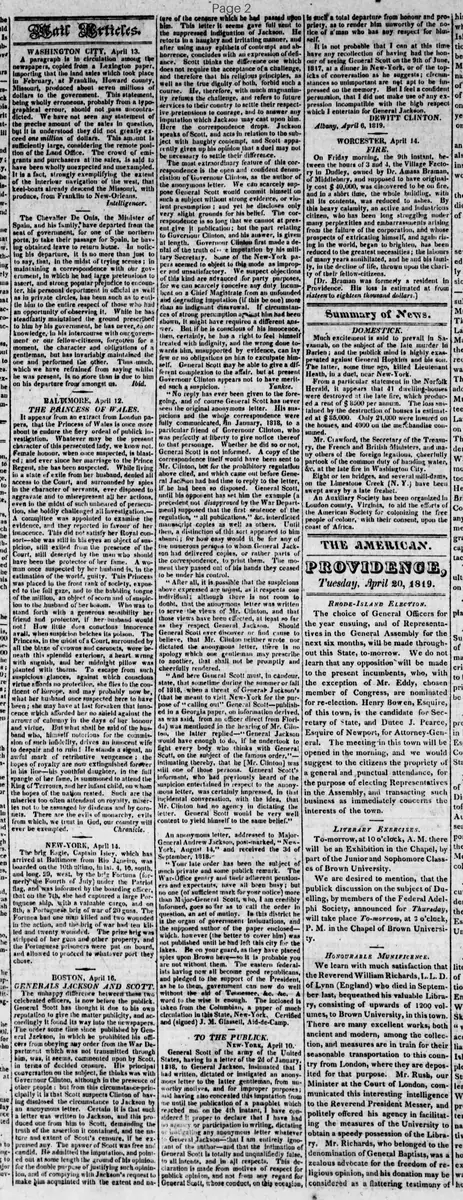
GENERALS JACKSON AND SCOTT
The unhappy difference between these two celebrated officers, is now before the public. General Scott has thought it due to his own reputation to give the matter publicity, and accordingly it found its way into the newspapers. The order some time since published by General Jackson, in which he prohibited his officers from obeying any order from the War Department which was not transmitted through him, was, it seems, commented upon by Scott, in terms of decided censure. His principal conversation on the subject, he thinks was with Governor Clinton, although in the presence of other people: but from this circumstance principally it is that Scott suspects Clinton of having disclosed the circumstance to Jackson by an anonymous letter. Certain it is that such a letter was written to Jackson, and this produced one from him to Scott, demanding the truth of the assertion it contained, and the nature and extent of Scott's censure, if he expressed any. The answer of Scott was free and candid. He admitted the imputation, and pointed out at some length the ground of his opinion, for the double purpose of justifying such opinion, and of complying with Jackson's request to make him acquainted with the extent and nature of the censure which he had passed upon him. This letter it seems gave full vent to the suppressed indignation of Jackson. He retorts in a haughty and irritating manner, and after using many epithets of contempt and abhorrence, concludes with an expression of defiance. Scott thinks the difference one which does not require the acceptance of a challenge, and therefore that his religious principles, as well as the true dignity of both, forbid such a course. He, therefore, with much magnanimity refuses the challenge, and refers to future services to their country to settle their respective pretensions to courage, and to answer any imputation which Jackson may cast upon him. Here the correspondence drops. Jackson speaks of Scott, and acts in relation to the subject with haughty contempt, and Scott apparently gives up his opinion that a duel may not be necessary to settle their difference.
The most extraordinary feature of this correspondence is the open and confident denunciation of Governor Clinton, as the author of the anonymous letter. We can scarcely suppose General Scott would commit himself on such a subject without strong evidence, or violent presumption; and yet he discloses only very slight grounds for his belief. The correspondence is so long that we cannot at present give it publication; but the part relating to Governor Clinton, and his answer, is given at length. Governor Clinton first made a denial of the truth of the imputation by his military Secretary. Some of the New-York papers seemed to object to this mode as improper and unsatisfactory. We suspect objections of this kind are advanced for party purposes, for we can scarcely conceive any duty incumbent on a Chief Magistrate from an unfounded and degrading imputation (if this be one) more than an indignant disavowal. If circumstances of strong presumption against him had been shown, it might have required a different answer. But if he is conscious of his innocence, then, certainly, he has a right to feel himself treated with indignity, and the wrong done towards him, unsupported by evidence, can lay few or no obligations on him to exculpate himself. General Scott may be able to give a different complexion to the affair, but at present Governor Clinton appears not to have merited such a suspicion.
Yankee.
"No reply has ever been given to the foregoing, and of course General Scott has never seen the original anonymous letter. His suspicions and the whole correspondence were fully communicated, in January, 1818, to a particular friend of Governor Clinton, who was perfectly at liberty to give notice thereof to that personage. Whether he did so or not, General Scott is not informed. A copy of the correspondence itself would have been sent to Mr. Clinton, but for the prohibitory regulation above cited, and which came out before General Jackson had had time to reply to the letter, if he had been so disposed. 'General Scott, until his opponent has set him the example (a precedent not disapproved by the War Department) supposed that the first sentence of the regulation, all publications,' &c. interdicted manuscript-copies as well as others. Until then, a distinction of this sort appeared to him absurd; for how easy would it be for any of the numerous persons to whom General Jackson had delivered copies, or rather parts of the correspondence, to print them. The moment they passed out of his hands they ceased to be under his control.
"After all, it is possible that the suspicions above expressed are unjust, as it respects one individual; although there is not room to doubt, that the anonymous letter was written to serve the views of Mr. Clinton, and that those views have been effected, at least so far as they respect General Jackson. Should General Scott ever discover or find cause to believe, that Mr. Clinton neither wrote nor dictated the anonymous letter, there is no apology which one gentleman may prescribe to another, that shall not be promptly and cheerfully rendered.
"And here General Scott must, in candour, state, that sometime during the summer or fall of 1818, when a threat of General Jackson's (that he meant to visit New-York for the purpose of "calling out" General Scott—published in a Georgia paper, on information derived, as was said, from an officer direct from Florida) was mentioned in the hearing of Mr. Clinton, the latter replied—"General Jackson would have enough to do, if he undertook to fight every body who thinks with General Scott, on the subject of the famous order,"—intimating thereby, that he [Mr. Clinton] was still one of those persons. General Scott's informant, who had previously heard of the suspicion entertained in respect to the anonymous letter, was certainly impressed, in that incidental conversation, with the idea, that Mr. Clinton had no agency in dictating the letter. General Scott would be very well content to yield himself to the same belief."
An anonymous letter, addressed to Major-General Andrew Jackson, post-marked, "New York, August 14," and received the 3d of September, 1818.
"Your late order has been the subject of much private and some public remark. The War-Office gentry and their adherent pensioners and expectants, have all been busy; but no one (of sufficient mark for your notice) more than Major-General Scott, who, I am credibly informed, goes so far as to call the order in question, an act of mutiny. In this district he is the organ of government insinuations, and the supposed author of the paper enclosed—which, however (the better to cover him) was not published until he had left this city for the lakes. Be on your guard, as they have placed spies upon Brown here—so it is probable you are not without them. The eastern federalists having now all become good republicans, and pledged to the support of the President, as he to them, government can now do well without the aid of Tennessee. &c. &c. A word to the wise is enough. The inclosed is taken from the Columbian, a paper of much circulation in this State, New-York. Certified and (signed) J. M. Glassell, Aid-de-Camp.
TO THE PUBLICK.
New-York, April 10.
General Scott of the army of the United States, having in a letter of the 2d of January, 1818, to General Jackson, insinuated that I had written, dictated or instigated an anonymous letter to the latter gentleman, from unworthy motives, and for improper purposes; and having also concealed this imputation from me until the publication of a pamphlet which reached me on the 4th instant, I have considered it proper to declare that I have had no agency or participation in writing, dictating or instigating any anonymous letter whatever to General Jackson; that I am entirely ignorant of the author—and that the intimation of General Scott is totally and unqualifiedly false, to all intents, and in all respects. This declaration is made from motives of respect for public opinion, and not from any regard for General Scott, whose conduct, on this occasion, is such a total departure from honour and propriety, as to render him unworthy of the notice of a man who has any respect for himself.
It is not probable that I can at this time have any recollection of having had the honour of seeing General Scott on the 9th of June, 1817, at a dinner in New-York, or of the topics of conversation as he suggests; circumstances so unimportant are not apt to be impressed on the memory. But I feel a confident persuasion, that I did not make use of any expression incompatible with the high respect which I entertain for General Jackson.
DEWITT CLINTON.
Albany, April 6, 1819.
What sub-type of article is it?
What themes does it cover?
What keywords are associated?
What entities or persons were involved?
Where did it happen?
Story Details
Key Persons
Location
Boston, New York
Event Date
April 16, 1818 1819
Story Details
Dispute arises from General Jackson's order prohibiting officers from obeying War Department orders not through him, censured by General Scott. Anonymous letter to Jackson accuses Scott of calling it mutiny, suspected from Governor Clinton. Correspondence ensues with accusations, defiance, and refusal of duel. Clinton denies involvement publicly.