Thank you for visiting SNEWPapers!
Sign up free
Spirit Of The Times
Portsmouth, Ironton, Scioto County, Lawrence County, Ohio
What is this article about?
Report on debates and balloting in the U.S. House of Representatives for the election of Speaker during the Fourth Congress, involving candidates Banks, Richardson, and Fuller, with discussions on Union, slavery, and procedural resolutions amid failed votes and no final election.
Clipping
OCR Quality
Full Text
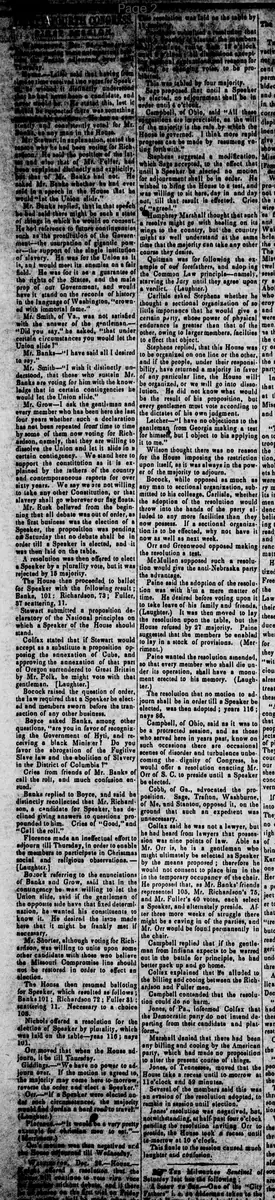
Last time received five votes for Speaker. A. B. C. D. E. F. G. H. I. J. K. L. M. N. O. P. Q. R. S. T. U. V. W. X. Y. Z.
In consistently voted for N. as any man in the House.
Mr. Stewart, in explanation, stated why he had been voting for Rich. He paid the position of the lat. rood low that of Mr. Fulfor, had aorpl laed dietinetly and explicitly what Mr. Baako had not. He asked Mr. Bink, whether he had ever in a speech in the House that he would let the Union slide."
Mr. Bank replied, that in that speech he had said there might be such a state of things in which he would so consent. He had reference to future contingencies such as the prostitution of the Government--the usurpation of gigantic power--the support of the single institution of slavery. He was for the Union as it is and would meet its enemies on a fair field. He was for it as a guarantee of the rights of the States, and the main prop of our Government, and would have it stand on the records of history in the language of Washington, "crowned with immortal fame."
Mr. Smith, of Va., was not satisfied with the answer of the gentleman.-- "Did you say," he asked, "that under certain circumstances you would let the Union slide!"
Mr. Banks--"I have said all I desired to say."
Mr. Smith--"I wish it distinctly understood, that those who sustain Mr. Banks are voting for him with the knowledge that in certain contingencies he would let the Union slide."
Mr. Grow--I ask the gentleman and every member who has been here the last four years whether such a declaration has not been repeated from time to time by some of them now voting for Richardson, namely, that they are willing to dissolve the Union and let it slide in a certain contingency. We stand here to support the constitution as it is explained by the fathers of the country and contemporaneous reports for over sixty years. We say we are not willing to take any other Constitution, or that slavery shall go wherever our flag floats.
Mr. Rusk believed from the beginning that all debate was out of order, as the first business was the election of a Speaker, the proposition was pending on Saturday that no debate shall be in order till a Speaker is elected, and it was then laid on the table.
A resolution was then offered to elect a Speaker by a plurality vote, but it was rejected by 15 majority.
The House then proceeded to ballot for Speaker with the following result: Banks, 101; Richardson, 73; Fuller, 37 scattering, 11.
Stewart submitted a proposition declaratory of the National principles on which a Speaker of the House should stand.
Colfax stated that if Stewart would accept as a substitute a proposition opposing the annexation of Cuba, and approving the annexation of that part of Oregon surrendered to Great Britain by Mr. Polk, he might vote with that gentleman, [Laughter.]
Bocock raised the question of order. the law required that a Speaker be elected and members sworn before the transaction of any other business.
Boyce asked Banks, among other questions, "are you in favor of recognizing the Government of Hayti, and receiving a black Minister? Do you favor the abrogation of the Fugitive Slave Law and the abolition of Slavery in the District of Columbia ?"
Cries from friends of Mr. Banks of call the roll, and much confusion ensued.
Banks replied to Boyce, and said he distinctly recollected that Mr. Richardson, a candidate for Speaker, has declined giving answers to questions propounded to him. Cries of "Good," and "Call the roll."
Florence made an ineffectual effort to adjourn till Thursday, in order to enable the members to participate in Christmas social and religious observations.-- [Laughter.]
Bocock referring to the enunciations of Banks and Grow, said that in the contingency he was willing to let the Union slide, said if the gentlemen of the opposite side have that fixed determination, he wanted his constituents to know it. He desired the issue made here that it might be frankly met if necessary.
Mr. Shorter, although voting for Richardson, was willing to unite upon some other candidate with those who believe the Missouri Compromise line should not be restored in order to effect an election.
The House then resumed balloting for Speaker, which resulted as follows: Banks 101; Richardson 72; Fuller 81; scattering 11. Necessary to a choice 108.
Nichols offered a resolution for the election of Speaker by plurality, which was laid on the table--yeas 116; nays 101.
Orr moved that when the House adjourn, it be till Thursday.
Giddings: "We have no power to adjourn over. If the motion is agreed to, the majority may come here to-morrow reverse the order and elect Speaker."
Of if a Speaker were elected under such circumstances, the majority would have a hard road to travel.
It would be a very pretty sample--what then resolved a Whig House.
This resolution was laid on the table by 2 majority. A motion that members remain until 10 o'clock unless on explanation and reason for not voting, to be provided, was tabled by four majority.
Sage proposed that until a Speaker be elected, no adjournment shall be in order until 6 o'clock.
Campbell, of Ohio, said "All these propositions are impracticable, as the will of the majority is the rule by which the House is governed. I think more rapid progress can be made by resuming voting forthwith."
Stephens suggested a modification, which Sage accepted to the effect that until Speaker be elected no motion for adjournment shall be in order. He wished to bring the House to a test, and was willing to sit here, day in and day out, till that result is effected. Cries of "agreed."
Humphrey Marshall thought that such a resolve might go with healing on its wings to the country, but the country might as well understand at the same time that the majority can take any other course they desire.
Quitman was for following the example of our forefathers, and adopting the Common Law principle--namely, starving the Jury until they agree upon a verdict. (Laughter.)
Carlisle asked Stephens whether he thought a sectional organization of so little importance that he would give a certain party, whose power of physical endurance is greater than that of the other, owing to larger members, facilities to effect that object.
Stephens replied, that this House was to be organized on one line or the other, and if the people, under their responsibility, have returned a majority in favor of any particular line, the House will be organized, or we will go into dissolution. He did not know what would be the result of his proposition, but every gentleman must vote according to the dictates of his own judgment.
Letcher--"I have no objections to the gentleman from Georgia making a test for himself, but I object to his applying it to me."
Wilson thought there was no reason for the House imposing the restriction upon itself, as it was always in the power of the majority to adjourn.
Bocock, while opposed as much as any man to sectional organization, submitted to his colleague, Carlisle, whether the adoption of the resolution would throw into the hands of the party alluded to any more facilities than they now possess. If a sectional organization is to be effected, why not have it now as well as next week.
Orr and Greenwood opposed making the resolution a test.
McMullen supposed such a resolution would give the anti-Nebraska party the advantage.
Paine said the adoption of the resolution was with him a mere matter of time. He desired before voting upon it to take leave of his family and friends, (Laughter.) It was then moved to lay the resolution upon the table, but the House refused by 27 majority. Paine suggested that the members be enabled to lay in a stock of provisions. (Merriment.)
Paine wanted the resolution amended, so that every member who shall die under its operation, shall have a monument erected to his memory. (Laughter.)
The resolution that no motion to adjourn shall be in order till a Speaker be elected, was then adopted; yeas 116; nays 86.
Campbell, of Ohio, said as it was to be a protracted session, and as those who served here in years past, know on such occasions there are occasional scenes of disorder and turbulence unbecoming the dignity of Congress, he would offer a resolution enacting Mr. Orr of S. C. to preside until a Speaker be elected.
Cobb, of Ga., advocated the proposition. Sage, Trafton, Washburne, of Me., and Stanton, opposed it, on the ground that such an expedient was unnecessary.
Colfax said he was not a lawyer, but he had heard from lawyers that possession was nine points of law. Able as Mr. Orr is, he is a gentleman who might ultimately be selected as Speaker by the means proposed; therefore he would not consent to place him in the temporary occupancy of the chair.
He proposed that, as Mr. Banks' friends represented 105, Mr. Richardson's 75, and Mr. Fuller's 40 votes, each select a Speaker, and alternately preside. After three more weeks of struggle there might be a caving in of the parties, and Mr. Orr would be found permanently in the chair.
Campbell replied that if the gentleman from Indiana expects to be wearied out in the battle of principle, he had better pack up and go home.
Colfax explained that he alluded to the billing and cooing between the Richardson and Fuller men.
Campbell contended that the resolution could do no harm.
Jones, of Pa., informed Colfax that the Democratic party do not intend departing from their candidate and platform.
Marshall denied that there had been any billing and cooing by the American party, which had made no proposition to alter the present course of things.
Jones, of Tennessee, moved that the House take a recess until to-morrow 10 o'clock and 69 minutes.
Several of the members said this was an evasion of the resolution adopted, to remain in session until election.
Jones' resolution was negatived, but, notwithstanding at half-past four o'clock pending the resolution inviting Orr to preside, the House took a recess until to-morrow at 10 o'clock.
This farce to the session caused much laughter and confusion.
Milwaukee Sentinel
What sub-type of article is it?
What keywords are associated?
What entities or persons were involved?
Where did it happen?
Domestic News Details
Primary Location
Washington, D.C.
Key Persons
Outcome
multiple ballots held with no speaker elected: banks received 101 votes, richardson 72-73, fuller 37-81, scattering 11. resolutions for plurality voting and adjournment restrictions passed or failed; house adopted rule to continue session without adjournment until speaker elected but took recess anyway.
Event Details
The U.S. House debated and balloted for Speaker amid tensions over Union preservation, slavery, and sectional issues. Candidates Banks, Richardson, and Fuller vied for votes. Exchanges questioned loyalty to the Union under contingencies like slavery expansion. Procedural motions on debate, plurality election, and adjournment were debated and voted on, with no election achieved and session extended.