Thank you for visiting SNEWPapers!
Sign up free
The Augusta Courier
Augusta, Richmond County, Georgia
What is this article about?
Governor Ernest F. Hollings criticizes the U.S. Supreme Court for overstepping its authority by mandating school integration, claiming it illegally amends the Constitution and usurps states' rights in education and elections. He defends Southern resistance and quotes Washington and justices to argue for lawful amendments only.
Merged-components note: Within-page continuation on page 4 of the article on Governor Hollings' testimony before the Senate subcommittee.
Clipping
OCR Quality
Full Text
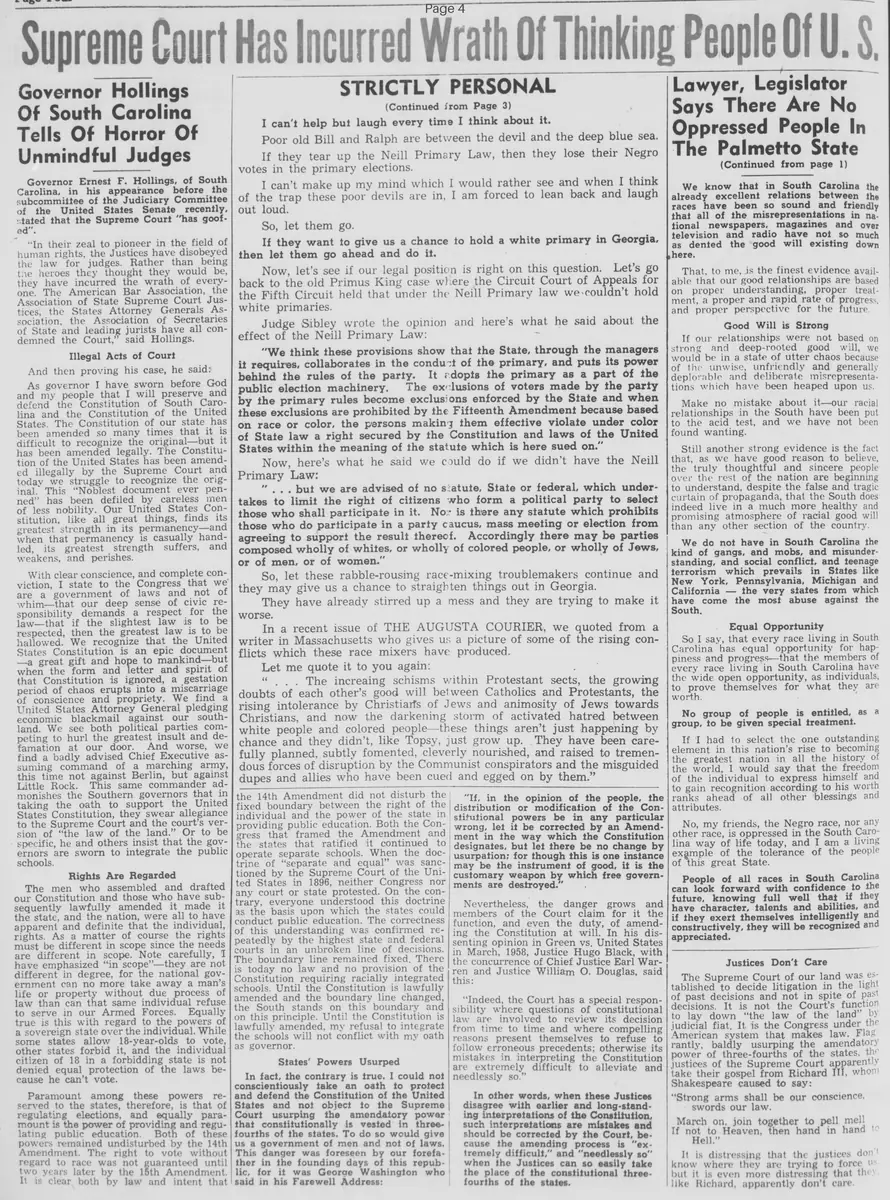
Governor Hollings Of South Carolina Tells Of Horror Of Unmindful Judges
Governor Ernest F. Hollings, of South Carolina, in his appearance before the subcommittee of the Judiciary Committee of the United States Senate recently, stated that the Supreme Court "has goofed".
"In their zeal to pioneer in the field of human rights, the Justices have disobeyed the law for judges. Rather than being the heroes they thought they would be, they have incurred the wrath of everyone. The American Bar Association, the Association of State Supreme Court Justices, the States Attorney Generals Association, the Association of Secretaries of State and leading jurists have all condemned the Court," said Hollings.
Illegal Acts of Court
And then proving his case, he said:
As governor I have sworn before God and my people that I will preserve and defend the Constitution of South Carolina and the Constitution of the United States. The Constitution of our state has been amended so many times that it is difficult to recognize the original but it has been amended legally. The Constitution of the United States has been amended illegally by the Supreme Court and today we struggle to recognize the original. This "Noblest document ever penned" has been defiled by careless men of less nobility. Our United States Constitution, like all great things, finds its greatest strength in its permanency-and when that permanency is casually handled, its greatest strength suffers, and weakens, and perishes.
With clear conscience, and complete conviction, I state to the Congress that we are a government of laws and not of whim--that our deep sense of civic responsibility demands a respect for the law-that if the slightest law is to be respected, then the greatest law is to be hallowed. We recognize that the United States Constitution is an epic document -a great gift and hope to mankind but when the form and letter and spirit of that Constitution is ignored, a gestation period of chaos erupts into a miscarriage of conscience and propriety. We find a United States Attorney General pledging economic blackmail against our southland. We see both political parties competing to hurl the greatest insult and defamation at our door. And worse, we find a badly advised Chief Executive assuming command of a marching army, this time not against Berlin, but against Little Rock. This same commander admonishes the Southern governors that in taking the oath to support the United States Constitution, they swear allegiance to the Supreme Court and the court's version of "the law of the land." Or to be specific, he and others insist that the governors are sworn to integrate the public schools.
Rights Are Regarded
The men who assembled and drafted our Constitution and those who have subsequently lawfully amended it made it apparent and definite that the individual, the state, and the nation, were all to have rights. As a matter of course the rights must be different in scope since the needs are different in scope. Note carefully, I have emphasized "in scope" —they are not different in degree, for the national government can no more take away a man's life or property without due process of law than can that same individual refuse to serve in our Armed Forces. Equally true is this with regard to the powers of a sovereign state over the individual. While some states allow 18-year-olds to vote, other states forbid it, and the individual citizen of 18 in a forbidding state is not denied equal protection of the laws because he can't vote.
Paramount among these powers reserved to the states, therefore, is that of regulating elections, and equally paramount is the power of providing and regulating public education. Both of these powers remained undisturbed by the 14th Amendment. The right to vote without regard to race was not guaranteed until two years later by the 15th Amendment. It is clear both by law and intent that
the 14th Amendment did not disturb the fixed boundary between the right of the individual and the power of the state in providing public education. Both the Congress that framed the Amendment and the states that ratified it continued to operate separate schools. When the doctrine of "separate and equal" was sanctioned by the Supreme Court of the United States in 1896, neither Congress nor any court or state protested. On the contrary, everyone understood this doctrine as the basis upon which the states could conduct public education. The correctness of this understanding was confirmed repeatedly by the highest state and federal courts in an unbroken line of decisions. The boundary line remained fixed. There is today no law and no provision of the Constitution requiring racially integrated schools. Until the Constitution is lawfully amended and the boundary line changed, the South stands on this boundary and on this principle. Until the Constitution is lawfully amended, my refusal to integrate the schools will not conflict with my oath as governor.
States' Powers Usurped
In fact, the contrary is true. I could not conscientiously take an oath to protect and defend the Constitution of the United States and not object to the Supreme Court usurping the amendatory power that constitutionally is vested in three-fourths of the states. To do so would give us a government of men and not of laws.
This danger was foreseen by our forefathers in the founding days of this republic, for it was George Washington who said in his Farewell Address:
"If, in the opinion of the people, the distribution or modification of the Constitutional powers be in any particular wrong, let it be corrected by an Amendment in the way which the Constitution designates, but let there be no change by usurpation; for though this is one instance may be the instrument of good, it is the customary weapon by which free governments are destroyed."
Nevertheless, the danger grows and members of the Court claim for it the function, and even the duty, of amending the Constitution at will. In his dissenting opinion in Green vs. United States in March, 1958, Justice Hugo Black, with the concurrence of Chief Justice Earl Warren and Justice William O. Douglas, said this:
"Indeed, the Court has a special responsibility where questions of constitutional law are involved to review its decision from time to time and where compelling reasons present themselves to refuse to follow erroneous precedents; otherwise its mistakes in interpreting the Constitution are extremely difficult to alleviate and needlessly so."
In other words, when these Justices disagree with earlier and long-standing interpretations of the Constitution, such interpretations are mistakes and should be corrected by the Court, because the amending process is extremely difficult, and "needlessly so" when the Justices can so easily take the place of the constitutional three-fourths of the states.
What sub-type of article is it?
What keywords are associated?
What entities or persons were involved?
Editorial Details
Primary Topic
Supreme Court Overreach In School Integration And Constitutional Amendment
Stance / Tone
Strongly Pro States' Rights And Anti Federal Judicial Activism
Key Figures
Key Arguments