Thank you for visiting SNEWPapers!
Sign up free
Editorial
May 13, 1858
Wheeling Daily Intelligencer
Wheeling, Ohio County, West Virginia
What is this article about?
The editor defends their newspaper's accurate report of a heated exchange at a political convention between Mr. Vincent and the Editor of the Times over allegations of irregular delegate appointments and pledges for Mr. Dorsey, refuting claims of caricature or injustice.
Clipping
OCR Quality
95%
Excellent
Full Text
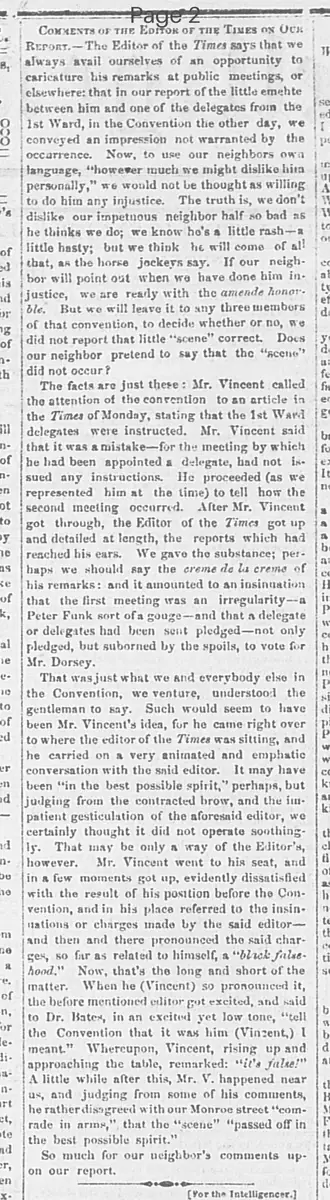
Comments of the Editor of the Times on Our Report.—The Editor of the Times says that we always avail ourselves of an opportunity to caricature his remarks at public meetings, or elsewhere: that in our report of the little emeute between him and one of the delegates from the 1st Ward, in the Convention the other day, we conveyed an impression not warranted by the occurrence.
Now, to use our neighbor's own language, "however much we might dislike him personally," we would not be thought as willing to do him any injustice. The truth is, we don't dislike our impetuous neighbor half so bad as he thinks we do: we know he's a little rash—a little hasty; but we think he will come off all that, as the horse jockeys say. If our neighbor will point out when we have done him injustice, we are ready with the amende honorable. But we will leave it to any three members of that convention, to decide whether or not we did not report that little "scene" correct. Does our neighbor pretend to say that the "scene" did not occur?
The facts are just these: Mr. Vincent called the attention of the convention to an article in the Times of Monday, stating that the 1st Ward delegates were instructed. Mr. Vincent said that it was a mistake—for the meeting by which he had been appointed a delegate, had not issued any instructions. He proceeded (as we represented him at the time) to tell how the second meeting occurred. After Mr. Vincent got through, the Editor of the Times got up and detailed at length, the reports which had reached his ears. We gave the substance; perhaps we should say the creme de la creme of his remarks: and it amounted to an insinuation that the first meeting was an irregularity—a Peter Funk sort of a gouge—and that a delegate or delegates had been sent pledged—not only pledged, but suborned by the spoils, to vote for Mr. Dorsey.
That was just what we and everybody else in the Convention, we venture, understood the gentleman to say. Such would seem to have been Mr. Vincent's idea, for he came right over to where the editor of the Times was sitting, and he carried on a very animated and emphatic conversation with the said editor. It may have been "in the best possible spirit," perhaps, but judging from the contracted brow, and the impatient gesticulation of the aforesaid editor, we certainly thought it did not operate soothingly. That may be only a way of the Editor's, however. Mr. Vincent went to his seat, and in a few moments got up, evidently dissatisfied with the result of his position before the Convention, and in his place referred to the insinuations or charges made by the said editor— and then and there pronounced the said charges, so far as related to himself, a "black falsehood." Now, that's the long and short of the matter. When he (Vincent) so pronounced it, the before mentioned editor got excited, and said to Dr. Bates, in an excited but low tone, "tell the Convention that it was him (Vincent,) I meant."
Whereupon, Vincent, rising up and approaching the table, remarked: "it's false!" A little while after this, Mr. V. happened near us, and judging from some of his comments, he rather disagreed with our Monroe street "comrade in arms," that the "scene" "passed off in the best possible spirit."
So much for our neighbor's comments upon our report.
Now, to use our neighbor's own language, "however much we might dislike him personally," we would not be thought as willing to do him any injustice. The truth is, we don't dislike our impetuous neighbor half so bad as he thinks we do: we know he's a little rash—a little hasty; but we think he will come off all that, as the horse jockeys say. If our neighbor will point out when we have done him injustice, we are ready with the amende honorable. But we will leave it to any three members of that convention, to decide whether or not we did not report that little "scene" correct. Does our neighbor pretend to say that the "scene" did not occur?
The facts are just these: Mr. Vincent called the attention of the convention to an article in the Times of Monday, stating that the 1st Ward delegates were instructed. Mr. Vincent said that it was a mistake—for the meeting by which he had been appointed a delegate, had not issued any instructions. He proceeded (as we represented him at the time) to tell how the second meeting occurred. After Mr. Vincent got through, the Editor of the Times got up and detailed at length, the reports which had reached his ears. We gave the substance; perhaps we should say the creme de la creme of his remarks: and it amounted to an insinuation that the first meeting was an irregularity—a Peter Funk sort of a gouge—and that a delegate or delegates had been sent pledged—not only pledged, but suborned by the spoils, to vote for Mr. Dorsey.
That was just what we and everybody else in the Convention, we venture, understood the gentleman to say. Such would seem to have been Mr. Vincent's idea, for he came right over to where the editor of the Times was sitting, and he carried on a very animated and emphatic conversation with the said editor. It may have been "in the best possible spirit," perhaps, but judging from the contracted brow, and the impatient gesticulation of the aforesaid editor, we certainly thought it did not operate soothingly. That may be only a way of the Editor's, however. Mr. Vincent went to his seat, and in a few moments got up, evidently dissatisfied with the result of his position before the Convention, and in his place referred to the insinuations or charges made by the said editor— and then and there pronounced the said charges, so far as related to himself, a "black falsehood." Now, that's the long and short of the matter. When he (Vincent) so pronounced it, the before mentioned editor got excited, and said to Dr. Bates, in an excited but low tone, "tell the Convention that it was him (Vincent,) I meant."
Whereupon, Vincent, rising up and approaching the table, remarked: "it's false!" A little while after this, Mr. V. happened near us, and judging from some of his comments, he rather disagreed with our Monroe street "comrade in arms," that the "scene" "passed off in the best possible spirit."
So much for our neighbor's comments upon our report.
What sub-type of article is it?
Partisan Politics
What keywords are associated?
Convention Dispute
Delegate Instructions
Newspaper Rivalry
Political Insinuations
Editor Confrontation
What entities or persons were involved?
Editor Of The Times
Mr. Vincent
Dr. Bates
Mr. Dorsey
1st Ward Delegates
Editorial Details
Primary Topic
Defense Of Reporting On Convention Dispute Over Delegate Instructions
Stance / Tone
Defensive Justification Of Report Accuracy
Key Figures
Editor Of The Times
Mr. Vincent
Dr. Bates
Mr. Dorsey
1st Ward Delegates
Key Arguments
Report Accurately Conveyed The Insinuations Made By Editor Of The Times About Irregular Delegate Meetings And Pledges
Mr. Vincent Denied Instructions And Called Charges A 'Black Falsehood'
Editor Of The Times Implied Subornation By Spoils To Vote For Mr. Dorsey
Incident Involved Animated Conversation And Excited Responses
Willing To Make Amends If Injustice Proven, But Facts Support The Report