Thank you for visiting SNEWPapers!
Sign up free
Editorial
December 11, 1904
The News & Observer
Raleigh, Wake County, North Carolina
What is this article about?
Editorial criticizes Congress for publishing Thomas Jefferson's 'The Morals of Jesus of Nazareth' at public expense, arguing it violates constitutional principles and Jefferson's own views on separating government from religion. Discusses Jefferson's creation of the book as a personal moral guide, not for propagation.
Clipping
OCR Quality
98%
Excellent
Full Text
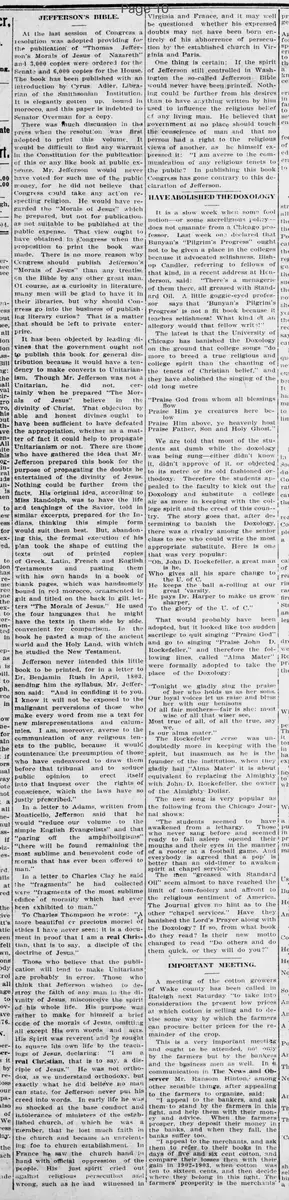
JEFFERSON'S BIBLE.
At the last session of Congress a resolution was adopted providing for the publication of "Thomas Jefferson's Morals of Jesus of Nazareth" and 3,000 copies were ordered for the Senate and 6,000 copies for the House. The book has been published with an introduction by Cyrus Adler, Librarian of the Smithsonian Institution. It is elegantly gotten up, bound in morocco, and this paper is indebted to Senator Overman for a copy.
There was much discussion in the press when the resolution was first adopted to print this volume. It would be difficult to find any warrant in the Constitution for the publication of this or any like book at public expense. Mr. Jefferson would never have voted for such use of the public money, for he did not believe that Congress could take any action respecting religion. He would have regarded the "Morals of Jesus" which he prepared, but not for publication as not suitable to be published at the public expense. That view ought to have obtained in Congress when the proposition to print the book was made. There is no more reason why Congress should publish Jefferson's "Morals of Jesus" than any treatise on the Bible by any other great man. Of course, as a curiosity in literature many men will be glad to have it in their libraries, but why should Congress go into the business of publishing literary curios? That is a matter that should be left to private enterprise.
It has been objected by leading divines that the government ought not to publish this book for general distribution because it would have a tendency to make converts to Unitarianism. Though Mr. Jefferson was not a Unitarian, he did not, certainly when he prepared "The Morals of Jesus" believe in the divinity of Christ. That objection by able and honest divines ought to have been sufficient to have defeated the appropriation, whether as a matter of fact it could help to propagate Unitarianism or not. There are those who have gathered the idea that Mr. Jefferson prepared this book for the purpose of propagating the doubts he entertained of the divinity of Jesus. Nothing could be further from the facts. His original idea, according to Miss Randolph, was to have the life and teachings of the Savior, told in similar excerpts, prepared for the Indians, thinking this simple form would suit them best. But, abandoning this, the formal execution of his plan took the shape of cutting the texts out of printed copies of Greek, Latin, French and English Testaments and pasting them with his own hands in a book of blank pages, which was handsomely bound in red morocco, ornamented in gilt and titled on the back in gilt letters "The Morals of Jesus." He used the four languages that he might have the texts in them side by side. convenient for comparison. In the book he pasted a map of the ancient world and the Holy Land, with which he studied the New Testament.
Jefferson never intended this little book to be printed, for in a letter to Dr. Benjamin Rush in April, 1803, sending him the syllabus, Mr. Jefferson said: "And in confiding it to you I know it will not be exposed to the malignant perversions of those who make every word from me a text for new misrepresentations and calumnies. I am, moreover, averse to the communication of any religious tenets to the public, because it would countenance the presumption of those who have endeavored to draw them before that tribunal and to seduce public opinion to erect itself into that inquest over the rights of conscience, which the laws have so justly prescribed."
In a letter to Adams, written from Monticello, Jefferson said that he would "reduce our volume to the simple English Evangelists" and that "paring off the amphiboligisms" "there will be found remaining the most sublime and benevolent code of morals that has ever been offered to man."
In a letter to Charles Clay he said the "fragments" he had collected were "fragments of the most sublime edifice of morality which had ever been exhibited to man."
To Charles Thompson he wrote: "A more beautiful or precious morsel of ethics I have never seen: it is a document in proof that I am a real Christian, that is to say, a disciple of the doctrine of Jesus."
Those who believe that the publication will tend to make Unitarians are probably in error. Those who think that Jefferson wished to destroy the faith of any man in the divinity of Jesus, misconceive the spirit of his whole life. His purpose was rather to make for himself a brief code of the morals of Jesus, omitting all except His own words and acts. His Spirit was reverent and he sought to square his own life by the teachings of Jesus, declaring: "I am a real Christian, that is to say, a disciple of Jesus." He was not orthodox, as we understand orthodoxy, but exactly what he did believe no man can state, for Jefferson never put his creed into words. In early life he was so shocked at the base conduct and intolerance of ministers of the established church, of which he was a member, that he lost much faith in the church and became an unrelenting foe to church establishment. In France he saw the church hand in hand with official oppression of the people. His just spirit cried out against religious persecution and wrong, such as he had witnessed in Virginia and France, and it may well be questioned whether his expressed doubts may not have been born entirely of his abhorrence of persecution by the established church in Virginia and Paris.
One thing is certain: If the spirit of Jefferson still controlled in Washington the so-called Jefferson Bible would never have been printed. Nothing could be further from his desires than to have anything written by him used to influence the religious belief of any living man. He believed that government at no place should touch the conscience of man and that no person had a right to the religious views of another, as he himself expressed it: "I am averse to the communication of any religious tenets to the public." In publishing this book Congress has gone contrary to this declaration of Jefferson.
At the last session of Congress a resolution was adopted providing for the publication of "Thomas Jefferson's Morals of Jesus of Nazareth" and 3,000 copies were ordered for the Senate and 6,000 copies for the House. The book has been published with an introduction by Cyrus Adler, Librarian of the Smithsonian Institution. It is elegantly gotten up, bound in morocco, and this paper is indebted to Senator Overman for a copy.
There was much discussion in the press when the resolution was first adopted to print this volume. It would be difficult to find any warrant in the Constitution for the publication of this or any like book at public expense. Mr. Jefferson would never have voted for such use of the public money, for he did not believe that Congress could take any action respecting religion. He would have regarded the "Morals of Jesus" which he prepared, but not for publication as not suitable to be published at the public expense. That view ought to have obtained in Congress when the proposition to print the book was made. There is no more reason why Congress should publish Jefferson's "Morals of Jesus" than any treatise on the Bible by any other great man. Of course, as a curiosity in literature many men will be glad to have it in their libraries, but why should Congress go into the business of publishing literary curios? That is a matter that should be left to private enterprise.
It has been objected by leading divines that the government ought not to publish this book for general distribution because it would have a tendency to make converts to Unitarianism. Though Mr. Jefferson was not a Unitarian, he did not, certainly when he prepared "The Morals of Jesus" believe in the divinity of Christ. That objection by able and honest divines ought to have been sufficient to have defeated the appropriation, whether as a matter of fact it could help to propagate Unitarianism or not. There are those who have gathered the idea that Mr. Jefferson prepared this book for the purpose of propagating the doubts he entertained of the divinity of Jesus. Nothing could be further from the facts. His original idea, according to Miss Randolph, was to have the life and teachings of the Savior, told in similar excerpts, prepared for the Indians, thinking this simple form would suit them best. But, abandoning this, the formal execution of his plan took the shape of cutting the texts out of printed copies of Greek, Latin, French and English Testaments and pasting them with his own hands in a book of blank pages, which was handsomely bound in red morocco, ornamented in gilt and titled on the back in gilt letters "The Morals of Jesus." He used the four languages that he might have the texts in them side by side. convenient for comparison. In the book he pasted a map of the ancient world and the Holy Land, with which he studied the New Testament.
Jefferson never intended this little book to be printed, for in a letter to Dr. Benjamin Rush in April, 1803, sending him the syllabus, Mr. Jefferson said: "And in confiding it to you I know it will not be exposed to the malignant perversions of those who make every word from me a text for new misrepresentations and calumnies. I am, moreover, averse to the communication of any religious tenets to the public, because it would countenance the presumption of those who have endeavored to draw them before that tribunal and to seduce public opinion to erect itself into that inquest over the rights of conscience, which the laws have so justly prescribed."
In a letter to Adams, written from Monticello, Jefferson said that he would "reduce our volume to the simple English Evangelists" and that "paring off the amphiboligisms" "there will be found remaining the most sublime and benevolent code of morals that has ever been offered to man."
In a letter to Charles Clay he said the "fragments" he had collected were "fragments of the most sublime edifice of morality which had ever been exhibited to man."
To Charles Thompson he wrote: "A more beautiful or precious morsel of ethics I have never seen: it is a document in proof that I am a real Christian, that is to say, a disciple of the doctrine of Jesus."
Those who believe that the publication will tend to make Unitarians are probably in error. Those who think that Jefferson wished to destroy the faith of any man in the divinity of Jesus, misconceive the spirit of his whole life. His purpose was rather to make for himself a brief code of the morals of Jesus, omitting all except His own words and acts. His Spirit was reverent and he sought to square his own life by the teachings of Jesus, declaring: "I am a real Christian, that is to say, a disciple of Jesus." He was not orthodox, as we understand orthodoxy, but exactly what he did believe no man can state, for Jefferson never put his creed into words. In early life he was so shocked at the base conduct and intolerance of ministers of the established church, of which he was a member, that he lost much faith in the church and became an unrelenting foe to church establishment. In France he saw the church hand in hand with official oppression of the people. His just spirit cried out against religious persecution and wrong, such as he had witnessed in Virginia and France, and it may well be questioned whether his expressed doubts may not have been born entirely of his abhorrence of persecution by the established church in Virginia and Paris.
One thing is certain: If the spirit of Jefferson still controlled in Washington the so-called Jefferson Bible would never have been printed. Nothing could be further from his desires than to have anything written by him used to influence the religious belief of any living man. He believed that government at no place should touch the conscience of man and that no person had a right to the religious views of another, as he himself expressed it: "I am averse to the communication of any religious tenets to the public." In publishing this book Congress has gone contrary to this declaration of Jefferson.
What sub-type of article is it?
Moral Or Religious
Constitutional
What keywords are associated?
Jefferson Bible
Congress Publication
Separation Church State
Religious Freedom
Unitarianism
Morals Of Jesus
Thomas Jefferson Religion
What entities or persons were involved?
Thomas Jefferson
Congress
Cyrus Adler
Senator Overman
Benjamin Rush
John Adams
Charles Clay
Charles Thomson
Editorial Details
Primary Topic
Criticism Of Congress Publishing Jefferson's Bible
Stance / Tone
Opposed To Government Funding Of Religious Publications
Key Figures
Thomas Jefferson
Congress
Cyrus Adler
Senator Overman
Benjamin Rush
John Adams
Charles Clay
Charles Thomson
Key Arguments
No Constitutional Warrant For Publishing Religious Books At Public Expense
Jefferson Opposed Government Action On Religion
Book Was Personal, Not For Publication Or Propagation
Publication Risks Promoting Unitarianism
Jefferson Created It As A Moral Guide From Jesus' Teachings
Jefferson Averse To Public Communication Of Religious Tenets
Government Should Not Influence Religious Beliefs