Thank you for visiting SNEWPapers!
Sign up free
Story
December 3, 1852
Pawtucket Gazette And Chronicle
Pawtucket, Providence County, Rhode Island
What is this article about?
In 1840, an 18-year-old girl from Canada arrives in Schenectady, NY, supports herself as a seamstress, adopts two orphans after their mother's death, and reunites with her forgiving family, who welcome the children too.
Clipping
OCR Quality
92%
Excellent
Full Text
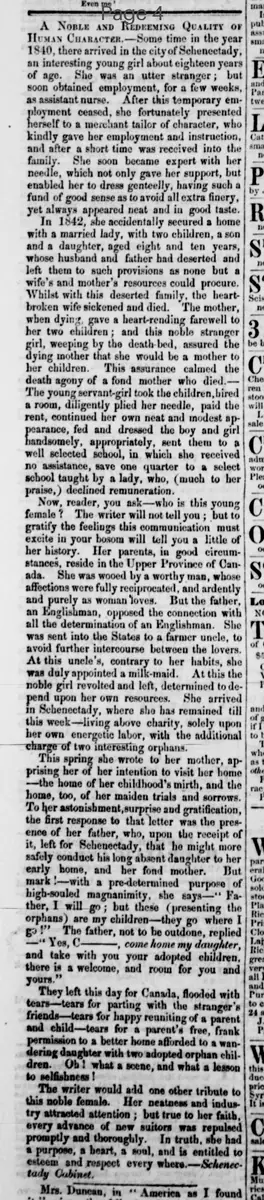
A Noble And Redeeming Quality of Luxuriant Character.—Some time in the year 1840, there arrived in the city of Schenectady, an interesting young girl about eighteen years of age. She was an utter stranger; but soon obtained employment, for a few weeks, as assistant nurse. After this temporary employment ceased, she fortunately presented herself to a merchant tailor of character, who kindly gave her employment and instruction. and after a short time was received into the family. She soon became expert with her needle, which not only gave her support, but enabled her to dress genteelly, having such a fund of good sense as to avoid all extra finery, yet always appeared neat and in good taste. In 1842, she accidentally secured a home with a married lady. with two children, a son and a daughter, aged eight and ten years, whose husband and father had deserted and left them to such provisions as none but a wife's and mother's resources could procure. Whilst with this deserted family, the heart- broken wife sickened and died. The mother. when dying, gave a heart-rending farewell to her two children: and this noble stranger girl, weeping by the death-bed, assured the dying mother that she would be a mother to her children. This assurance calmed the death agony of a fond mother who died.- The young servant-girl took the children, hired a room, diligently plied her needle, paid the rent, continued her own neat and modest appearance, fed and dressed the boy and girl handsomely, appropriately, sent them to a well selected school, in which she received no assistance, save one quarter to a select school taught by a lady, who, (much to her praise,) declined remuneration. Now, reader, you ask-who is this young female? The writer will not tell you : but to gratify the feelings this communication must excite in your bosom will tell you a little of her history. Her parents, in good circumstances, reside in the Upper Province of Canada. She was wooed by a worthy man, whose affections were fully reciprocated, and ardently and purely as woman loves. But the father, an Englishman, opposed the connection with all the determination of an Englishman. She was sent into the States to a farmer uncle. to avoid further intercourse between the lovers. At this uncle's, contrary to her habits, she was duly appointed a milk-maid. At this the noble girl revolted and left, determined to depend upon her own resources. She arrived in Schenectady, where she has remained till this week-living above charity, solely upon her own energetic labor, with the additional charge of two interesting orphans. This spring she wrote to her mother, ap- prising her of her intention to visit her home --the home of her childhood's mirth, and the home, too, of her maiden trials and sorrows. To her astonishment, surprise and gratification, the first response to that letter was the pres- ence of her father, who, upon the receipt of it, left for Schenectady, that he might more safely conduct his long absent daughter to her early home, and her fond mother. But mark !-with a pre-determined purpose of high-souled magnanimity, she says-" Fa- ther, I will go; but these (presenting the orphans) are my children-they go where I !" The father, not to be outdone, replied —" Yes, C, come home my daughter, and take with you your adopted children, there is a welcome, and room for you and yours." They left this day for Canada, flooded with tears-tears for parting with the stranger's friends-tears for happy reuniting of a parent and child-tears for a parent's free, frank permission to a better home afforded to a wan- dering daughter with two adopted orphan chil- dren. Oh ! what a scene, and what a lesson to selfishness! The writer would add one other tribute to this noble female. Her neatness and indus- try attracted attention ; but true to her faith, every advance of new suitors was repulsed promptly and thoroughly. In truth, she had a purpose, a heart, a soul, and is entitled to esteem and respect every where.-Schenec- tady Cabinet.
What sub-type of article is it?
Biography
Personal Triumph
Heroic Act
What themes does it cover?
Family
Moral Virtue
Triumph
What keywords are associated?
Adopted Orphans
Family Reunion
Noble Sacrifice
Seamstress
Schenectady
What entities or persons were involved?
Young Girl (C)
Father
Mother
Dying Mother
Two Orphans
Where did it happen?
Schenectady, Upper Province Of Canada
Story Details
Key Persons
Young Girl (C)
Father
Mother
Dying Mother
Two Orphans
Location
Schenectady, Upper Province Of Canada
Event Date
1840 1842
Story Details
An 18-year-old girl exiled from Canada arrives in Schenectady in 1840, works as a seamstress, adopts two orphans after their mother's death in 1842, rejects suitors, and reunites with her family in spring, who welcome the orphans too.