Thank you for visiting SNEWPapers!
Sign up free
Story
April 19, 1954
The Nome Nugget
Nome, Nome County, Alaska
What is this article about?
Cpl. Edward S. Dickenson, 23, goes on trial in Washington for allegedly informing on fellow POWs while captive in Korea. His lawyer questions the court on soldier blame under Communist pressure; members cite history of torture resistance.
Clipping
OCR Quality
98%
Excellent
Full Text
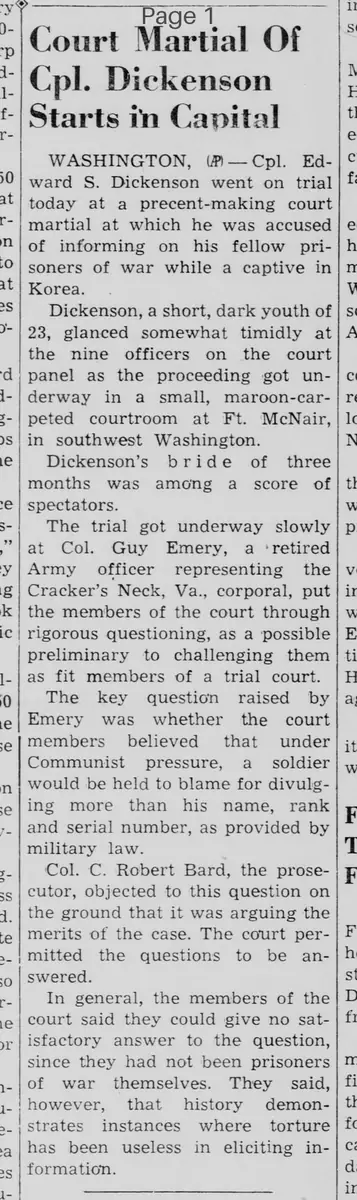
Court Martial Of Cpl. Dickenson Starts in Capital
WASHINGTON, (P)--Cpl. Edward S. Dickenson went on trial today at a precedent-making court martial at which he was accused of informing on his fellow prisoners of war while a captive in Korea.
Dickenson, a short, dark youth of 23, glanced somewhat timidly at the nine officers on the court panel as the proceeding got underway in a small, maroon-carpeted courtroom at Ft. McNair, in southwest Washington.
Dickenson's bride of three months was among a score of spectators.
The trial got underway slowly at Col. Guy Emery, a retired Army officer representing the Cracker's Neck, Va., corporal, put the members of the court through rigorous questioning, as a possible preliminary to challenging them as fit members of a trial court.
The key question raised by Emery was whether the court members believed that under Communist pressure, a soldier would be held to blame for divulging more than his name, rank and serial number, as provided by military law.
Col. C. Robert Bard, the prosecutor, objected to this question on the ground that it was arguing the merits of the case. The court permitted the questions to be answered.
In general, the members of the court said they could give no satisfactory answer to the question, since they had not been prisoners of war themselves. They said, however, that history demonstrates instances where torture has been useless in eliciting information.
WASHINGTON, (P)--Cpl. Edward S. Dickenson went on trial today at a precedent-making court martial at which he was accused of informing on his fellow prisoners of war while a captive in Korea.
Dickenson, a short, dark youth of 23, glanced somewhat timidly at the nine officers on the court panel as the proceeding got underway in a small, maroon-carpeted courtroom at Ft. McNair, in southwest Washington.
Dickenson's bride of three months was among a score of spectators.
The trial got underway slowly at Col. Guy Emery, a retired Army officer representing the Cracker's Neck, Va., corporal, put the members of the court through rigorous questioning, as a possible preliminary to challenging them as fit members of a trial court.
The key question raised by Emery was whether the court members believed that under Communist pressure, a soldier would be held to blame for divulging more than his name, rank and serial number, as provided by military law.
Col. C. Robert Bard, the prosecutor, objected to this question on the ground that it was arguing the merits of the case. The court permitted the questions to be answered.
In general, the members of the court said they could give no satisfactory answer to the question, since they had not been prisoners of war themselves. They said, however, that history demonstrates instances where torture has been useless in eliciting information.
What sub-type of article is it?
Crime Story
Historical Event
What themes does it cover?
Crime Punishment
Justice
Betrayal
What keywords are associated?
Court Martial
Pow Trial
Korea Captive
Informing Accusation
Communist Pressure
What entities or persons were involved?
Edward S. Dickenson
Col. Guy Emery
Col. C. Robert Bard
Where did it happen?
Ft. Mcnair, In Southwest Washington
Story Details
Key Persons
Edward S. Dickenson
Col. Guy Emery
Col. C. Robert Bard
Location
Ft. Mcnair, In Southwest Washington
Story Details
Cpl. Edward S. Dickenson is accused of informing on fellow POWs in Korea and faces court martial. His lawyer questions the panel on culpability under pressure; prosecutor objects but questions proceed; court members reference historical torture resistance.