Thank you for visiting SNEWPapers!
Sign up free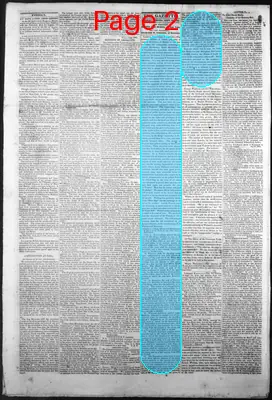
Editorial
September 22, 1835
The New Hampshire Gazette
Portsmouth, Rockingham County, New Hampshire
What is this article about?
This editorial laments the regression of liberal principles in Europe since Napoleon's fall, highlighting betrayals in England's Reform Act under William IV and France's 1830 revolution under Louis Philippe, who introduced repressive press laws. It ends with hope for English reform via Melbourne and Brougham.
Clipping
OCR Quality
98%
Excellent
Full Text
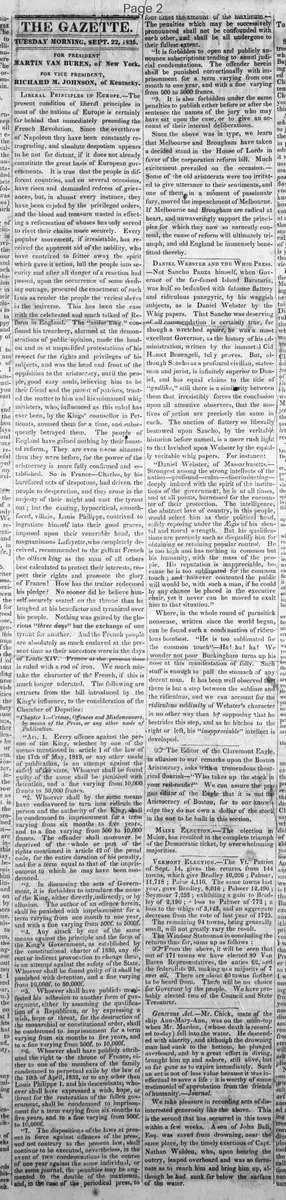
Liberal Principles in Europe.—The present condition of liberal principles in most of the nations of Europe is certainly far behind that immediately preceding the French Revolution. Since the overthrow of Napoleon they have been constantly retrograding, and absolute despotism appears to be not far distant, if it does not already constitute the great basis of European governments. It is true that the people in different countries, and on several occasions, have risen and demanded redress of grievances, but, in almost every instance, they have been cajoled by the privileged orders, and the blood and treasure wasted in effecting a reformation of abuses has only served to rivet their chains more securely. Every popular movement, if irresistible, has received the apparent aid of the nobility, who have contrived to fritter away the spirit which gave it action, lull the people into security and after all danger of a reaction had passed, upon the occurrence of some seeming outrage, procured the enactment of such laws as render the people the veriest slaves in the universe. This has been the case with the celebrated and much talked of Reform in England. The "sailor king," confounded his treachery, alarmed at the demonstrations of public opinion, made the loudest and most unqualified protestations of his respect for the rights and privileges of his subjects, and was the head and front of the opposition to the aristocracy, until the people, good easy souls, believing him to be their friend and the purest of patriots, trusted the matter to him and his misnamed whig ministers, who, influenced as this cabal has ever been, by the Kings' counsellor in Petticoats, amused them for a time, and subsequently betrayed them. The people of England have gained nothing by their boasted reform. They are even worse situated than they were before, for the power of the aristocracy is more fully confirmed and established. So in France—Charles, by his barefaced acts of despotism, had driven the people to desperation, and they arose in the majesty of their might and cast the tyrant out; but the canting, hypocritical, smooth-faced, villain, Louis Philippe, contrived to ingratiate himself into their good graces, imposed upon their venerable head, the magnanimous Lafayette, who completely deceived, recommended to the gallant French the citizen king as the man of all others best calculated to protect their interests, respect their rights and promote the glory of France! How has the traitor redeemed his pledge? No sooner did he believe himself securely seated on the throne than he laughed at his benefactor and tyrannized over his people. Nothing was gained by the glorious "three days" but the exchange of one tyrant for another. And the French people are absolutely as much enslaved at the present time as their ancestors were in the days of Louis XIV. France at the present time is ruled with a rod of iron. We much mistake the character of the French, if this is much longer tolerated. The following are extracts from the bill introduced by the King's influence, to the consideration of the Chamber of Deputies:
"Chapter 1.—Crimes, Offences and Misdemeanors by means of the Press, or any other mode of Publication.
"Art. 1. Every offence against the person of the King, whether by one of the means mentioned in article 1 of the law of the 17th of May, 1819, or any other mode of publication, is an attempt against the safety of the state. Whoever shall be found guilty of the same shall be punished with detention, and a fine varying from 10,000 francs to 50,000 francs.
"2. Whoever shall by the same means have endeavored to turn into ridicule the person and the authority of the King, shall be condemned to imprisonment for a term varying from six months to five years, and to a fine varying from 500 to 10,000 francs. The offender shall moreover be deprived of the whole or part of the rights mentioned in article 42 of the penal code, for the entire duration of his penalty, and for a term equal to that of the imprisonment to which he may have been condemned.
"3. In discussing the acts of Government, it is forbidden to introduce the name of the King, either directly, indirectly, or by allusion. The author of an offence herein, shall be punished with imprisonment for a term varying from one month to one year and with a fine varying from 500f. to 5000f.
"4. Any attack by one of the same means against the principle and the form of the King's Government, as established by the constitutional charter of 1830, any direct or indirect provocation to change them, is an attempt against the safety of the State. Whoever shall be found guilty of it shall be punished with detention, and a fine varying from 10,000f. to 50,000f.
"5. Whoever shall have publicly manifested his adhesion to another form of government, either by assuming the qualification of a Republican, or by expressing a wish, hope or threat, for the destruction of the monarchical or constitutional order, shall be condemned to imprisonment for a term varying from six months to five years, and to a fine varying from 500f. to 10,000f.
"6. Whoever shall have publicly attributed the right to the throne of France, either to one of the members of the family condemned to perpetual exile by the law of the 10th of April, 1832, or to any other than Louis Philippe I. and his descendants; whoever shall have expressed a wish, hope, or threat for the restoration of the fallen government, shall be condemned to imprisonment for a term varying from six months to five years, and to a fine varying from 500f. to 10,000f.
"7. The dispositions of the laws at present in force against offences of the press, and not contrary to the present law, shall continue to be executed, nevertheless, in the event of two condemnations in the course of one year against the same individual, or the same journal, the penalties may be augmented to the double of the maximum, and, in the case of the periodical press, to four times the amount of the maximum. The penalties which may be successively pronounced shall not be confounded with each other, and shall be all undergone to their fullest extent.
"It is forbidden to open and publicly announce subscriptions tending to annul judicial condemnations. The offender herein shall be punished correctionally with imprisonment for a term varying from one month to one year, and with a fine varying from 500 to 5000 francs.
"8. It is also forbidden under the same penalties to publish either before or after the sentence the names of the jury who may have sat upon the case, or to give an account of their internal deliberations."
Since the above was in type, we learn that Melbourne and Brougham have taken a decided stand in the House of Lords in favor of the corporation reform bill. Much excitement prevailed on the occasion.— Some of the old aristocrats were too irritated to give utterance to their sentiments, and one of them in a moment of passionate fury, moved the impeachment of Melbourne. If Melbourne and Brougham are radical at heart, and unwaveringly support the principles for which they now so earnestly contend, the cause of reform will ultimately triumph, and old England be immensely benefited thereby.
"Chapter 1.—Crimes, Offences and Misdemeanors by means of the Press, or any other mode of Publication.
"Art. 1. Every offence against the person of the King, whether by one of the means mentioned in article 1 of the law of the 17th of May, 1819, or any other mode of publication, is an attempt against the safety of the state. Whoever shall be found guilty of the same shall be punished with detention, and a fine varying from 10,000 francs to 50,000 francs.
"2. Whoever shall by the same means have endeavored to turn into ridicule the person and the authority of the King, shall be condemned to imprisonment for a term varying from six months to five years, and to a fine varying from 500 to 10,000 francs. The offender shall moreover be deprived of the whole or part of the rights mentioned in article 42 of the penal code, for the entire duration of his penalty, and for a term equal to that of the imprisonment to which he may have been condemned.
"3. In discussing the acts of Government, it is forbidden to introduce the name of the King, either directly, indirectly, or by allusion. The author of an offence herein, shall be punished with imprisonment for a term varying from one month to one year and with a fine varying from 500f. to 5000f.
"4. Any attack by one of the same means against the principle and the form of the King's Government, as established by the constitutional charter of 1830, any direct or indirect provocation to change them, is an attempt against the safety of the State. Whoever shall be found guilty of it shall be punished with detention, and a fine varying from 10,000f. to 50,000f.
"5. Whoever shall have publicly manifested his adhesion to another form of government, either by assuming the qualification of a Republican, or by expressing a wish, hope or threat, for the destruction of the monarchical or constitutional order, shall be condemned to imprisonment for a term varying from six months to five years, and to a fine varying from 500f. to 10,000f.
"6. Whoever shall have publicly attributed the right to the throne of France, either to one of the members of the family condemned to perpetual exile by the law of the 10th of April, 1832, or to any other than Louis Philippe I. and his descendants; whoever shall have expressed a wish, hope, or threat for the restoration of the fallen government, shall be condemned to imprisonment for a term varying from six months to five years, and to a fine varying from 500f. to 10,000f.
"7. The dispositions of the laws at present in force against offences of the press, and not contrary to the present law, shall continue to be executed, nevertheless, in the event of two condemnations in the course of one year against the same individual, or the same journal, the penalties may be augmented to the double of the maximum, and, in the case of the periodical press, to four times the amount of the maximum. The penalties which may be successively pronounced shall not be confounded with each other, and shall be all undergone to their fullest extent.
"It is forbidden to open and publicly announce subscriptions tending to annul judicial condemnations. The offender herein shall be punished correctionally with imprisonment for a term varying from one month to one year, and with a fine varying from 500 to 5000 francs.
"8. It is also forbidden under the same penalties to publish either before or after the sentence the names of the jury who may have sat upon the case, or to give an account of their internal deliberations."
Since the above was in type, we learn that Melbourne and Brougham have taken a decided stand in the House of Lords in favor of the corporation reform bill. Much excitement prevailed on the occasion.— Some of the old aristocrats were too irritated to give utterance to their sentiments, and one of them in a moment of passionate fury, moved the impeachment of Melbourne. If Melbourne and Brougham are radical at heart, and unwaveringly support the principles for which they now so earnestly contend, the cause of reform will ultimately triumph, and old England be immensely benefited thereby.
What sub-type of article is it?
Foreign Affairs
Press Freedom
Constitutional
What keywords are associated?
Liberal Principles
European Despotism
English Reform
French Revolution 1830
Press Censorship
Louis Philippe
Aristocracy Betrayal
What entities or persons were involved?
Napoleon
William Iv
Louis Philippe
Lafayette
Charles X
Melbourne
Brougham
Editorial Details
Primary Topic
Decline Of Liberal Principles In Europe And French Press Censorship
Stance / Tone
Critical Of European Monarchies And Supportive Of Reform
Key Figures
Napoleon
William Iv
Louis Philippe
Lafayette
Charles X
Melbourne
Brougham
Key Arguments
Liberal Principles Have Retrograded Since Napoleon's Overthrow
English Reform Act Betrayed The People, Strengthening Aristocracy
French 1830 Revolution Exchanged One Tyrant For Another Under Louis Philippe
French Press Bill Imposes Severe Penalties For Criticizing The King Or Government
Melbourne And Brougham May Advance True Reform In England