Thank you for visiting SNEWPapers!
Sign up free
Gazette Of The United States And Daily Evening Advertiser
Philadelphia, Philadelphia County, Pennsylvania
What is this article about?
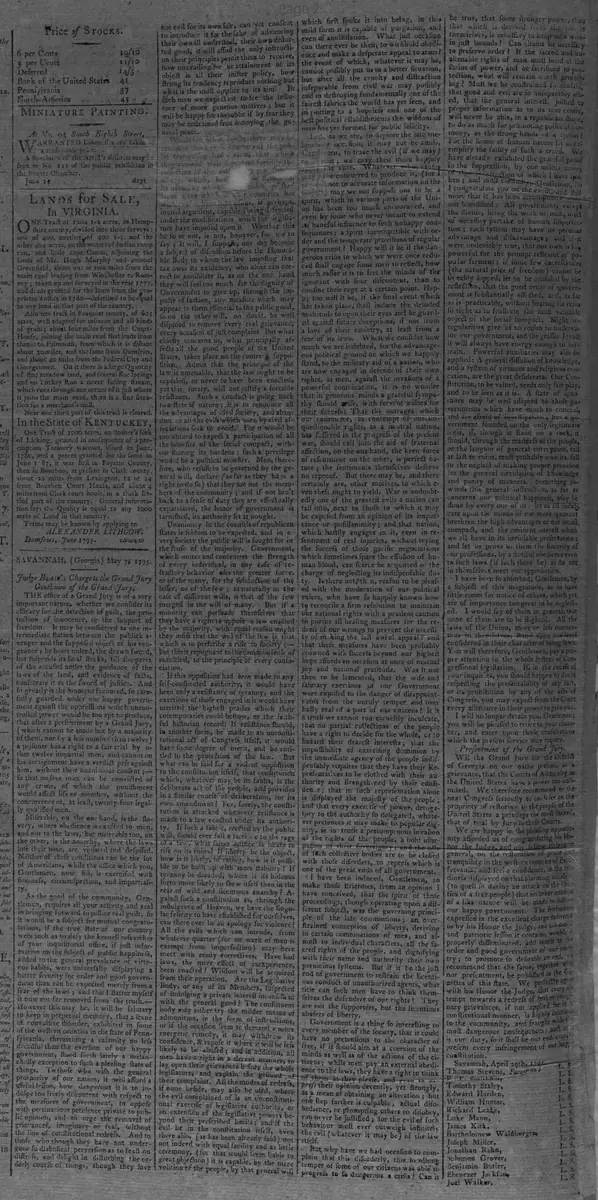
On May 25, 1795, in Savannah, Georgia, Judge Blair charged the Grand Jury on the role of juries in upholding justice and law, critiquing the Whiskey Rebellion as unconstitutional resistance. The jury, in a presentment dated April 20, 1795, urged limits on Admiralty Courts' powers and praised the rebellion's peaceful suppression.
Clipping
OCR Quality
Full Text
Judge Blair's Charge to the Grand Jury
Gentlemen of the Grand Jury,
THE office of a Grand Jury is of a very important nature, whether we consider its efficacy for the detection of guilt, the protection of innocence, or the support of freedom. It may be considered as one intermediate station between the public avenger and the supposed object of his vengeance; he bears indeed, the drawn sword, but suspends its fatal stroke, till the peers of the accused under the guidance of the laws of the land, and evidence of facts, direct it as the sword of justice. And so greatly is the innocent favoured, so carefully guarded under our happy government against the oppressions which uncontrolled power would be too apt to produce, that after a presentment by a Grand Jury, (which cannot be made but by a majority of them, nor by a less number than twelve) a prisoner has a right to a fair trial by other twelve impartial men, and cannot on his arraignment have a verdict passed against him, without their unanimous consent; so that no free man can be convicted of any crime, of which the punishment would affect life or member, without the concurrence of, at least, twenty-four legally qualified men.
Miserable, on the one hand, is the slavery, where obedience is exacted to men, and not to the laws, but miserable too, on the other, is the anarchy, where the laws lose their tone, are violated and despised. Neither of these conditions can be the lot of Americans, while the office which you, Gentlemen, now fill, is exercised with firmness, circumspection, and impartiality.
As the good of the community, Gentlemen, requires all your activity and zeal in bringing forward to justice real guilt, so it would be a subject for mutual congratulations, if the true state of our country were such as to defy the keenest researches of your inquisitorial office, if just information on the subject of public happiness, added to the general prevalence of virtuous habits, were universally displaying a better security for order and good government than can be expected merely from a fear of the laws; and this I flatter myself is now not far removed from the truth. However this may be, it will be salutary to keep in perpetual memory, that a scene of convulsive disorder, exhibited in some of the western counties in the state of Pennsylvania, threatening a calamity no less dreadful than the subversion of our happy government, stood forth lately a melancholy exception to such a pleasing state of things. To those who wish the general prosperity of our nation, it will afford a useful lesson, how dangerous it is to indulge too freely discontent with respect to the measures of government, to oppose with pertinacious petulance private to public opinion, and to urge the removal of grievances, imaginary or real, without the line of constitutional redress. And to those who though they have not undergone so diabolical a perversion as to feast on distress, and delight in disturbing the orderly course of things, though they love to introduce it for the sake of advancing their own ill understood, their own distorted good, it will afford the only instruction their own principles permit them to receive, how unavailing for the attainment of its object is all their sinister policy, how strong its tendency to reproduce nothing but what is the most opposite to its aim. In presence of more generous motives; but it will be happy for the public if by fear they may be restrained from annoying the general peace.
Whatever other objects there may be reason to think these insurgents of the public tranquillity had a view, that which they avowed was, to prevent forcibly the collection of the tax of which, however its name, by which and distinguished from a tax which in other countries has with even less reason held odious, is, perhaps, no cool argument, capable of being defended under the modifications which the legislature have imposed upon it. Whether this be so or not, is not, however, for me to say; It will, I suppose, one day become a subject of discussion before the Honorable Body to whom the law imposing that tax owes its existence, who alone can correct or annihilate it, as on the one hand they will feel too much for the dignity of Government to give up, through the impulse of faction, any measure which may appear to them essential to the public good, so on the other will, no doubt, be well disposed to remove every real grievance, every occasion of just complaint But what chiefly concerns us, what principally affects all the good people of the "United States, takes place on the contrary supposition. Admit that the principle of the law is untenable, that the law ought to be repealed, or never to have been enacted, yet this, surely, will not justify a forcible resistance. Such a conduct is going back to a state of nature; it is to renounce all the advantages of civil society, and abandon to all the evils which men by civil associations seek to avoid. For it would be too absurd to expect a participation of all the benefits of the social compact, without sharing its burdens; such a privilege would be a political monster. Men, therefore, who refuse to be governed by the general will, declare (as far as they have a right to do so that they are not the members of the community; and if not bro't back to a sense of duty they are effectually expatriated, the honor of government is tarnished, its authority set at nought.
Unanimity in the councils of republican states is seldom to be expected, and in every society the public will is sought for in the sense of the majority. Government, which unites and concentres the strength of every individual, in any case of refractory behavior uses the greater force. or of the many, for the subduing of the fewer, or of the few; as naturally in the case of different wills, is that of the few merged in the will of many. But if a minority can persuade themselves that they have a right to oppose a law enacted by the majority, with equal reason might they insist that-the will of the few is that which is to prescribe a rule to society; but this is repugnant to the common sense of mankind, to the principle of every social association.
: If this opposition had been made to any self-constituted authority, it would have been only a resistance of tyranny, and the exertions of those engaged in it would have merited the highest praises which their contemporaries could bestow, or the faithful historian record: If resistance should. in another form, be made to an unconstitutional act of Congress itself, it would have some degree of merit, and be entitled to the protection of the law. But what can be said for a violent opposition to the constitution itself, that constitution which, whatever may be its faults, is the deliberate act of the people, and provides in a similar course of deliberation, for its own amendment? For, surely, the constitution is attacked whenever resistance is made to a law enacted under its authority. If such a fabric, erected by the public will, should ever fall a sacrifice to the rage of a few, what fairer edifice is likely to rise on its ruins? if liberty be the object, how is it likely, or rather, how is it possible to be built up with more stability ! If tyranny be dreaded, where is its hideous form more likely to show itself than in the rear of wild and licentious anarchy? Against such a constitution as, through the indulgence of Heaven, we have the singular felicity to have established for ourselves, can there ever be an apology for violence? All the evils which can intrude, from whatever quarter ( for no work of man is exempt from imperfection) may here meet with ready correctives. Have bad laws, the mere effect of inexperience, been enacted ? Wisdom will be acquired from their operation. Are the Legislative Body, or any of its Members, suspected of indulging a private interest inconsistent with the general good? The constituent body may either try the milder means of admonition, in the form of instructions, or if the occasion seem to demand a more energetic remedy, it may withdraw its confidence, & repose it where it will be less likely to be abused; and in addition, all men have a right in a decent manner, to lay open their grievances before the whole legislature, and explain the ground of their complaint. All the modes of redress, if none beside, may also be used, where the evil complained of is an unconstitutional exercise of legislative authority, or an extension of the legislative powers beyond their prescribed limits; and if the evil be in the constitution itself, even there also, (as has been already said) not indeed with equal facility and as little ceremony, (for that would seem liable to great objection ) it is capable, by the mere volition of the people, by that general will which first spoke it into being, in this mild form it is capable of purgation, and even of annihilation. What just occasion can there ever be then, to withhold obedience and make a desperate appeal to arms? the event of which, whatever it may be, cannot possibly put us in a better situation, but after all the cruelty and distraction inseparable from civil war may possibly end in destroying fundamentally one of the fairest fabrics the world has yet seen, and in putting to a hopeless end one of the best political establishments the wisdom of man has yet formed for public felicity.
Led, as we are, to deplore the late melancholy occasion, it may not be amiss, Gentlemen, to trace the evil (if we may) to its root; we may then more happily may have concurred to produce it, (for I presume not to accurate information on the subject) may we not suppose one to be a spirit, which in various parts of the Union has been too much encouraged, and even by some who never intended to extend its baneful influence to such unhappy consequences; a spirit incompatible with order and the temperate provisions of regular government ? Happy will it be if the dangerous crisis to which we were once reduced shall engage some men to reflect, how much easier it is to fret the minds of the ignorant with our discontent, than to confine their rage at a certain point. Happy too will it be, if the final event which has taken place, shall induce the deluded multitude to open their eyes and be guarded against future deceptions, if not from a love of their country, at least from a fear of its laws. When we consider how much we are indebted, for the advantageous political ground on which we happily stand, to the military aid of a nation, who are now engaged in defence of their own rights, as men, against the invasions of a powerful combination, it is no wonder that in generous minds a grateful sympathy should arise, with fervent wishes for their success: That the outrages which our commerce, in contempt of our unquestionable rights, as a neutral nation, has suffered in the progress of the present war, should call into the aid of fraternal affection, on the one hand, the keen force of resentment on the other, is perfect nature; the sentiments themselves deserve no reproof. But there may be, and there certainly are, other motives, to which even these ought to yield. War is undoubtedly one of the greatest evils a nation can fall into, next to those to which it may be exposed from an opinion of its importance or pusillanimity; and that nation, which hastily engages in it, even in resentment of real injuries, without trying the success of those pacific negociations which sometimes spare the effusion of human blood, can scarce be acquitted of the charge of neglecting its indispensable duty. Is there not, then, reason to be pleased with the moderation of our political rulers, who have so happily known how to reconcile a firm resolution to maintain our national rights with a prudent caution to pursue all healing measures for the redress of our wrongs to prevent the necessity of making the last awful appeal? and that these measures have been probably crowned with success beyond our highest hope affords an occasion at once of mutual joy and national gratitude. Was it not then to be lamented, that the wise and salutary exertions of our Government were exposed to the danger of disappointment from the unruly temper and over hasty zeal of a part of our citizens? It it a truth we cannot too earnestly inculcate, that no partial collections of the people have a right to decide for the whole, or to hazard their dearest interests; that the impossibility of exercising dominion by the immediate agency of the people indispensably requires that they have their Representatives to be clothed with their authority and strengthened by their confidence; that in such representation alone is displayed the majesty of the people; and that every exercise of power, derogatory to the authority so delegated, whatever pretences it may make to popular dignity, is in truth a presumptuous invasion of the rights of the people, a bold usurpation of their sovereignty, and the acts of such collective bodies are to be classed with those disorders, to repress which is one of the great ends of all government.
I have been induced, Gentlemen, to make those strictures, from an opinion I have conceived, that the spirit of those proceedings, though operating upon a different subject, was the governing principle of the late commotions; an over-strained conception of liberty, deriving to certain combinations of men, and almost to individual characters, all the sacred rights of the people, and dignifying with their name and authority their own pernicious systems. But if it be the just end of government to restrain the licentious conduct of unauthorized agents, what title can such men have to think themselves the defenders of our rights ! They are not the supporters, but the licentious abusers of liberty.
Government is a thing so interesting to every member of the society, that it could have no pretensions to the character of free, if it should aim at a coercion of the minds as well as of the actions of the citizens; while men pay an external obedience to the laws, they have a right to think of them as they please. and even express their opinion decently, yet strongly, as a mean of obtaining an alteration ; but one step farther is culpable; actual disobedience, or prompting others to disobey, can never be justified; for the evil of such behaviour must ever outweigh infinitely the evil (whatever it may be) of the law itself.
But why have we had occasion to complain that this disorderly, this headlong temper of some of our citizens was able to progress to so dangerous a crisis ? Can it be true, that some stronger power, than that which is derived from the people themselves, is necessary to keep men within just bounds? Can chains be necessary to preserve order ? If the sacred and unalienable rights of man must bend at the shrine of power, and be sacrificed to protection, what will remain worth protecting ? Must we be constrained to confess, that good and evil are so inseparably allied, that the general interest, joined to proper information as to its true centre, will never be able, in a republican shape, to do as much for promoting political harmony, as the strong hands of a tyrant? For the honor of human nature let us exemplify the fallacy of such a creed. We have already exhibited the grateful proof in the suppression, by our militia alone of that insurrection of which I have spoken; and most cordially, Gentlemen, do I congratulate you on the event, and still more that it has been accomplished without bloodshed: All government, except the divine, being the work of man, must of necessity partake of human imperfection; each system may have its peculiar advantage and disadvantage; and if it were undeniably true, that our own is less powerful for the prompt restraint of popular ferment; ir some few excrescences (the natural price of freedom) cannot be to easily lopped, let us be consoled by the reflection, that the good order of government is substantially effected, a d, as far as is practicable, without bearing its reins so tight as to frustrate the most valuable object of the social compact. Slight irregularities give us no reason to undervalue our government, and the groer I trust it will always have energy enough to restrain. Powerful auxiliaries may also be applied: A general diffusion of knowledge, and a system of virtuous and religious education, are the great desiderata. Our Constitution, to be valued, needs only fair play, and to be seen as it is. A state of ignorance may be well adapted 'to those governments which have much to conceal, and are afraid of investigation, but a government founded on the only legitimate basis, if, though it stand on a rock, it should, through the madness of the people, or the languor of general corruption, fall at last to ruins, must probably owe its fall to the neglect of making proper provision for the general circulation of knowledge and purity of manners. Something towards this general instruction, as far as concerns our political happiness, may be done by every one of us; let us all inculcate upon the minds of our more ignorant brethren the high advantages of our social compact, and the eminent interest which we all have in its inviolable preservation; and let us prove to them the sincerity of our professions, by a dutiful obedience even to such laws (if such there be) as do not in themselves meet our approbation.
J have been so absorbed, Gentlemen, by a subject of this magnitude, as to have little room or notice of others, which yet are of importance too great to be neglected. I would ay of them in general, that none of them are to be slighted. All the laws of the Union. more or les momentous in themselves. stand opon one level considered in their character of being laws. You will therefore, Gentlemen, pay a proper attention to the whole system of Congressional legislation. I, in the course of your inquiries, you should happen to doubt respecting the presentability of any fact, or its prohibition by any of the acts of Congress, you may expect from the Court every assistance in their power to give you. I will no longer detain you, Gentlemen; you will be pleased to retire to your chamber, and enter upon those consultations which the present service may require.
Presentment of the Grand Jury.
WE the Grand Jury for the District of Georgia on our oaths present, as a grievance, that the Courts of Admiralty in the United States have a power too unlimited. We therefore recommend to the next Congress earnestly to consider on the propriety of restoring to the people of the United States a privilege the most sacred, that of. trial by jury in those Courts.
We are happy in the pleasing opportunity afforded us of congratulating his Honor the Judge, and our fellow citizen in general, on the restoration of peace tranquility in the western counties of Pennsylvania, and feel a confidence, in the readiness displayed on that alarming occasion, (to quell so daring an attack on the liberties of a free people ) that no other attempt of a like nature will be made to disturb our happy government. The sentiments us by his Honor the Judge, and the more expressed in the excellent charge delivered and patriotic lesson contains would order and good government of our country; to promote o desirable an end, recommend that the same, together wi our presentment, be published in the Gazettes of this state. We perfectly agree with his Honor the Judge, that any attempt towards a redress of real or imaginary grievances, if not applied for in constitutional manner highly injurious to the community, and fraught with t is our duty, o it shall be our end avor, to mot dangerous consequences and as preent every infringement of our hapl constitution.
Savannah, April 20th, 1795
Thomas Stevens, Foreman
F P. Enithon,
Timothy Staley,
Edward Harden,
Luke Mann,
William Hunter,
Richard Leake,
James Kirk,
Bartholomew Waldburger
Joseph Miller,
Solomon Grover,
Jonathan Rahn,
Ebenezer Jackson
Joel Walker,
Benjamin Butler,
What sub-type of article is it?
What keywords are associated?
What entities or persons were involved?
Where did it happen?
Domestic News Details
Primary Location
Savannah, Georgia
Event Date
May 25, 1795
Key Persons
Outcome
the grand jury presented a grievance regarding unlimited powers of admiralty courts and recommended trial by jury; they congratulated on the peaceful suppression of the whiskey rebellion in pennsylvania.
Event Details
Judge Blair delivered a charge to the Grand Jury emphasizing the importance of grand juries in justice, protection of innocence, and support of freedom. He discussed the Whiskey Rebellion as an unconstitutional resistance to tax collection, advocating constitutional redress over violence. The Grand Jury's presentment, dated April 20, 1795, addressed Admiralty Court powers and endorsed the charge's sentiments.