Thank you for visiting SNEWPapers!
Sign up free
Letter to Editor
April 12, 1792
National Gazette
Philadelphia, Philadelphia County, Pennsylvania
What is this article about?
An extract from a letter dated April 6 from West-Jersey critiques the book 'The Travels of Captain Farrago' by Mr. B. for containing vulgar Irish-isms, profanity, and mockery of holy things and the clergy, arguing it is unsuitable for school-children and young clergymen.
Clipping
OCR Quality
95%
Excellent
Full Text
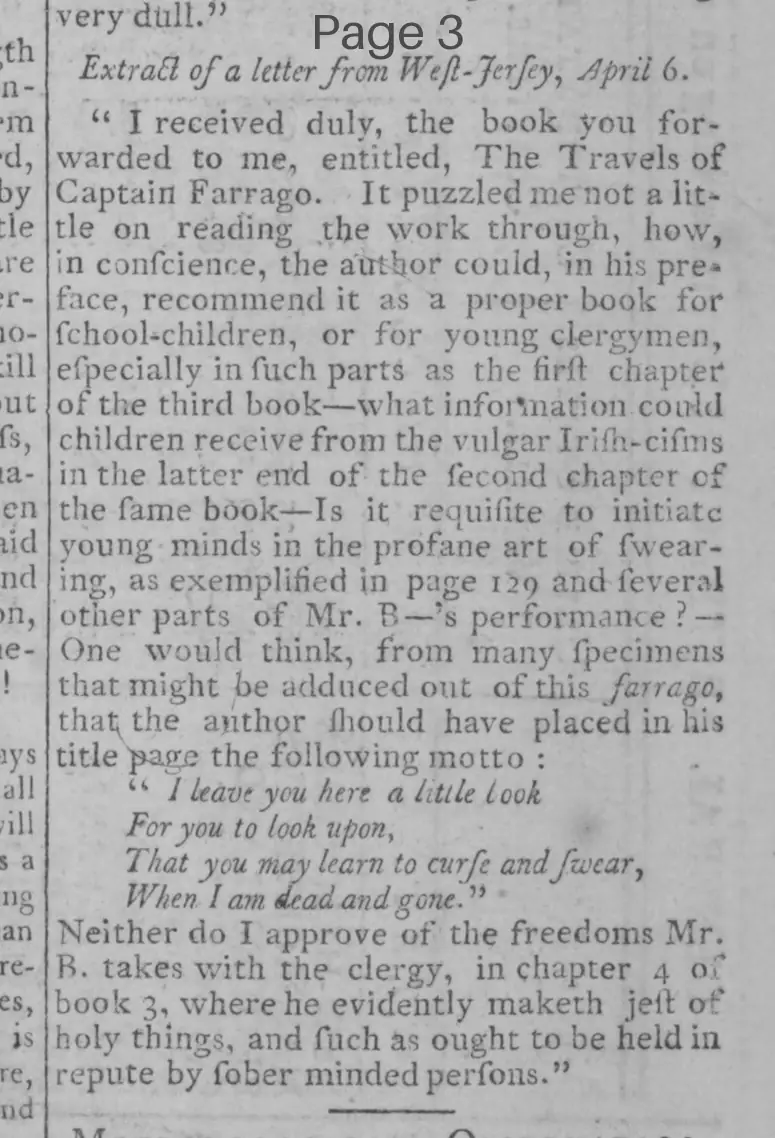
Extract of a letter from West-Jersey, April 6.
" I received duly the book you forwarded to me, entitled, The Travels of Captain Farrago. It puzzled me not a little on reading the work through, how, in conscience, the author could, in his preface, recommend it as a proper book for school-children, or for young clergymen, especially in such parts as the first chapter of the third book—what information could children receive from the vulgar Irish-isms in the latter end of the second chapter of the same book—Is it requisite to initiate young minds in the profane art of swearing, as exemplified in page 129 and several other parts of Mr. B-'s performance ?—One would think, from many specimens that might be adduced out of this farrago, that the author should have placed in his title page the following motto :
I leave you here a little book
For you to look upon,
That you may learn to curse and swear,
When I am dead and gone.
Neither do I approve of the freedoms Mr. B. takes with the clergy, in chapter 4 of book 3, where he evidently maketh jest of holy things, and such as ought to be held in repute by sober minded persons."
" I received duly the book you forwarded to me, entitled, The Travels of Captain Farrago. It puzzled me not a little on reading the work through, how, in conscience, the author could, in his preface, recommend it as a proper book for school-children, or for young clergymen, especially in such parts as the first chapter of the third book—what information could children receive from the vulgar Irish-isms in the latter end of the second chapter of the same book—Is it requisite to initiate young minds in the profane art of swearing, as exemplified in page 129 and several other parts of Mr. B-'s performance ?—One would think, from many specimens that might be adduced out of this farrago, that the author should have placed in his title page the following motto :
I leave you here a little book
For you to look upon,
That you may learn to curse and swear,
When I am dead and gone.
Neither do I approve of the freedoms Mr. B. takes with the clergy, in chapter 4 of book 3, where he evidently maketh jest of holy things, and such as ought to be held in repute by sober minded persons."
What sub-type of article is it?
Ethical Moral
Persuasive
What themes does it cover?
Morality
Education
Religion
What keywords are associated?
Book Critique
Captain Farrago
Profanity
Clergy Mockery
Vulgar Language
Moral Suitability
Letter to Editor Details
Main Argument
the book 'the travels of captain farrago' is unsuitable for school-children and young clergymen due to its vulgar language, profanity, and mockery of the clergy and holy things.
Notable Details
References Specific Chapters And Page 129 For Examples Of Swearing
Critiques Vulgar Irish Isms In Second Chapter Of Book 3
Proposes Satirical Motto For The Title Page
Disapproves Of Jesting Holy Things In Chapter 4 Of Book 3