Thank you for visiting SNEWPapers!
Sign up free
Gazette Of The United States
New York, New York County, New York
What is this article about?
Count Lally's motion in the French National Assembly on July 24 praises the King's efforts to build trust, calls for harmony between the King, Assembly, and people, and stresses legal prosecution of crimes against the nation. The resolution is lauded as honorable for Count La Fayette.
Merged-components note: Continuation of the extract from the Journal of the National Assembly regarding Count Lally's motion and related commentary on French politics.
Clippings
1 of 2
OCR Quality
Full Text
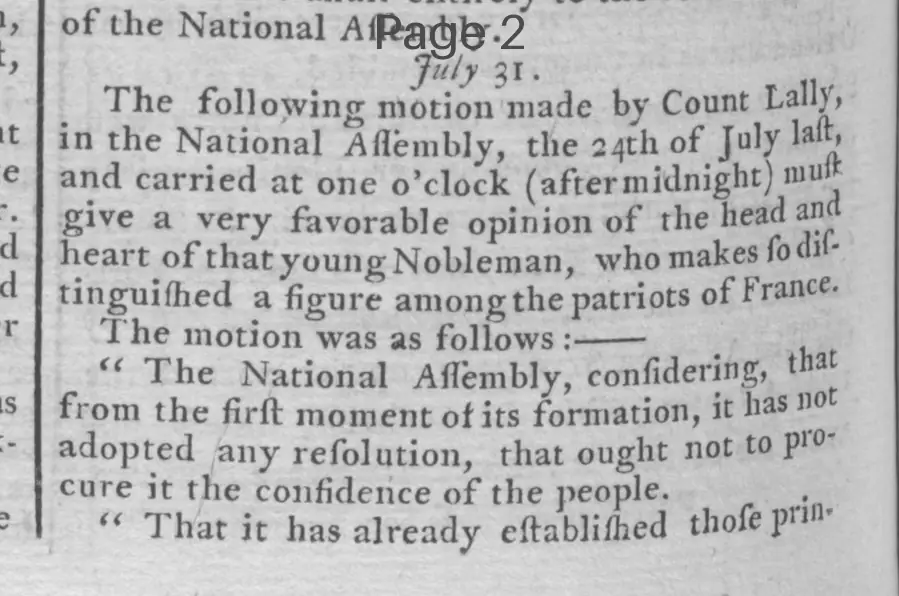
The following motion made by Count Lally, in the National Assembly, the 24th of July last, and carried at one o'clock after midnight, gives a very favorable opinion of the head and heart of that young Nobleman who makes so distinguished a figure among the patriots of France.
The motion was as follows :-
"The National Assembly, considering, that from the first moment of its formation, it has not adopted any resolution, that ought not to procure it the confidence of the people.
"That it has already established those principles, which ought to be the basis, on which the liberty and happiness of the public must be raised.
"That the King has acquired greater rights than ever to the confidence of his faithful subjects.
That not only he has himself invited them to claim their liberty and their rights, but has also, to gratify the wishes of this Assembly, removed all grounds for distrust, that might alarm the people—
"That he sent back from the capital, the troops, whose presence had spread a terror through it—
"That he sent back from his presence the Ministers and advisers, who had occasioned so much inquietude to the nation at large—
"That he has recalled those, whose return was wished for by his people—
"That he came into this Assembly like a father among his children, and called upon it to assist him in saving the State—
"That led by the same sentiment, he went to his capital, and mixed with his people, to remove, by his presence, the grounds of fear, which they might have entertained—
"That in this perfect harmony and understanding between the head of the Nation and its representatives, after the happy union of the three orders, the attention of this Assembly is directed, and will continue to be directed to the great object of a National Constitution—
That any distrust, which should interrupt or disturb the harmony, that at present so happily reigns between all the orders and their head, would impede the progress of this great work, defeat the patriotic intentions of the King, and give a fatal blow to the general interest of the Nation at large, as well as to the particular interest of every individual, of whom it is composed.
"That there is not a member of the community who ought not to shudder at the bare idea of the confusion that would ensue.—The dispersion of families—the interruption and suspension of trade—the poor deprived of relief—all labor at a stand—and the general subversion of all order and government, would be the fatal but inevitable consequences of such a distrust.
"The National Assembly taking all these circumstances into its most serious consideration, holds out to the whole Nation an invitation to peace and harmony, to the maintenance of order and good government. It invites those who glory in the name of Frenchmen, to cherish that confidence which they ought to place in their King and their Representatives, and to show that respect for the laws, without which there can be no true liberty.
"It declares, at the same time, that those who, invested with power have been, or by their crimes may be the cause of public calamities, ought to be accused, convicted, and punished; but that it is only by law that they should be tried and punished, and that the law should protect their persons, until it has pronounced their judgment.
"That the prosecution of crimes against the Nation, belongs to the Nation's Representatives.
"And that this Assembly, in framing the Constitution which now occupies its attention, will take care to provide a proper tribunal, for the trial of persons accused of crimes of this nature; and to point out the manner in which such prosecutions shall be conducted, laying it down as a principle, that publicity shall be inseparably annexed to all such trials."
The sentiments and opinions contained in this resolution or address to the nation, are not those of a mad reformer, more intent upon pulling down than building up—They are worthy of a Philosopher and a Legislator, who knows that where there is no Law, there can be no government—that innocence itself may be termed guilt by a mad populace, too much heated to be capable of discerning between the one and the other, or at least of giving that calm and patient hearing which Justice calls for, and the Law enjoins.
This resolution, if it was the only one praiseworthy in the political career of COUNT LA FAYETTE, would, even singly, be an eternal monument to his honor.
What sub-type of article is it?
What keywords are associated?
What entities or persons were involved?
Where did it happen?
Foreign News Details
Primary Location
France
Event Date
24th Of July Last
Key Persons
Outcome
motion carried at one o'clock after midnight
Event Details
Motion by Count Lally in the National Assembly praising the King's actions to build trust, removing troops and ministers, calling for harmony, confidence in King and representatives, respect for laws, and legal prosecution of crimes against the nation with public trials.